India’s electricity demand has grown steadily in recent years, driven by industrial expansion, rising commercial activity and extreme weather events. Consequently, the need for reliable standby power has increased across sectors where even short outages can disrupt operations and lead to revenue losses. In tandem, grid congestion, ageing infrastructure and weather-related disruptions have made uninterrupted power supply more challenging. In response, demand for rental power solutions has grown significantly. These solutions provide temporary and backup power without the high upfront cost of purchasing generators. They can also be deployed quickly to meet emergency requirements, seasonal peaks and power needs during maintenance or grid upgrades. Among the available technologies, diesel generator sets continue to dominate the rental power market owing to their proven reliability and ease of deployment.
Given their benefits, rental power has found widespread application across various industries. In addition, the rapid expansion of data centres and telecom networks is creating new demand for backup power. Meanwhile, the rental power industry itself is evolving with digital technologies such as artificial intelligence (AI) and internet of things (IoT), stricter emission norms and changing customer demands.
Market characterisation
The rental power market can be segmented by power rating into below 75 kVA, 75-375 kVA, 375-750 kVA, and above 750 kVA categories. Among these, the above 750 kVA segment currently accounts for the largest share, driven by demand from mission-critical and heavy-duty applications. However, the below 75 kVA segment is expected to grow the fastest in the coming years as more offices, shops and small industrial units turn to rental power solutions.
By application, the market is divided into continuous power, standby power and peak shaving segments. The standby power segment currently leads the market, supported by strong demand from manufacturing facilities, hospitals, data centres and telecom networks that require immediate backup during power outages. Parallelly, peak-shaving solutions are also witnessing growing adoption as commercial and industrial (C&I) consumers look to reduce grid consumption during peak tariff hours.
By fuel type, diesel remains the preferred choice because of its reliability, widespread fuel availability and the ability to handle heavy-duty operations. However, natural gas-based generators are being adopted as cleaner and quieter alternatives, although their adoption remains limited by the availability of gas infrastructure and their lower suitability for mobile applications. In addition, hybrid and renewable-based rental solutions are gradually expanding owing to tighter emission norms, rising diesel prices and falling technology costs.
Key end-use segments
Rental power solutions serve a wide range of end users, including the oil and gas, metals and mining, construction, manufacturing, utilities, healthcare, IT and data centres, and telecom sectors. Among these, the oil and gas, mining and construction sectors account for a significant share of demand as they require reliable power for operations in remote or off-grid locations.
In the oil and gas industry, rental diesel generators power drilling rigs, pumps and other critical equipment where grid access is unavailable. Meanwhile, the construction and infrastructure sectors rely on rental generators to operate heavy machinery, site offices and lighting systems at locations with limited or unreliable grid connectivity. Since project power requirements vary over time, rental solutions provide flexibility without the capital cost of purchasing and maintaining equipment.
The manufacturing sector also depends on rental generators to minimise production losses during outages, maintenance shutdowns and load testing. Utilities, meanwhile, use rental power to support grid maintenance, manage peak demand and maintain essential services during emergencies. Healthcare facilities are another key user segment that relies on rental generators to ensure uninterrupted power for life-saving equipment.
The rapid expansion of data centres and telecom networks is further driving demand for dependable backup systems. Data centres use rental generators during outages, maintenance, facility expansion and commissioning to ensure uninterrupted operations. Telecom operators rely on rental power during network rollouts and in areas where permanent power infrastructure is unavailable.
Cost economics
For many businesses, renting a generator is more economical than purchasing one, especially when power is required only for short-term projects, seasonal demand or emergency situations. Buying a generator involves substantial upfront investment, along with recurring costs for maintenance, storage and servicing. In contrast, rental solutions eliminate capital expenditure and maintenance responsibilities while providing access to the latest generator models. This makes them a cost-effective option for businesses with limited budgets.
Another key advantage of rental generators is flexibility. Rental providers offer generators across a wide range of capacities and rental periods, allowing users to scale power requirements up or down as operational needs change. This is especially valuable for industries with fluctuating or seasonal demand, as it helps businesses avoid overinvesting in capacity or facing power shortfalls. In addition, rental generators minimise storage requirements because they do not require dedicated storage space when not in use.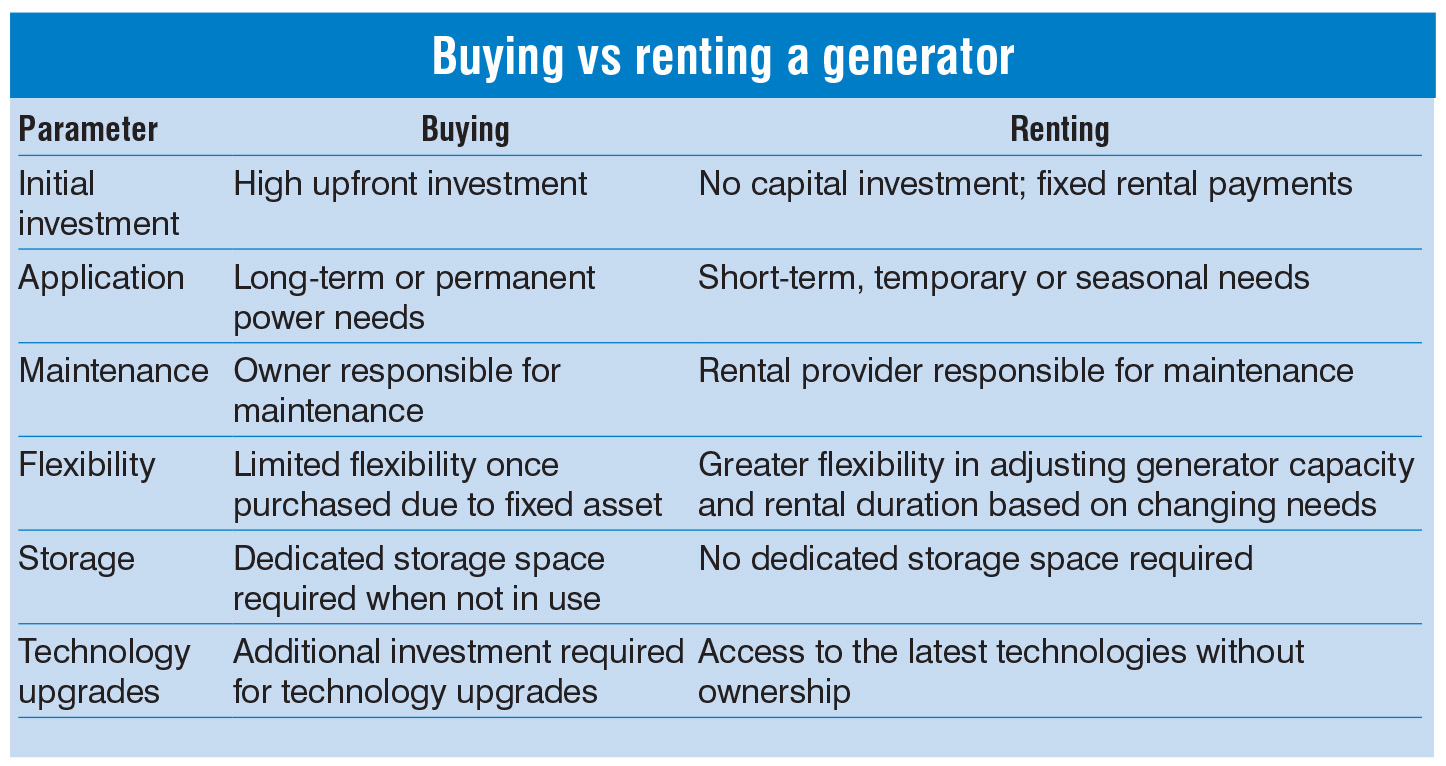
Technology advancements
The rental power market is undergoing rapid technological change. A key area of innovation is remote monitoring through IoT-enabled telematics. Using sensors and cloud connectivity, these systems provide real-time information on fuel levels, engine temperature, oil pressure, battery status and equipment loading. They also send instant alerts for potential issues, allowing rental providers to detect faults early, reduce downtime and schedule maintenance before failures occur.
AI is further facilitating predictive maintenance and performance optimisation. By analysing historical operating data, AI can identify abnormal fuel consumption and optimise load management and operating schedules. Smart controllers automatically respond to changing load conditions, regulating fuel delivery and shutting down equipment if abnormal operating conditions are detected.
In addition, environmental regulations are driving technology upgrades. Following the introduction of the Central Pollution Control Board IV+ emission standards in July 2023, rental companies have begun expanding their fleets with compliant diesel generators. These gensets incorporate advanced emission-control technologies while improving fuel efficiency and lowering noise levels.
Challenges
The diesel generator rental market faces growing costs and regulatory challenges. One of the biggest concerns is the volatility in diesel prices, as fuel accounts for a significant share of the operating cost of rental fleets. Rising fuel costs directly affect rental economics and put pressure on profit margins. In response, rental companies are increasingly adopting smart fuel management systems that monitor fuel consumption and optimise engine performance to improve efficiency.
At the same time, compliance with stricter emission norms requires significant investment in cleaner technologies. Hybrid systems that combine diesel with battery storage and renewable energy sources such as solar and wind are also gaining traction. While these upgrades improve efficiency and reduce emissions, they also increase capital and operating costs for rental providers. In addition, several urban and industrial regions have introduced restrictions on diesel generator usage to address air pollution.
Another emerging challenge is the growing adoption of renewable energy and battery energy storage systems. As C&I consumers increasingly invest in solar, wind and energy storage, demand for diesel generator rentals for backup power and peak load management is expected to decline. Falling levellised costs of renewable energy and storage, coupled with corporate decarbonisation targets, are likely to accelerate this shift.
The way forward
Going forward, the rapid expansion of data centres is expected to create significant opportunities for the rental power market. India’s data centre capacity has increased from about 375 MW in 2020 to nearly 1,500 MW in 2025. The sector’s electricity demand is projected to reach 13.56 GW by 2031-32.
At the same time, India’s rental power market is steadily moving towards cleaner and more efficient technologies. Rental providers are increasingly adding lower-carbon alternatives such as natural gas, dual-fuel and hybrid systems to their fleets. The expansion of the city gas distribution network is also improving access to natural gas, making gas-based rental solutions more viable across C&I applications.
Furthermore, under the National Green Hydrogen Mission, India aims to produce 5 million tonnes of green hydrogen annually by 2030, creating opportunities for hydrogen fuel cell-based backup power solutions. These systems offer zero-emission, low-noise operation, and are emerging as a promising option for applications such as telecom towers.
Nevertheless, even as cleaner technologies gain wider adoption, diesel generators are expected to remain the mainstay of the rental market due to their compatibility with existing infrastructure, ease of maintenance and proven reliability.
Khushi Rohatgi