The building sector is one of India’s fastest growing energy consumers, driven by rapid urbanisation, expanding commercial activity and infrastructure development. Large commercial, institutional and residential buildings account for a significant share of electricity consumption, contribute to peak power demand and generate substantial greenhouse gas emissions. Improving their energy performance is therefore critical for enhancing energy security, reducing carbon emissions and supporting India’s climate goals. Accordingly, in June 2026, the Ministry of Power (MoP) proposed a mandatory star rating framework for large commercial, residential and office buildings to promote energy efficiency, improve transparency in building performance and advance sustainable development.
Key features of the proposal
The proposed framework aims to establish a nationally recognised star rating system for large buildings, providing a simple, transparent and credible measure of energy performance. It seeks to standardise energy performance assessment, benchmarking and public disclosure, promote the adoption of energy-efficient building designs and technologies, enhance consumer awareness, and accelerate the transition to sustainable, high-performance buildings. It also brings existing building rating systems under a common regulatory framework, ensuring consistency, transparency and credibility while leveraging established institutional mechanisms.
Applicability: The MoP has proposed amendments to its February 2018 notification on the Energy Conservation and Building Code Rules to incorporate revised provisions that will apply to all new buildings and building complexes with a proposed built-up area of 20,000 square metres or more. Following the 2022 amendment to the Energy Conservation Act, the Energy Conservation and Building Code has been renamed the Energy Conservation and Sustainable Building Code (ECSBC).
Mandatory rating of buildings: Any building or building complex with a proposed built-up area of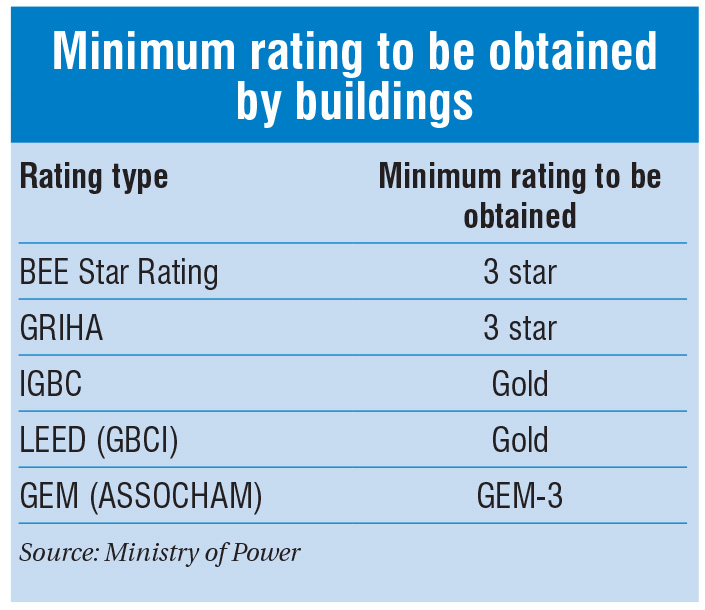 20,000 square metres or more, intended for use as office, commercial or residential space, will be required to obtain a building rating from the Bureau of Energy Efficiency (BEE) or from a building rating agency registered with BEE, in accordance with the prescribed rating methodology. Existing rating agencies such as the Green Rating for Integrated Habitat Assessment (GRIHA), Indian Green Building Council (IGBC), Green Business Certification Inc. and the Associated Chambers of Commerce and Industry of India (ASSOCHAM) will be required to register with BEE and submit their respective rating methodologies. Any other agency seeking to issue building ratings must also register with BEE and submit its methodology for approval. Further, all registered rating agencies will be required to submit an annual report to BEE, listing the buildings that they have rated.
BEE star rating: BEE’s building rating system will be known as the BEE Star Rating and will assess buildings on a scale of 3-star to 5-star based on their level of compliance with the ECSBC. According to the new rating methodology issued by the bureau, a building with a 5-star rating will fall under the Super ECSBS category, while a building with a 4-star rating will fall under the ECSBS Plus category, and the ECSBS Code will be applicable to a building with a 3-star rating. Under the proposed framework, all large buildings will have to obtain a rating from BEE or any of the other agencies. This would require a minimum 3-star rating in the case of GRIHA and the BEE Star Rating, Gold rating under the IGBC and GBCI’s Leadership in Energy and Environmental Design (LEED), and GEM-3 rating under ASSOCHAM’s Green and Eco-friendly Movement (GEM).
Display of the rating: The owner or occupant of a building will be required to prominently display the building rating issued by BEE or the authorised rating agency at clearly visible locations within the premises. In addition, the rating must be included in all advertisements and promotional materials to inform the public, including prospective buyers, tenants and other stakeholders, about the building’s energy performance and sustainability credentials.
Procedure to obtain BEE star rating for buildings: The proposed framework lays down a three-stage process for obtaining a BEE star rating for buildings. First, the building owner or occupier must register on BEE’s web portal by paying the prescribed fee and submitting the required compliance documents, along with a certificate of compliance issued by a certified energy auditor (building) or an empanelled third-party assessor. Based on these submissions, BEE will issue a provisional star-rating certificate. To obtain the final star-rating certificate, the owner or occupier must submit the prescribed compliance documents demonstrating adherence to the applicable requirements. BEE is required to issue the final building rating within 30 days of receiving the complete set of compliance documents.
Validity of BEE star rating and renewal process: The final BEE star rating for commercial and office buildings will remain valid for 10 years from the date of issuance. To renew the rating, the owner or occupier must submit the prescribed compliance documents along with a certificate of compliance issued by a certified energy auditor (building) or an empanelled third-party assessor. The renewal application must be submitted to BEE within three months of the expiry of the existing rating, together with the prescribed renewal fee. Failure to submit the application, supporting documents and fee within the stipulated period will render the rating invalid, following which BEE will cancel the registration. In such cases, the owner or occupier will be required to submit a fresh application, along with the necessary compliance documents, certificate of compliance and registration fee, to obtain a new BEE star rating.
Registration fees for BEE star rating: The MoP has proposed a one-time, non-refundable registration fee structure for buildings. Commercial and office buildings will be required to pay a registration fee of Rs 100,000, with a renewal fee of Rs 50,000. Residential buildings, meanwhile, will be subject to a one-time registration fee of Rs 50,000.
Verification process: BEE may conduct sample verification of the building ratings displayed on buildings, either directly or through an energy auditor (building) or an empanelled third-party assessor. A copy of the verification findings will be provided to the building owner or occupant. In cases of non-compliance, the owner or occupant will be required to remove the displayed building rating information, and BEE will place the verification findings related to such non-compliance in the public domain. In addition, state governments are empowered to impose penalties for non-compliance under Section 15, read with Section 14(p) and Section 26 of the Energy Conservation Act, 2001.
Issues and challenges
Despite the availability of building energy codes and voluntary green building rating systems, India currently lacks a mandatory, nationally harmonised framework for assessing, benchmarking and publicly disclosing the energy performance of large buildings. As a result, the adoption of energy-efficient building practices varies significantly across states and building categories, while the energy performance of buildings is not readily available to consumers and other stakeholders.
The absence of a standardised, performance-based rating framework also limits transparency for building owners, occupants, investors and financial institutions, making it difficult to compare the energy performance of buildings or identify high-performing assets. Moreover, the lack of mandatory disclosure weakens market incentives for developers to exceed minimum energy efficiency requirements.
Another key challenge is the absence of a centralised repository of building energy performance data, which restricts the ability of policymakers to monitor compliance, assess the effectiveness of policy measures, identify sectoral trends and design evidence-based interventions. To address these gaps, there is a need to establish a transparent, nationally harmonised and performance-based star rating framework for large buildings under the provisions of the Energy Conservation Act, 2001.
Expected outcome
The proposed mandatory star rating framework for large buildings marks a significant step towards mainstreaming energy efficiency in India’s building sector through a transparent, standardised and performance-based rating system. The framework is expected to enhance transparency by enabling the standardised assessment and public disclosure of building energy performance. In addition, the framework is expected to accelerate the adoption of energy-efficient technologies and sustainable building practices, while providing greater market recognition to buildings that demonstrate superior energy performance.
The way forward
The draft notification has been released for stakeholder consultation before being finalised. As India seeks to meet its climate commitments while addressing the rising energy demand from rapid urbanisation, the proposed mandatory star rating framework represents an important step towards promoting a more energy-efficient, transparent and sustainable building sector. Its successful implementation and adoption by market participants will play a key role in shaping the future of sustainable construction in the country.
Akanksha Chandrakar