While India’s renewable energy capacity is growing rapidly, this alone is not sufficient to achieve the energy transition; supplying clean energy reliably, securely and affordably requires a transformation of the grid and a shift towards smart grid technologies. In order to successfully integrate large volumes of intermittent renewable energy and reliably meet the growing demand for power, it is important that the electricity grid and power distribution operations are equipped with flexibility and intelligence.
As per an International Energy Agency estimate, grid digitalisation could reduce the curtailment of variable renewable energy systems by more than 25 per cent by 2030, increasing system efficiency and reducing costs for customers.
Further, a recent report by NITI Aayog titled, “Scenarios Towards Viksit Bharat and Net Zero”, notes that constructing new transmission corridors and substations, along with integrating smart grid technologies, is essential for evacuating power and ensuring system reliability. In many regions, the grid is outdated and ill-equipped to manage the variability of renewable energy sources and the increasing number of decentralised generation points.
In essence, a smart grid transforms the way electricity is distributed. At the distribution level, smart metering and advanced grid systems are emerging as key enablers. Smart meters provide granular, real-time consumption data, improving billing accuracy, reducing losses and enabling better demand management. When integrated with broader digital grid platforms, they support applications such as demand response, time-of-day pricing and improved load forecasting. Together, these technologies enhance visibility at the grid edge and enable utilities to operate more efficiently while empowering consumers to actively manage their energy usage.
Progress under government schemes and initiatives
The government’s latest initiative to accelerate smart grid deployment is the development of the India Energy Stack (IES), which aims at the creation of digital public infrastructure for the power sector. As the national digital backbone of the power sector, the IES will help address long-standing challenges such as data silos, fragmented systems and non-uniform protocols that have restricted the adoption of data-driven analytics and decision-making in the sector.
The IES will provide a standardised, modular and secure framework to manage, monitor and innovate across the energy ecosystem. It aims to uniquely identify and connect stakeholders and assets, and enable seamless data exchange and interoperability through uniform specifications, shared standards and a common data taxonomy. The IES will thereby transform how power sector entities, including discoms, gencos, transcos, charger booking platforms and prosumers, interact with each other. It will enable the implementation of a wide range of advanced use cases, such as peer-to-peer energy trading, enhanced visibility of distributed energy resources, consumer-side flexibility and improved management of behind-the-meter assets.
The Ministry of Power (MoP) has constituted a multi-stakeholder task force to define the roadmap, architecture and design of the stack. Pilot implementations have been planned across distribution utilities in Delhi, Gujarat, Andhra Pradesh, Uttar Pradesh and Mumbai, with demonstration targeted for 2026-27. The government has allocated Rs 513 million for the development of the IES, of which Rs 38.8 million has been released so far.
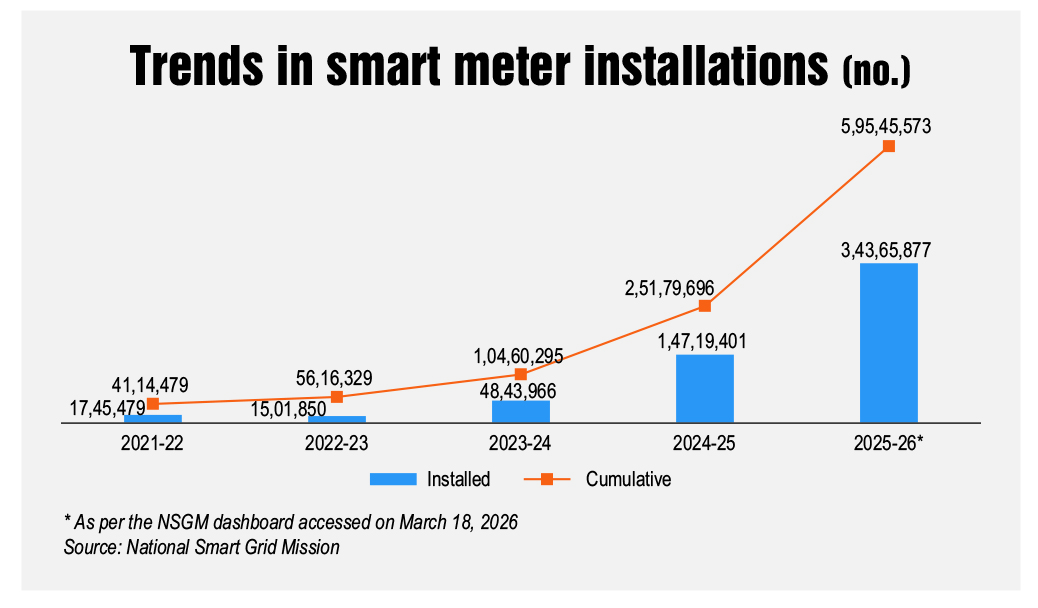 In the smart metering space, the Revamped Distribution Sector Scheme, with a total outlay of Rs 3 trillion, is driving the adoption of smart meters in a significant way. The scheme, which envisages the installation of 250 million smart consumer meters, originally had a sunset period of March 2026; however, this is now set to be extended to March 2028. As of March 18, 2026, nearly 60 million smart consumer meters have been installed across the country. In 2025-26, smart meter installations crossed 34 million – nearly double the additions recorded in the previous year. Early adopter states have begun witnessing tangible improvements from smart metering in billing and collection efficiencies, as well as loss reduction.
Apart from this, the National Smart Grid Mission (NSGM), which was established by the government in 2015, has made significant strides in advancing smart grid initiatives across discoms in the country. The mission has facilitated the development of an advanced metering infrastructure (AMI) ecosystem and the demonstration of various smart grid functionalities. In its initial phase, the NSGM handheld utilities through pre-feasibility studies, technology selection, cost-benefit analyses and financing. Additionally, it provided training and capacity building for state-level project management units and project teams, developed model standard bidding documents and best practices, and promoted consumer awareness. Under the NSGM, 11 pilots worth Rs 2.47 billion, including a smart grid knowledge centre in Manesar, have been completed, with the MoP contributing 50 per cent of the funding. Approximately 0.16 million smart meters were installed in these pilots, which demonstrated important functionalities such as AMI, peak load management and outage management systems. Impact assessments have also been carried out for these pilots.
Smart distribution
As India moves ahead on smart grid development, the focus is now shifting to smart distribution. The aim is to progressively embed digital intelligence and data-driven decision-making into distribution systems and processes.
A key focus area is the creation of an integrated digital layer for utilities. This involves installing AMI, control and monitoring systems, and better mapping of network assets. As utilities adopt data analytics, automation tools and technologies such as drones, asset inspection and maintenance are becoming more efficient and predictive. This, in turn, is driving better planning and targeted upgrades of the network. There is also a growing focus on modernising physical infrastructure, including underground cabling and advanced substation technologies, in line with system requirements.
Another important trend is the move towards a more flexible and interactive grid. Pilot projects are testing concepts such as time-of-use tariffs, demand response, distributed energy resource management and peer-to-peer energy trading. These initiatives are expected to improve load management and support higher renewable energy integration.
Overall, smart distribution marks a shift from conventional networks to more intelligent and responsive systems. It will play a key role in improving service quality and supporting India’s evolving power system. Together, these measures will help reduce losses, improve operations and enable better decision-making.
The way forward
The role of data in the power sector is shifting from passive collection to active decision-making. With the roll-out of smart meters and digital systems, utilities now have access to large volumes of real-time data across the grid. This data is enabling better visibility across the network, from generation and transmission flows to consumption patterns. As a result, utilities can move from reactive operations to more proactive and predictive management of the grid, including forecasting demand, identifying faults early and optimising power flows. However, the key challenge is not data availability but data quality and integration.
Data from multiple sources, such as smart meters, supervisory control and data acquisition systems and network mapping, must be standardised and combined to generate meaningful insights. Without this, decision-making can remain fragmented and inefficient.
Furthermore, as smart grid projects increase digitalisation and interconnectivity across the power sector, cybersecurity is becoming critical. Greater reliance on real-time data, automation and connected systems expands the grid’s vulnerability to cyberthreats. This makes it essential to secure data flows, protect critical infrastructure and adopt continuous monitoring systems. Going forward, strong cyber resilience will be key to ensuring reliable operations and safeguarding consumer data.
Apart from this, as India’s power sector evolves with the growing integration of renewables, digitalisation and advanced grid technologies, continuous capacity building will be essential. There is a need to institutionalise regular and specialised training and develop upskilling programmes for power sector professionals, including discom personnel, grid operators and regulatory staff, especially in areas such as smart grid operations, cybersecurity, renewables and demand forecasting, and storage integration. Collaborations with premier technical institutions, public-private training partnerships, and the development of modular online courses can make capacity building more accessible and scalable.
Priyanka Kwatra