
India’s discoms have shown measurable improvement in their aggregate financial performance in FY 2025. For the first time, the sector recorded a positive profit after tax (PAT) on an accrual basis. The average cost of supply-average revenue realised (ACS-ARR) gap has also narrowed significantly, while payment cycles of discoms have shortened. However, these gains have not resolved the sector’s deeper financial distress, as discoms continue to face high accumulated losses, substantial debt, weak debt-servicing capacity, and high interest costs. State governments have responded with repeated bailout packages through various schemes for over a decade. While these measures have provided relief, they have not addressed the underlying issues. Consequently, privatisation with debt restructuring and greater access to capital markets are emerging as longer-term solutions to strengthening discom finances.
Discom performance
On the whole, distribution utilities’ revenue increased from Rs 5,719 billion during 2017-18 to Rs 8,964.68 billion during 2024-25. MSEDCL, TNPDCL and PSPCL recorded the highest revenues at Rs 1,253 billion, Rs 1,005 billion, and Rs 493 billion, respectively. The ARR also improved by 14 paise per unit at the all-India level compared to FY 2024. However, overall expenditure remained high at Rs 9,735 billion during 2023-24, led by MSEDCL at Rs 1,352.8 billion, TNPDCL at Rs 983.4 billion and PSPCL at Rs 469 billion.
Further, the sector reported a positive PAT of Rs 27.02 billion during FY 2024-25 on an accrual basis, against a loss of Rs 255.53 billion during FY 2023-24. Punjab recorded the highest state-level PAT at Rs 62.16 billion, driven entirely by PSPCL. Gujarat and Bihar also reported a strong PAT of Rs 33 billion and Rs 21 billion, respectively, supported by utilities such as PGVCL and NBPDCL.
The ACS-ARR gap narrowed sharply from Re 0.51 per kWh during 2022-23 to Re 0.06 per kWh during 2024-25, indicating improved cost recovery. Payment cycles also shortened from 132 days to 113 days during the year.
Financial stress
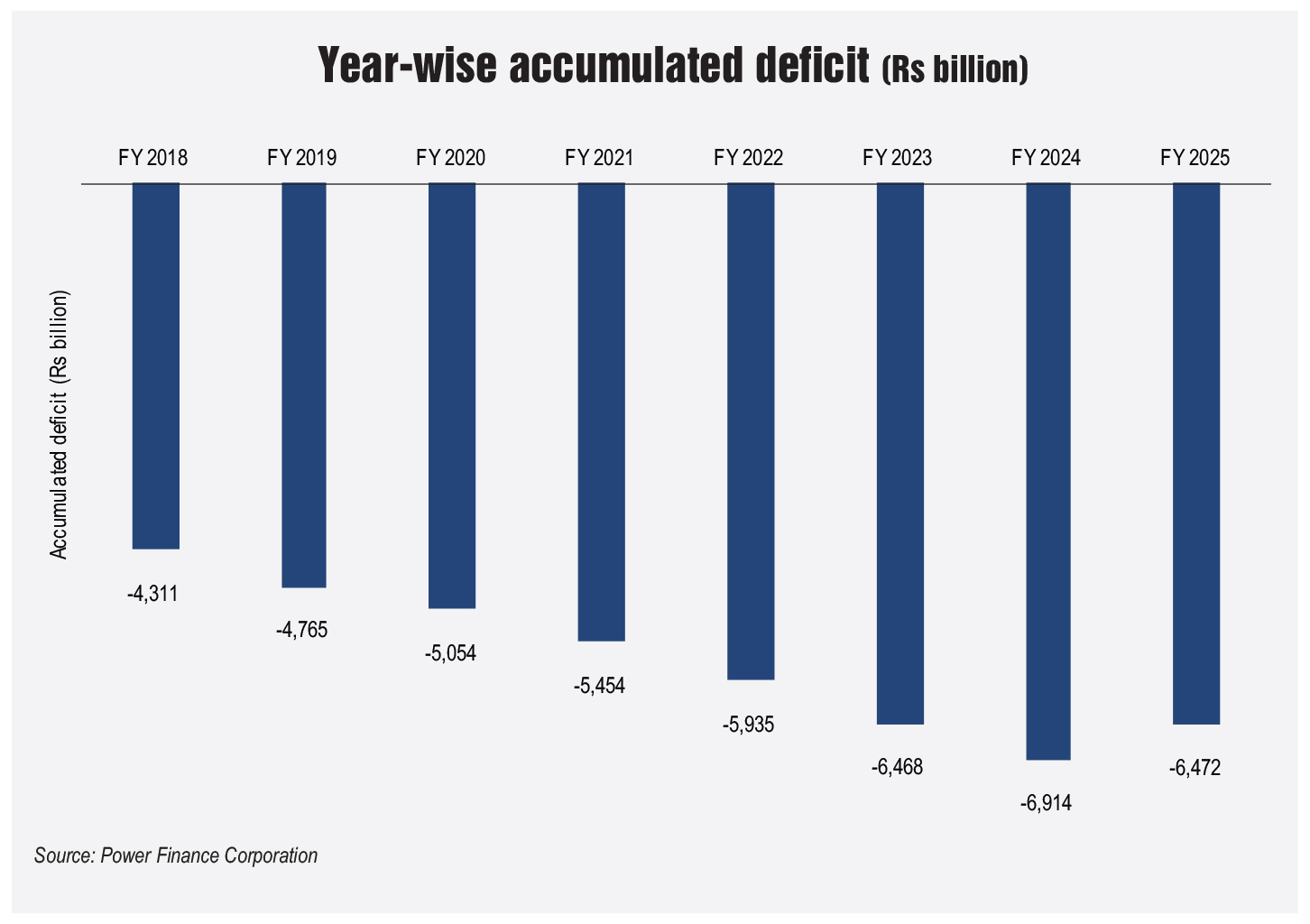
Despite improvements in aggregate performance, financial stress across states remains deep even after years of reform-linked support and bailout packages. At the end of FY 2025, discoms’ accumulated losses stood at Rs 6.47 trillion, nearly 2 per cent of India’s GDP. Non-cost-reflective tariffs and delayed subsidy payments remain the key drivers. Tamil Nadu had the highest accumulated losses at Rs 1,191.53 billion, followed by Uttar Pradesh at Rs 1,008.58 billion and Rajasthan at Rs 924.63 billion.
Outstanding dues to gencos fell sharply following the Electricity (Late Payment Surcharge) Rules, 2022, from Rs 1,399.47 billion in June 2022 to Rs 33.3 billion in March 2026. However, the improvement largely reflects debt restructuring rather than financial recovery as existing liabilities were shifted from gencos to state-backed lenders such as the Power Finance Corporation (PFC) and REC through fresh 10-year loans. According to the Prayas Energy Group, these loans amounted to Rs 1,137.37 billion, covering 81 per cent of the legacy dues targeted under the LPS Rules.
The high debt burden further highlights the sector’s structural weakness. Discoms’ outstanding debt stood at around Rs 7.26 trillion at the end of FY 2025, including Rs 7,114.02 billion owed by state-owned discoms and Rs 149.75 billion by private utilities. Tamil Nadu, Rajasthan and Maharashtra accounted for the highest borrowings at Rs 1,017.82 billion, Rs 984.88 billion and Rs 906.59 billion respectively.
During 2025-26, REC’s distribution disbursements, excluding the revolving bills payment facility, increased by 175 per cent to Rs 672.58 billion from Rs 244.89 billion during 2024-25. As of March 2026, distribution loans accounted for about Rs 4 trillion, or 36 per cent of PFC’s and REC’s combined outstanding loan portfolio. Meanwhile, discom interest costs rose from Rs 698.21 billion during 2022-23 to Rs 776.53 billion during 2024-25.
Restructuring trends
States are increasingly turning to structural restructuring to address discom solvency. A report by the Council on Energy, Environment and Water estimates that 13 major agrarian states, accounting for 99 per cent of India’s agricultural electricity sales, incurred over Rs 1.3 trillion in farm power subsidies in FY 2025. This burden has prompted states to separate agricultural loads from the broader discom business.
Telangana has taken this approach through Telangana Rythu Power Distribution Company Limited, India’s first dedicated utility focused on agriculture and rural water supply. The utility received a distribution licence in July 2026 and will take over Rs 269.5 billion of payables to state-owned gencos and a Rs 90.32 billion working capital loan. The move follows substantial financial stress at the state’s two discoms, whose combined losses and debt stood at Rs 697.41 billion and Rs 592.3 billion, respectively, during 2024-25.
Maharashtra has adopted a similar model. In April 2026, it approved the demerger of MSEDCL’s agricultural distribution business. MSEDCL had borrowings of Rs 906.59 billion and accumulated losses of Rs 356.71 billion in FY 2025, while agricultural consumers accounted for 78 per cent of net receivables. Under the plan, MSEDCL will serve non-agricultural consumers, while MSEB Solar Agro Power Limited (MSAPL) will serve agricultural consumers. Of the Rs 595.27 billion pending agricultural dues of MSEDCL, Rs 326.79 billion will be written off against government securities, while the remaining Rs 268.48 billion will be transferred to MSAPL, along with related subsidy receivables and security deposits.
Haryana has also proposed a separate agriculture discom in its 2026-27 budget, although the proposal has faced stakeholder opposition.
Discom privatisation
Privatisation is gaining support as a key reform to address the long-pending financial crisis of state discoms. Maharashtra is linking its restructuring exercise to the proposed listing of MSEDCL’s non-agricultural distribution business. The state plans to launch the initial public offering (IPO) within six to nine months of completing the restructuring, combining a fresh equity issue with an offer for sale by the state government. As per industry reports, MSEDCL has appointed eight investment bankers and could raise Rs 80 billion-Rs 100 billion. The issuance would be the first IPO by a purely state-run discom in India.
The 16th Finance Commission has also recommended cleaning up discom debt through privatisation. The suggestion is to move nearly Rs 7.5 trillion of discom debt into special purpose vehicles (SPVs) to shield private investors from legacy debt. The repayment of the SPV debt would be supported through the Special Assistance Scheme for Capital Investment after the privatisation process is complete.
The way forward
Addressing the persistent financial stress of Indian discoms will require structural reforms in tariff rationalisation, subsidy and payment discipline, debt management and capital market access.
The Central Electricity Authority’s recent report on improving fixed-cost recovery highlights a key weakness. Fixed costs account for 38-56 per cent of discoms’ annual revenue requirement, but fixed charges contribute only 9-20 per cent of retail tariff revenue. This leaves discoms dependent on consumption-linked energy charges and exposed to demand, weather and economic fluctuations. The report proposes raising fixed-cost recovery to 25 per cent for domestic and agricultural consumers by 2030 and 50 per cent by 2035. For industrial, commercial and institutional consumers, the target is 100 per cent recovery.
Meanwhile, debt management is critical too. Rajasthan’s discoms reduced their debt by around Rs 13.52 billion during 2025-26 through financial controls, expenditure management, and revenue recovery. A 0.90-1.40 per cent reduction in PFC and REC lending rates has also helped. Timely subsidy payments and settlement of government electricity dues are equally important. According to a report by Prayas, subsidy shortfalls led to Rs 265 billion in additional interest payments during 2016-17 to 2024-25. While separation of agricultural distribution can isolate this burden, it may leave agriculture discoms heavily dependent on subsidies without the financial viability provided by commercial and industrial consumers.
At the discom level, cost and loss reduction, better metering and collections, network upgrades, theft control, refinancing and legacy debt restructuring will also be essential to improve the sector’s financial performance.
Khushi Rohatgi