
At a recent Power Line conference on “Digitalisation of Power Plants”, the session on “Experience and Plans of Leading Gencos” brought together industry leaders to discuss the evolving role of digital technologies in power generation, the experience of utilities in adopting these technologies, and their plans for further digitalisation across thermal and renewable assets.
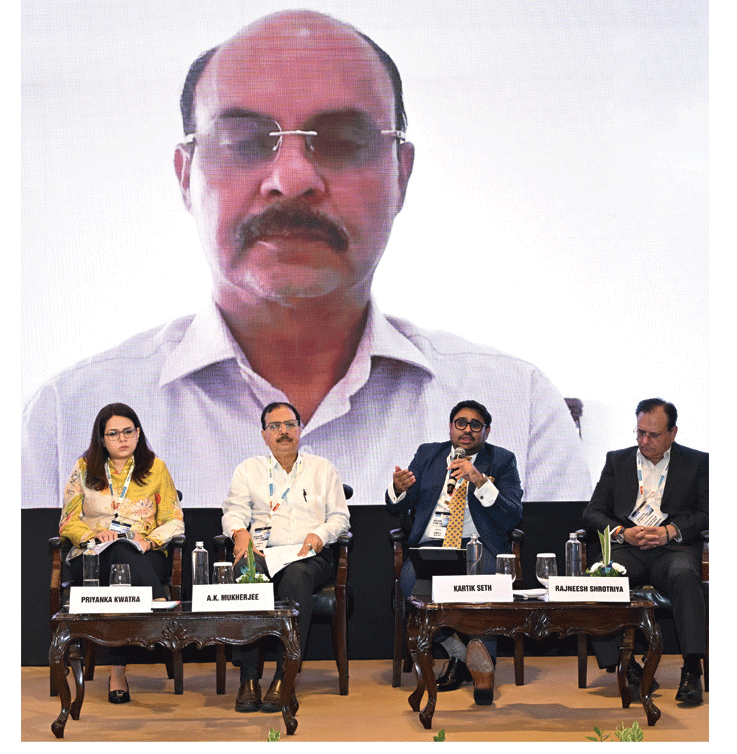
The panellists included A.K. Mukherjee, Director, Projects, West Bengal Power Development Corporation Limited; Kartik Seth, Founder, Chambers of Kartik Seth; Rajneesh Shrotriya, Chief Technology Officer, Sterling and Wilson Renewable Energy; and S.N. Tripathi, Director, Technical, Uttar Pradesh Rajya Vidyut Utpadan Nigam Limited (UPRVUNL). They discussed the growing use of centralised monitoring, artificial intelligence (AI)/machine learning (ML), digital twins, predictive maintenance and data-driven decision-making, along with the challenges of digitalising ageing power plants and managing cybersecurity risks. Key takeaways from the session…
Digitalising power plants
The power sector has come a long way from radio-based communication, analogue systems and manual plant operations to robotics, drones, AI/ML and other advanced digital technologies. Thirty years ago, power plants relied heavily on logbooks, clipboards, charts and, most importantly, the experience of operators. Visibility was limited, and operating the plant depended substantially on human intervention.
The next phase is increasingly data-driven. As the energy transition progresses, power plants are expected to rely more on data, sensors and AI-based intelligence. This shift is already visible across the sector, although the transition is not without challenges. Generating companies have to integrate state-of-the-art technologies with ageing equipment while also responding to increasing requirements from regulatory commissions and the grid, as well as external and internal threats.
UPRVUNL, for instance, has plants that have been operating for nearly five decades. The utility is working to upgrade these facilities and recently floated a tender for establishing a centralised control room using available plant data. It is also creating a data lake through which AI can use information related to coal supply, operating parameters and load to support plant control. In addition, UPRVUNL plans to have its own technical merit-order rating for generating units to improve resource utilisation.
The need for such systems is also being driven by changing demand patterns. Variable demand and the growing requirement for flexibility are making it difficult to manage power plants through human intervention alone. Digitalisation and AI can assist operators in responding to changing demand and generation conditions and in making fuller use of available technology. Digital twins are another emerging tool. While digital twins have been developed for some boilers and fragmented areas, an overall digital twin covering the entire power plant, including the balance of plant, is yet to be developed. AI and internet of things can provide additional inputs for data-based decision-making, although generators have limited time to adopt these rapidly evolving technologies.
Digitalisation journey for renewables
Renewable assets have had a somewhat different digitalisation journey. By the time the solar sector emerged, much of the IT infrastructure was already available, making charts and manual processes less prevalent than in older thermal plants. SCADA and data acquisition systems were already being used to receive information from local instrumentation.
For example, in a solar power plant, the solar modules are connected in series to form a string. The performance and health of each string based on its parameters can be monitored locally. If a string is not performing, there is a colour change indicating that it needs attention. During project development, data ranging from KMZ files of land coordinates and terrain assessments to radiation availability and expected annual generation is gathered and analysed. Companies are compiling such information from sites across India to support project development and resource assessment.
During the construction phase, digital twins can be very useful. Drawings and documentation prepared through two-dimensional or three-dimensional AutoCAD can be compared with the construction taking place at the site. At present, daily reports are often prepared in Excel and compared with project progress. However, these reports may not provide complete or real-time information, particularly when there is a delay between construction activity and reporting.
A digital twin can provide a much more direct view of project progress. Project directors or senior executives sitting at a remote location can monitor what is happening at the site. The example of a project being developed in Khavda, near Bhuj in Kutch, illustrated how day-to-day activities can be monitored remotely from Delhi. Once the asset enters the operation and maintenance phase, the value of digitalisation becomes even more important. Repeated faults and recurring requirement of particular spares can be analysed to optimise resources, resume operations faster and reduce maintenance costs. This can also improve plant availability, plant load factor, asset managers and the country’s overall generation.
Centralised monitoring and predictive maintenance
Bringing old and new assets on to a common digital platform remains a major challenge. UPRVUNL is addressing this through a central control room in Lucknow, where important plant data required for operations is being brought together. The utility has a combination of newer 660 MW supercritical units and older plants such as Obra and Anpara, which have been operating for more than 40 years.
The plan is to bring operational and maintenance data on to the platform so that AI-based predictive maintenance can be implemented. Even at Obra, which was commissioned in the 1970s, a distributed control system is being installed, with efforts under way to bring as much data as possible to the central control room. The data can subsequently be used on an AI platform to support decisions based on the operating situation. The programme is also being extended to hydro assets, with the eventual objective of bringing hydro, solar and thermal portfolios on to the same platform.The transition to digital systems has also improved operator convenience. At NTPC Limited, the move from analogue systems to DDC-MIS reduced the need for operators to move between panels during an eight-hour shift. Instead, operators could sit at one location, view charts and issue commands.
In renewable generation, a similar approach is being followed through central monitoring stations. At Sterling and Wilson Renewable Energy, data from inverters and switchgear is transmitted through the internet or local wireless systems to a central office. Large screens provide information from plants across different locations, enabling comparisons between sites such as Rajasthan and South Africa and helping identify the impact of environmental conditions on solar generation.
Simulation software is also helping reduce workloads during design and engineering. In solar projects, where construction timelines are eight to nine months for a 1 GW plant, only around two months may be available for design engineering. Software tools can support simulations, civil engineering studies and electrical studies. They can also help determine reactive power compensation and harmonics before a plant is connected to the grid, in accordance with Central Electricity Authority requirements.
The growing size of renewable projects makes these tools increasingly important. While 10-50 MW solar plants were once considered large, 1 GW projects are now being developed. Connecting such large capacities to the grid and ensuring expected performance presents a significant challenge. Technology can also support generation forecasting, enabling state load despatch centres to plan their networks based on expected generation.
The way forward
Despite the progress, digitalisation is not yet complete. Central monitoring can optimise maintenance and reduce space and manpower requirements, but several manual operations continue. The renewable sector is also cautious about moving towards complete automation because cyberthreats and their implications are not yet fully understood. Appropriate safeguards will be necessary before plants can move towards 100 per cent automation.
Digitalisation can also create value at the tendering stage, where litigation can stall power projects for long periods. AI and digital tools can help identify potential issues and improve the quality of tender documents. Another area is resource adequacy planning. States have to communicate expected electricity demand to the centre, taking into account thermal generation, solar, other renewable sources and battery energy storage systems. Without digitalisation, such calculations remain largely manual and may not be as accurate as they could be with better data and digital tools.
The digitalisation journey is therefore not a single technology upgrade but a continuing process. Thermal generators are working to integrate ageing assets with modern digital systems, while renewable developers are increasingly embedding digital tools across project development, construction, and operations and management (O&M). AI, digital twins, central monitoring and predictive maintenance are emerging as important tools, but their adoption also depends on addressing cybersecurity and the practical challenges of integrating multiple systems.
The sector is still evolving – IT solutions are already being used extensively in development, design and O&M, with the sector moving towards greater use of AI.