

The power distribution segment has been grappling with multiple challenges, including a large revenue gap and high aggregate technical and commercial (AT&C) losses, and the pandemic further aggravated the discoms’ distress. The government has taken a slew of measures over the past few years to resolve the issues facing the segment including the introduction of the reforms-based, results-linked Revamped Distribution Sector Scheme (RDSS) and the Late Payment Surcharge Rules, allowing discoms to clear their dues in equated monthly instalments. Experts from various discoms share their views on the key challenges and solutions for the distribution segment, as well as the future outlook…
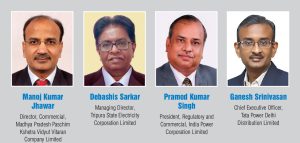
What is your assessment of the power sector’s progress during the past year?
Manoj Kumar Jhawar
The sector has recovered from the Covid shock and power demand has shown decent growth. The growth has exceeded pre-Covid levels, but after almost five years of power surplus, supply-related issues are again coming to the fore. Migration towards renewables has picked up pace and is likely to gather more steam. However, renewable energy generation still accounts for very little of the overall energy basket.
Debashis Sarkar
Over the past year, the implementation of renewable power plants has been prioritised in the form of solar, hydro and wind to replace conventional power plants, thus progressing towards net zero. The RDSS has been implemented to reduce AT&C losses. The large-scale commissioning of smart prepaid meters has been carried out to stop revenue leakage on part of discoms, through the provision of Rs 3 trillion in funding across the entire country. A greater degree of digitalisation has occurred, mainly in the call centre operation, and billing and collection fields, to make the life of the end consumer more comfortable.
Pramod Kumar Singh
If one takes a segmented view of the power sector value chain, the generation segment, especially renewables, has responded exceedingly well in recent years so far as capacity addition is concerned, making the country power surplus. Although we have seen demand increasing, due to the recent heightened volatility with respect to commodities globally, there have been some concerns on the fuel side, which are being addressed. The transmission segment continues to do well in terms of capacity addition and robustness, with decreased congestion, thus strengthening the One India One Grid-One Price initiative. Efforts are also being made towards generation flexibilisation and schedule optimisation by moving, to some extent, to a centralised schedule and introducing a despatch mechanism. Deepening of the power market through greater arrays of products, including the real-time market and separate renewable windows in the short-term market, is also in the works. The proposed general network access framework in transmission may further deepen the power market.
The challenges witnessed during the year concerned the emerging global fuel availability and price volatility risks, and the resultant stubbornness of the cost structure, given that fuel/power purchase account for at least two-thirds of costs. AT&C losses and other efficiency gains constitute key cost optimisation drivers and present great opportunities for further improvement, going forward.
Ganesh Srinivasan
India’s power sector is one of the most diversified in the world, providing solutions that include both conventional and non-conventional energy sources. The recovery path of the power sector, post the second wave of Covid, has been positive. The sector has experienced a significant rise in electricity consumption over the past few years. According to the Ministry of Power’s data, India’s power consumption grew by nearly 2 per cent year on year to 130.35 BUs in August 2022. Power consumption in August last year was recorded at 127.88 BUs, higher than the 109.21 BUs recorded in the same month of 2020. This year’s peak demand has remained at over 200,000 MW throughout the first two quarters.
The centre has also given some breather to the gencos by enforcing a payment security mechanism to bring the receivables of gencos under control. The government is promoting and encouraging the use of sustainable energy. To this end, in the Union Budget 2022, around Rs 33.65 billion was allocated to the solar segment. This is a 29 per cent increase over the previous year’s budget of Rs 26.06 billion. The focus is on promoting green energy, domestic manufacturing and technological advancements.
There has also been significant growth in terms of installed renewable energy capacities. At COP26, India committed to 500 GW of renewable energy capacity by 2030. The recently issued renewable purchase obligation and energy storage obligation trajectory till 2029-30 will play a major role in achieving that target. Moreover, for promoting green energy at the grassroots level, the government is encouraging the introduction of green hydrogen and green open access rules for the adoption of a wide and inclusive definition of green energy.
On the distribution front, under the reforms-based and results-linked RDSS, discoms have shown improvement in their operational efficiencies and financial sustainability, and have strengthened their supply infrastructure.
What, according to you, are some of the steps needed to address the challenges facing the power distribution segment?
Manoj Kumar Jhawar
- Tariff simplification and subsidy rationalisation.
- Timely receipt of government subsidies.
- Digitalisation of commercial processes, and building strong linkages with fintech to improve recoveries and compliances.
- More automation and investment in operation technologies.
- Addressing shortages of trained manpower, particularly in state-owned utilities.
Debashis Sarkar
- Addressing the high AT&C losses of discoms despite the implementation of so many schemes.
- Improving operational efficiency and optimising the power purchase cost.
- Improving employee motivation and ownership of their organisations.
- Cost plus tariff support by concerned regulators to ensure sustainability of the discoms.
- Improving supply reliability for end consumers through distribution automation.
- Improving cybersecurity.
Pramod Kumar Singh
The power distribution segment is a very vital segment, being the end link in the power value chain and the nodal point for consumers. The onus of overall cost recovery for the entire sector lies with the discoms, and hence their performance is key. It is imperative for the distribution segment to be financially viable, so that it garners enough cash to feed the rest of the value chain and maintain a surplus to fund future capex, while also keeping the tariff at an affordable/ manageable level. It is encouraging to see the steps being taken to introduce greater payment discipline in the sector, which will service and protect returns on investments already made, while also helping attract investments to the sector, resulting in the overall benefit of consumers. The creation of huge regulatory assets has been a bane for the sector. The proposed automatic pass-through for retail tariffs through power purchase adjustment charges without caps for generator cost increases, combined with the effective on-ground execution, which has resulted in performance efficiency gains in the distribution segment, will certainly help in maintaining the cash flow and reducing regulatory assets in the future. It is important to continue investing in this segment and using technology to optimise costs and improve customer service. This will help discoms effectively embrace the energy transition objective and transform into efficient utilities.
Ganesh Srinivasan
The sector is settling down after Covid and the coal supply crisis, which hit twice. A few challenges still persist, and support is required to address them:
- Reducing power purchase costs, and particularly offsetting the impact of imported coal and gas, is critical, as this is putting a huge stress on the discoms.
- The financial viability of discoms needs to be improved through timely and cost-reflective tariffs across customer categories.
- There is a need for clarity on the path towards reducing AT&C losses across states, especially regarding choosing between the models available for privatisation – PPP, franchisees, etc. – and the role of multiple players as per the Electricity Amendment Bill, 2022.
- The sector can explore scaling up of storage solutions through renewable energy round-the-clock contracts to cater particularly to the night peak, and grid solutions to support e-mobility.
- Stringent cybersecurity measures need to be taken, as the risks are increasing exponentially with the growing scale of automation and connectivity.
What is your outlook for the segment in the near to medium term?
Manoj Kumar Jhawar
In the medium term,
- Peak power shortages are likely to increase;
- Subsidies are likely to remain a sticky issue, considering the overall socio-political situation. This is likely to remain a drag on discom finances.
- Investments in the transmission sector are expected to further increase grid stability at the macro level.
- Investments proposed under the RDSS are likely to address investment needs in the distribution segment.
- Implementation of smart metering, although emphasised vigorously, is likely to take at least five years in the urban areas alone. Rural areas will possibly take longer.
Debashis Sarkar
- Private participation in PPPs or in franchise mode needs to grow to increase the efficiency of discoms.
- There needs to be greater injection of renewable energy such as solar and wind to reduce carbon usage.
- There needs to be 100 per cent installation of smart meters as well as their integration with smart grids to improve operational efficiency.
- Distribution automation needs to be implemented to improve supply reliability.
Pramod Kumar Singh
Our per capita power consumption has been more than doubling every decade, and has increased almost 2.3 times since 2003, but is still less than one-third the global average. This points to the need for much more capacity addition across segments in the future.
Meanwhile, there are structural changes under way. The country aims to push electricity steadily towards becoming the primary choice of fuel in automobiles over petrol and diesel. Electric vehicles are thus emerging as a strong disruption. On the supply side, we are seeing appreciable mainstreaming of renewables in the energy basket. Formats such as solar rooftops, decentralised generation and green hydrogen are expected to see a significant growth. Such structural changes need to be addressed effectively and successfully navigated at the discom end too.
The energy scenario of the future will be highly decentralised, decarbonised, democratised and flexible. Technology deployment and progress on the digital path by distribution utilities will play key roles in this transition. The grid of the future will have to adapt to the emerging energy transition path, changing customer needs and grid flexibility while maintaining grid security and supply.
Needless to say, in the context of these changes, the sector will have to learn quickly and back it up with stronger execution, as the landscape further evolves from the regulatory, policy, consumer preferences and technology points of view.
Ganesh Srinivasan
The future of the power sector looks bright since by 2026-27 the country’s installed power generation capacity will be close to 620 GW, of which 38 per cent will be from coal and 44 per cent from renewable energy sources. Customers are actively adopting renewable energy, from the residential to commercial segments. Moreover, green energy solutions have aggressively entered the mobility sector, particularly the vehicle and public transportation segments. Energy demand is expected to increase substantially. We will require strong and sustainable infrastructure to match consumer demand for green energy solutions. The grid-level integration of larger-scale renewable energy – both utility-scale and rooftop – is a strong point. It will enable power companies to educate consumers on the importance and long-term benefits of renewables.
Consumers will possibly become more aware and have higher expectations in terms of energy solution benefits and the services available to them. They will become more empowered due to green open access, which enables them to procure power from a utility of their choice.
The discoms will be a part of the bright future of the country by transitioning to clean and green energy solutions. However, increased efforts by key stakeholders and government officials will help in structuring and reforming the distribution sector as it is critical for meeting the growing demand, the aspirations of customers, and India’s sustainable energy transition targets.