
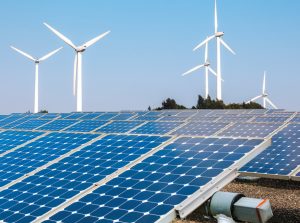
 India’s key renewable-rich states, Gujarat and Rajasthan have recently floated new renewable energy policies. As of September 2023, Gujarat’s total installed renewable energy capacity reached 21,715.45 MW, comprising approximately 11,094.02 MW of wind power, 10,417.56 MW of solar power, and smaller capacities of biomass (112.23 MW) and small-hydro power (91.64 MW). Gujarat holds the second-largest solar power capacity in the country, second only to Rajasthan (18,089.21 MW). In total, it accounts for approximately 16 per cent of India’s renewable energy portfolio.
Rajasthan’s achievements in power infrastructure have been remarkable as well. The state has a total installed renewable energy capacity of 23,431.56 MW as of September 2023. Solar energy accounts for approximately 77 per cent of the state’s total installed renewable energy capacity. Rajasthan has effectively harnessed its wind resources, coming fourth in terms of the total installed wind power capacity with 5,193.42 MW as of September 30, 2023. Meanwhile, Gujarat’s installed wind capacity at 11,094.02 MW is the highest among all states.
Power Line provides an overview of the key highlights of the states’ renewable energy policies…
Gujarat Renewable Energy Policy, 2023
Gujarat has introduced its renewable energy policy with a primary emphasis on harnessing the state’s substantial potential of 36 GW in solar and 143 GW in wind. The policy aims to facilitate the development of 100 GW of cumulative renewable energy capacity by 2030 with investments of around Rs 5,000 billion, utilising approximately 400,000 acres of land. This initiative aims to facilitate cost-effective and reliable power supply. This policy will remain in effect until September 30, 2028, and it will cover various types of renewable energy projects. These include ground-mounted solar, rooftop solar, floating solar, canal-top solar, wind, rooftop wind, and wind-solar hybrid initiatives. This policy aligns with the national goal of reaching 50 per cent of the total installed electric power capacity from non-fossil fuel sources by 2030.
Rooftop solar
For rooftop solar projects, consumers in the region can choose between net metering and gross metering arrangements based on the Gujarat Electricity Regulatory Commission’s (GERC) regulations. They are also eligible for incentives offered by central or state government schemes. For projects under the gross metering mechanism selling power to distribution licensees, the tariff is calculated as the simple average of competitive bidding results conducted by Gujarat Urja Vikas Nigam Limited (GUVNL) in the previous six months (either April to September or October to March), with an additional charge of Re 0.20 per unit. This determined tariff remains constant for the entire 25-year term of the PPA.
Floating/Canal-based solar
The state has several water reservoirs and canals that can be utilised for setting up floating/canal-based solar projects. As per the policy, floating or canal-based solar projects are to be implemented in consultation with the Narmada, Water Resources, Water Supply, Kalpsar Department, or other government authorities responsible for canals, rivers, streams, etc.
Wind
For wind energy, small-scale projects can be installed by consumers on rooftops or within premises under the net metering scheme to offset their own consumption or for selling the entire generation to discoms under a gross metering arrangement, following GERC regulations. Renewable energy developers may also access incentives or benefits available under central or state government schemes.
Wind-solar hybrids
Under the policy, wind-solar hybrid power projects are divided into two categories:
- Type A projects: This category involves the conversion of existing or under-construction standalone wind or solar power plants into hybrid projects. Wind or solar capacity under construction shall be considered based on the registration certificate issued by the Gujarat Energy Development Agency (GEDA) or the evacuation permission granted by Gujarat Energy Transmission Corporation Limited (GETCO)/state transmission utility (STU) to solar or wind renewable energy developers. The installed wind or solar capacity will be considered based on the capacity specified in the PPA or the wheeling agreement.
- Type B projects: This category encompasses entirely new wind-solar hybrid power generation projects that are not registered with GEDA or for which evacuation permission has not been granted by GETCO/STU as of the date of the policy’s issuance.
Renewable energy parks
As per the policy, the minimum capacity of a renewable energy park will be 50 MW, with the maximum park capacity determined in accordance with the guidelines or schemes issued by the Ministry of New and Renewable Energy (MNRE) from time to time.
Energy settlement and banking
Energy accounting and banking for all renewable energy projects, including rooftop projects, should adhere to regulations framed by GERC in accordance with the Green Energy Open Access Rules, 2022. Importantly, no banking charges will be applicable to solar power consumed by residential consumers with solar rooftop capacity up to 3.5 kW. Discoms may procure power from distributed solar projects up to 4 MW capacity and small-sized wind projects up to 25 MW at a pre-fixed levellised tariff as per the mechanism decided by GERC.
For hybrid projects set up for captive use or third-party sale, the renewable energy developer or consumer is required to seek sanction/allocation of transmission capacity for at least the installed capacity of the wind or solar capacity, whichever is higher.
For renewable energy projects exempted from the competitive bidding process as per the MNRE guidelines, discoms may procure power from distributed solar projects up to 4 MW at a predetermined levellised tariff determined by GERC. This tariff will be calculated as the simple average of tariffs discovered and contracted under the competitive bidding process conducted by GUVNL for solar projects in the preceding six-month period (either April to September or October to March), with an additional Re 0.20 per unit. This tariff will remain fixed for the 25-year term of the PPA. Similarly, discoms may procure power from small-sized wind power projects up to 25 MW capacity at a pre-fixed levellised tariff.
Sharing of carbon credit benefits
Renewable energy projects are eligible for carbon credits, including certified emission reductions, verified emission reductions, Gold Standard, or any other standards adopted at the national or international level for the issuance of carbon credits for renewable energy projects. Rooftop solar/wind projects that are implemented under a central or state government scheme should pass the carbon credits to discoms.
Repowering of wind projects
As per the policy, the repowering of wind turbine generators will be carried out by renewable energy developers on or before the completion of 25 years from the date of project commissioning or the extended term of the agreement. In case the wind project developer fails to repower the wind turbine generator at the end of the project’s agreed-upon lifespan/extended terms, they will have to decommission the wind power project and surrender the connectivity. If the project is set up on leased land, the developer will have to surrender their leasehold rights to the government.
Rajasthan Renewable Energy Policy, 2023
The primary objective of the Rajasthan Renewable Energy Policy, 2023 is to facilitate the development of 90 GW of clean power projects. Of this, 65 GW will be dedicated to solar energy, 15 GW to wind and hybrid sources, and 10 GW to hydro, pumped storage plants, and battery energy storage systems (BESSs). The policy will be in effect for four years.
Renewable energy facilitation charges
According to the policy, a fund will be set up to receive funds in the form of renewable energy facilitation charges. This will be utilised as per the plan approved by the state-level steering committee. Facilitation charges will be levied in cases where a renewable power project sells power to entities other than discoms. In such a scenario, the power producer must pay Rs 50,000 per hectare per year for the project’s solar component, which will continue throughout the project’s lifespan. Further, developers can either make these facilitation charge payments or supply 7 per cent of the power generated to discoms free of cost.
Solar parks
The developer should submit an application to Rajasthan Renewable Energy Corporation Limited for the registration of a solar park along with a non-refundable registration fee of Rs 10,000 per MW plus GST, with a maximum of Rs 2 million plus GST for each park.
Rooftop solar
- Rooftop solar with net metering: Under the net metering scheme, discoms will permit the addition of rooftop solar capacity up to 50 per cent of the capacity of the distribution transformer serving the respective areas. Rooftop systems can be established on government buildings under the renewable energy service company model. Consumers will be eligible for subsidies and incentives per the guidelines established by the MNRE and the state government.
- Rooftop solar with gross metering: Under the gross metering scheme, the entire power generated will be supplied to discoms at a tariff determined by the Rajasthan Electricity Regulatory Commission (RERC). Rooftop solar systems with up to 1 MW capacity will be allowed for gross metering under the programme.
Decentralised solar projects
Rajasthan will promote the establishment of decentralised solar projects with a minimum capacity of 500 kW and a maximum capacity of 5 MW, located at or near 33 kV grid substations. These projects will generate power for sale to discoms. According to the policy, substations suitable for such projects will either be selected by Rajasthan Urja Vikas Nigam Limited or discoms.
Wind projects
Rajasthan will promote the establishment of wind power projects for captive use or third-party sale both within and outside the state or through power exchanges.
Hybrid power projects
According to the policy, wind-solar hybrid power projects will be promoted for optimal and efficient utilisation of infrastructure and land and to enhance grid stability. Such projects will be promoted under the following categories:
- Sale of power to the discoms at tariffs discovered through transparent bidding processes.
- Captive use and sale to third parties within and outside the state through open access or power exchange.
The maximum permissible capacity of hybrid projects for captive use will be limited to the contract demand of the consumer as per RERC regulations. A wind-solar power project will be recognised as a hybrid project if the rated power capacity of one resource (wind/solar) is at least 25 per cent of the rated power capacity of the other resource (solar/wind).
Hybridisation of existing thermal power plants
The state will promote the hybridisation of existing thermal power plants, enabling them to meet their generation targets through either thermal or renewable power. This flexibility allows thermal power generators to utilise renewable energy sources efficiently and contribute to emissions reduction. Any net gain realised by the generator through the combination of renewable power with thermal power will be evenly distributed between the generator and discoms, subject to approval by the regulatory authority.
Hydropower and storage projects
Large hydropower projects, including pumped storage projects with over 25 MW capacity and energy from all small- hydro storage projects commissioned after March 8, 2019, will be considered renewable energy. The state will promote solar, wind, and wind-solar hybrid power projects with storage systems to reduce the variability of renewable power output into the grid and ensure the availability of reliable power for a particular period. The minimum rated energy capacity of an energy storage system will equal X/2 MWh, where X is the project’s installed capacity in MW.
Standalone BESSs
The energy from standalone BESSs will be considered as a renewable energy component. If, over a year, at least 85 per cent of the total energy stored within a BESS is sourced from renewable energy, it will qualify for meeting the energy storage obligation.
Renewables-based EV charging stations
Charging infrastructure will be developed as per the guidelines and standards issued by the Ministry of Power and the Central Electricity Authority. Electric vehicle (EV) charging stations can be established by state or central PSUs, private operators, or on the public-private partnership models. These charging station service providers can install renewable energy generation facilities on their premises for self-consumption. They can access renewable power from generation plants within the state through open access, thus leveraging incentives offered by the policy.
Further, the state will actively support research and development initiatives to promote the adoption of renewable energy at EV charging stations and assess the impact of EV charging infrastructure on the electrical grid.
Floating solar
The state will also promote the setting up of floating, reservoir-top, and canal-top solar power projects, either for selling electricity to discoms through competitive bidding, for self-consumption, or for third-party sale. Developers interested in floating solar projects will be allocated potential sites through a transparent allocation process, and the state’s energy department will issue specific guidelines for this.
The way forward
Gujarat holds immense potential for renewable energy development. Going forward, Gujarat is expected to maintain a strong position in India’s renewable energy market as it explores offshore wind projects in the near future.
Rajasthan has set ambitious targets to accelerate the growth of its renewable energy capacity. In 2023-24, the state aims to install 11 GW of renewable energy projects, according to the 2023 state budget. By scaling up solar and wind power deployment, adopting hybrid energy solutions and fostering partnerships, Rajasthan is positioned to make a significant contribution to India’s renewable energy targets. The new policies introduced by both states bode well for the sector.
Anusshka Duggal


