

 Japan’s electricity sector is undergoing a significant transformation, driven primarily by the imperative to enhance interregional connections. The country’s goal is to meet its carbon neutrality targets by 2050 under the Green Growth Strategy. Japan plans to achieve this through the carbon neutrality initiative, which necessitates decarbonising the power generation base and increasing the share of renewable energy sources in the nation’s generation mix. These changes are particularly crucial in light of Japan’s unique challenges, including a heavy reliance on liquefied natural gas (LNG) imports, geographical constraints limiting renewable energy expansion, and a lack of cross-border transmission interconnections.
Japan’s oil imports are at risk due to its growing dependence on the Middle East for nearly 95 per cent of its oil supply. This vulnerability is exacerbated by the global oil market uncertainties caused by the Russia-Ukraine and Israel-Hamas tensions. All these reasons have made it more imperative for Japan to diversify its energy sources and reduce its reliance on volatile fuels.
Under its carbon neutrality strategy, Japan emphasises the extensive adoption of renewable energy sources, besides encouraging innovation in the pursuit of new decarbonisation technologies for power generation, such as hydrogen and ammonia, as well as thermal plants with carbon capture, utilisation and storage technology. Japan has set a target of generating approximately 10 per cent of its total electricity output from offshore wind (OSW) farms, particularly in Hokkaido, Honshu and Kyushu. To facilitate the transportation of electricity from these regions to urban centres such as Tokyo and Osaka, it is essential to establish a well-connected national grid.
At present, Japan grapples with inadequate grid connections across regions, leading to challenges such as solar farms in Kyushu having to curtail generation due to grid limitations. To address this issue, the Ministry of Economy, Trade and Industry (METI) has collaborated with utility companies to enhance grid connections. Recently, in 2023, it published a draft Wide-Area Grid Long-Term Policy (master plan for wide-area interconnection system) to outline the direction for the development and renewal of wide-area interconnection systems at the national level for more than 10 years. Under this, Japan’s Organization for Cross-regional Coordination of Transmission Operators (OCCTO), which regulates the supply and demand of electricity nationwide, has called for an investment of JYP 6 trillion to JYP 7.9 trillion for the development of the country’s transmission and distribution (T&D) network by 2050.
Japan is on the path to transforming its electricity sector through initiatives such as doubling the regional electric grid capacity, connecting various regions via new transmission lines and undersea cables, and facilitating OSW energy projects. The aim is grid integration of the upcoming renewable energy capacity, facilitating power interchange between regions and increasing interregional flexibility. The report forecasts that more electricity will be transmitted from Hokkaido and Kyushu, which generate substantial renewable energy to areas such as the Tokyo metropolitan area, which consumes a lot of electricity.
Power sector overview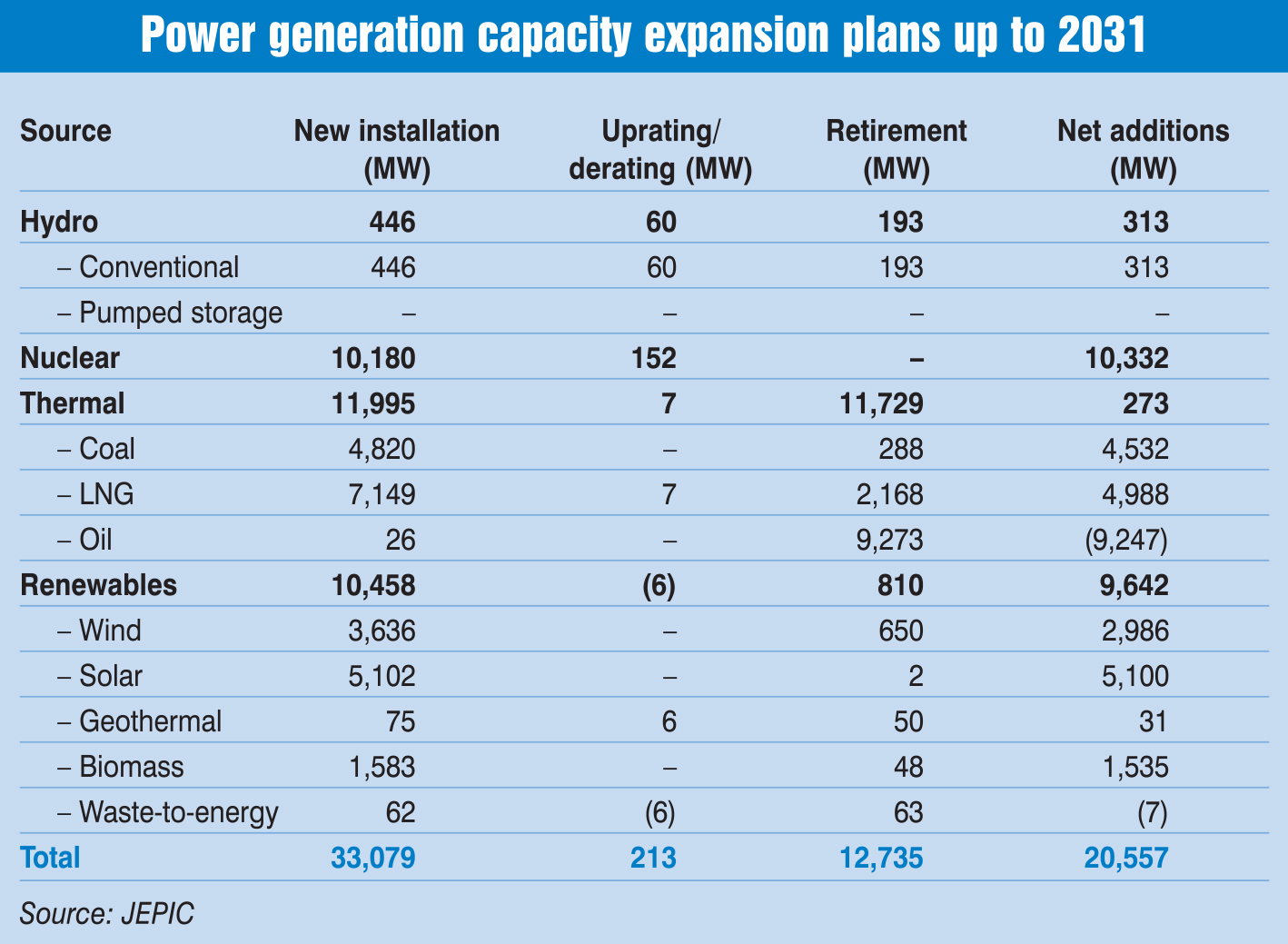
In recent years, Japan’s electricity sector has experienced a significant transformation. A reformation of the industry occurred with the full liberalisation of the retail market in April 2016, which led to the introduction of a new licensing system for electricity business operators, resulting in three primary categories – electricity generation, T&D and retailing. These categories are stringently regulated by METI through its Agency for Natural Resources and Energy. The 10 general electricity utilities that have historically been engaged in power supply since 1951 are now called “former general electricity utilities”.
Although the generation segment had 1,038 entities as of April 2022, approximately 80 per cent of the capacity was controlled by J-Power and the Japan Atomic Power Company Limited. In the T&D segment, 10 utilities (nine utilities spun out from the former general electricity utilities) have been conducting business as general electricity T&D businesses; three companies, including J-Power Transmission Network Company Limited, are conducting business as electricity transmission utilities; and 36 corporations, including Sumitomo Joint Electric Power Company Limited, are operating as specified electricity T&D utilities. To manage all these utilities, OCCTO was established in April 2015 as a government-authorised organisation that all electricity utilities are required to join. It aims to promote cross-regional transmission network development, enhance supply and demand adjustments and ensure energy supply resilience, both in normal conditions and during emergencies.
 Existing infrastructure
As of 2022, Japan had an installed capacity of 297,089 MW, of which 63 per cent or 188,247 MW was thermal, 17 per cent or 49,924 MW was hydro, 11 per cent or 33,083 MW was nuclear-based and 9 per cent or 25,835 MW was renewable-based.
The 2011 Great East Japan Earthquake and the subsequent Fukushima nuclear incident had a major impact on the electricity system. All nuclear power generation was temporarily halted. As a result, nuclear power now plays a minor role in Japan’s generation mix. On the thermal front, natural gas has emerged as the primary fuel source for electricity generation, closely followed by coal, while the share of oil has been decreasing.
Being an island nation with no cross-border power connections, Japan has to maintain a balance between its electricity generation and consumption. The country is divided into 10 distinct regions, each overseen by its own transmission system operator (TSO). Furthermore, Japan is divided into two separate regions, operating on different frequencies – 50 Hz and 60 Hz – due to historical reasons. This technological division necessitates careful management of interconnection capacity and coordination between the two regions. OCCTO plays a crucial role in coordinating power exchange among 10 TSOs during disruptions or emergencies. It also serves as a vital information-sharing hub of the national administration.
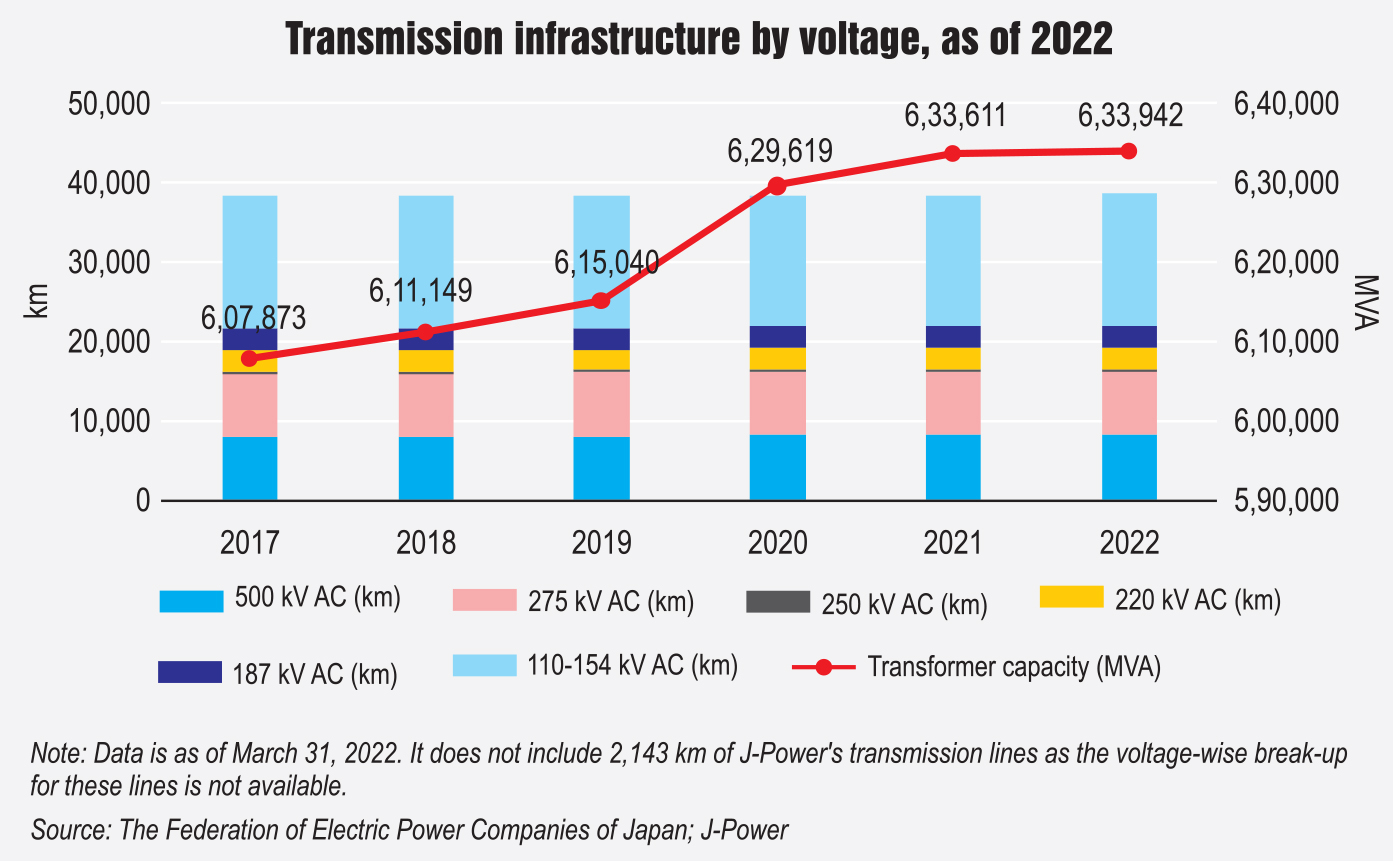
As of 2022, Japan’s grid comprised 38,573 km of line length between 110 kV and 500 kV voltage levels, of which 95 per cent or 36,611 km was overhead lines and the remaining 5 per cent or 1,962 km was underground cables. Voltage-wise, the majority or 43 per cent of the lines are at 110-154 kV, followed by 500 kV and 275 kV lines, both at about 21 per cent. Besides, Japan has a transformer capacity of 633,942 MVA, with 1,124 transformers.
The 10 general electricity T&D facilities in Japan taking care of their respective regions are Hokkaido Electric Power Network, Inc.; Tohoku Electric Power Network Company; TEPCO Power Grid, Inc.; Chubu Electric Power Grid Company; Hokuriku Electric Power T&D Company; Kansai T&D, Inc.; Chugoku Electric Power T&D Company; Shikoku Electric Power T&D Company; Kyushu Electric Power T&D Company; and Okinawa Electric Power Company.
Future plans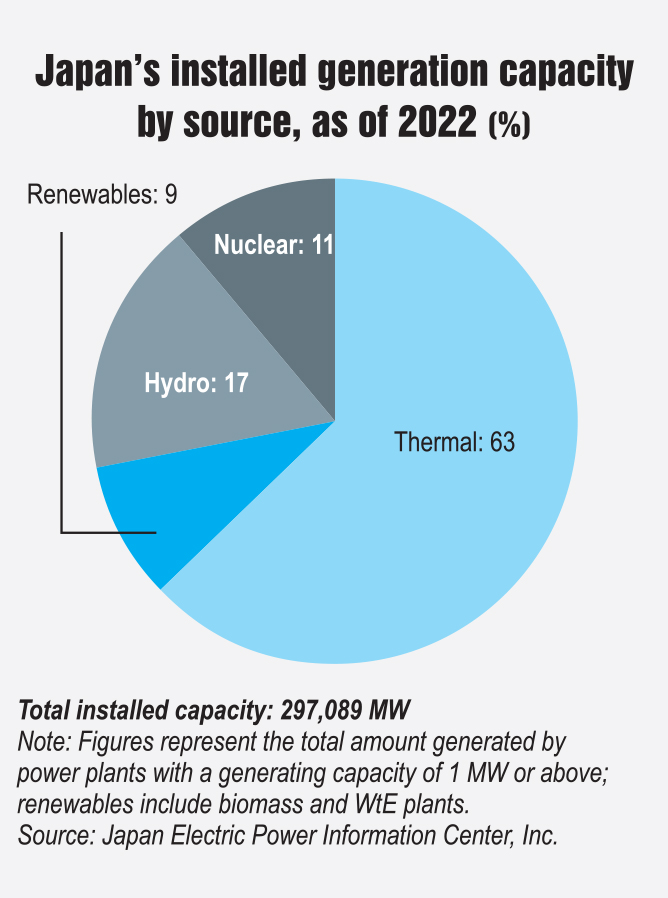
In line with the country’s carbon neutrality goal, Japan’s Sixth Strategic Energy Plan, which was approved by the cabinet in October 2021, aims to control electricity demand at 864 TWh in fiscal year 2030 through rigorous energy conservation efforts, in the backdrop of the expected economic growth. In line with these targets, OCCTO has also anticipated a slight reduction of 0.1 per cent in peak demand and 0.2 per cent in annual electric energy requirement during 2023-32. This reduction is mainly attributed to initiatives aimed at lowering electricity consumption, widespread adoption of energy-efficient electric appliances, a shrinking population and load-levelling measures.
The Strategic Energy Plan seeks to increase the share of renewables to 36-38 per cent by 2030, nuclear power is expected to contribute 20-22 per cent to the energy mix, while thermal power’s share will be minimised, with coal and LNG contributing 19 per cent and 20 per cent respectively.
Japan is resolutely committed to renewable energy as the primary source of electricity. To achieve this, the government has introduced various mechanisms, such as feed-in tariffs and feed-in premiums to incentivise renewable energy production. OSW power holds significant potential and Japan is actively promoting it as a means to transition to renewable energy. The government has also established rules for exclusive sea area use and designated offshore zones for wind power projects. The auctioning process has evolved to facilitate market entry for a wider range of enterprises and expedite project launches. Ongoing discussions are exploring amendments to bidding rules to further support OSW development.
Transmission plans
To support the change in the energy mix, efforts are under way to strengthen the electricity transmission system, ensuring efficient power distribution among regions. This includes enhancement of the grid network and the potential construction of a direct current submarine power transmission system. Japan is also embarking on an ambitious plan to bolster its interregional power grid capacity by 23 GW, mainly for wind projects. Between 2023 and 2032, Japan plans to add 777 km of line length capacity, of which 64 per cent or 498 km will be interregional connections (cross-regional links) and the remaining 36 per cent or 279 km will be intra-regional lines. The country has also planned to decommission 104.3 km of line length during the period. Further, about 31,262 MVA of substation capacity would be added, along with the decommissioning of 5,800 MVA, translating to a net increase in substation capacity of about 25,462 MVA. The decommissioning activities reflect Japan’s evolving energy landscape and a shift in transmission priorities.
One of the most notable cross-regional projects is the plan to link Hokkaido and Tokyo via an undersea cable of 8 GW to 12 GW. Similarly, Hokkaido and Honshu will be connected through an undersea cable, while the northern area of Tohoku and Greater Tokyo will be linked via landlines. Additionally, the interconnection facility enhancement plan between Tokyo and Chubu as well as that between Chubu and Kansai has been planned.
The way forward
Japan is in the process of developing a blueprint for its next-generation power network. While this roadmap is still evolving, reforms and initiatives that have been undertaken or are at the planning stages are expected to contribute to the establishment of a robust power grid and help achieve Japan’s decarbonisation objectives. The country is also planning to reduce its dependency on other countries for fuel imports. Net, net, Japan is taking proactive measures to achieve its carbon neutrality goals.
