

The implementation of smart metering in the country, especially under the Revamped Distribution Sector Scheme (RDSS), is transforming the country’s metering infrastructure. Prepaid smart metering for consumers and system metering at the feeder and distribution transformer levels is emphasised, facilitating automatic energy accounting and auditing, enhanced load forecasting, optimised power procurement, and reduced cost of power supply, ultimately benefiting end consumers and improving billing and collection efficiency of discoms.
Introduced in July 2021, the RDSS, totalling Rs 3.03 trillion with Rs 976.31 billion allocated from the central government budget, aims to reduce aggregate technical and commercial losses to 12-15 per cent by 2024-25. This scheme comprises two components – Part A focuses on financial aid for prepaid smart metering and distribution infrastructure upgrades, while Part B allocates around Rs 2 billion for training, capacity building and other supporting activities. Various state-owned discoms are utilising the package for system strengthening (RDSS-1) and significant effort has also taken place towards the modernisation of metering infrastructure (RDSS-2).
Under the RDSS, smart metering is being implemented under the public-private partnership mode on a total expenditure basis, which minimises the upfront costs for discoms. The projects are being awarded to advanced metering infrastructure service providers (AMISPs) through the bidding route, with the service charge per month per meter being the key bidding parameter. AMISPs will oversee the supply, maintenance and operation of smart meters.
Progress so far
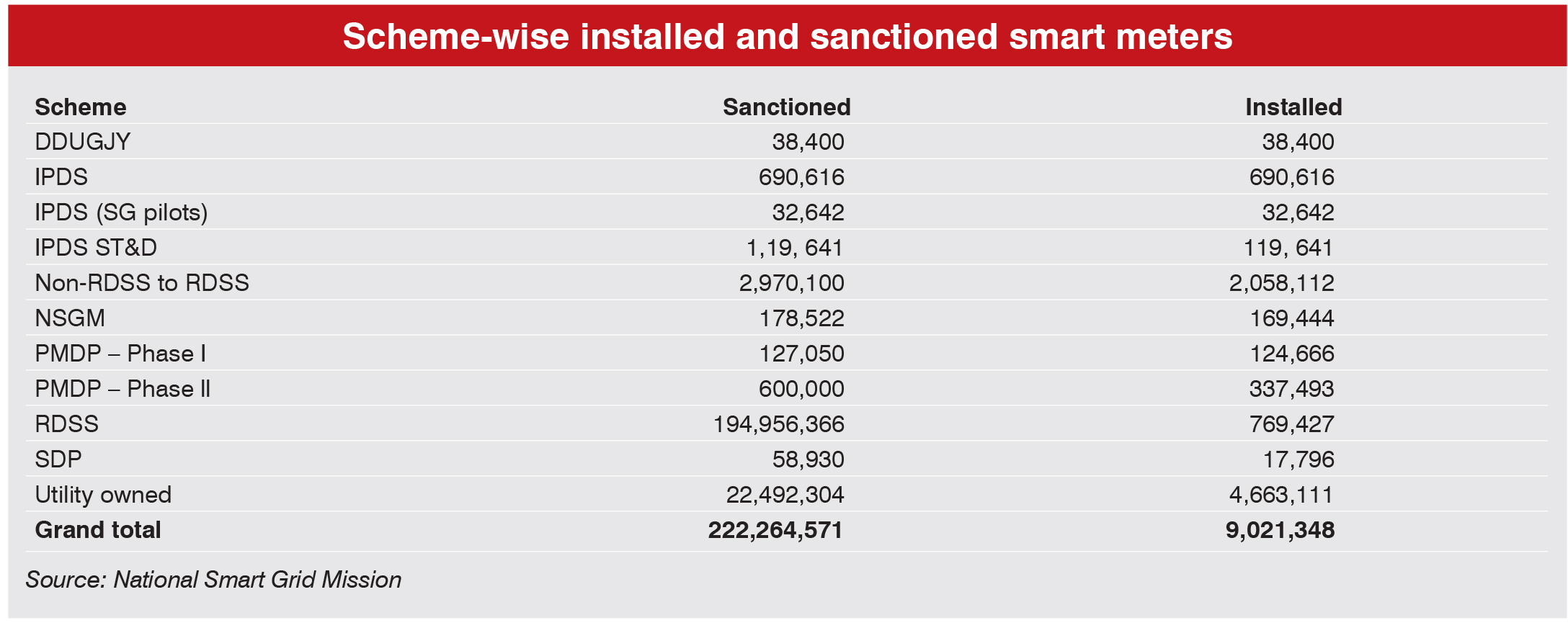
As of January 2024, 8.6 million smart consumer meters have been installed in the country. Notably, during 2023-24 (up to January 2024), 3.02 million smart consumer meters have been installed, nearly doubling the installations from the previous year. With the government mandating the transition to a complete smart metering system, replacing all the existing 250 million meters by 2025, the pace of smart meter awards and installations is expected to accelerate in the coming months. Of the total 222 million smart meters sanctioned so far, around 100 million have been awarded as of December 2023. Further, approximately 123 million smart meters are expected to be awarded in the near term, providing significant opportunities for meter manufacturers and AMISPs. Bihar leads with the highest installation of smart meters, totalling 2,609,485 followed by Assam with 1,200,619 installed. Uttar Pradesh closely trails with 1,186,953 meters installed, while Madhya Pradesh and Haryana have installed 702,020 and 853,683 meters respectively.
There has been significant activity in the smart metering tendering process. Tenders have been floated for about 1.8 million meters. The current status shows that 12 per cent of the tenders are ongoing, and 21 per cent are under evaluation. Additionally, 12 per cent of tenders have reached the stage of deciding the lowest bidder or are undergoing the letter of award (LoA) process. Notably, the majority, comprising 55 per cent of tenders, have already been awarded, reflecting substantial advancement in the implementation of smart metering projects across the country. As per the report by ICRA Limited, the pace of smart meter installations is anticipated to accelerate in the coming two years, bolstered by advancements in tendering processes and the government’s commitment to enhancing discom finances.
Recent smart metering/RDSS projects
In January 2024, HPL Electric and Power Limited secured an order worth Rs 2.4 billion for smart meters from an AMISP. In the same month, REC Power Development and Consultancy Limited (RECPDCL) signed an MoU with the Gujarat government amounting to Rs 20.94 billion for the implementation of the smart metering project in Paschim Gujarat Vij Company Limited’s distribution area.
Airtel Business announced a collaboration with Adani Energy Solutions Limited (AESL) in January 2024 to deploy connectivity for over 20 million smart meters, with the aim of ensuring reliable and secure connectivity for AESL’s smart metering deployments. In another development, Airtel has unveiled a strategic collaboration with IntelliSmart Infrastructure Private Limited to deploy up to 20 million smart meters nationwide, aimed at bolstering Airtel’s expanding internet of things initiatives across various industries in December 2023.
In January 2024, Polaris Smart Metering secured contracts worth Rs 52 billion from Madhyanchal Vidyut Vitaran Nigam Limited for installing 5.1 million smart prepaid meters in Lucknow and Ayodhya/Devipatan clusters in Uttar Pradesh. The company has also secured LoAs in West Bengal and Manipur, amounting to over Rs 24 billion, for the installation of over 2.3 million smart meters.
In December 2023, Techno Electric and Engineering Company Limited secured new orders worth Rs 10.41 billion for advanced metering infrastructure (AMI) from RECPDCL for 727,000 smart meters in Kashmir on a design, build, finance, own, operate, transfer basis.
In October 2023, Genus Power Infrastructures Limited received an LoA worth Rs 31.21 billion for the appointment of AMISPs. This includes designing an AMI system with the supply, installation and commissioning of 3.6 million smart prepaid meters. Earlier, in July 2023, Genus Power Infrastructures signed a definitive agreement with Gem View Investment Pte Limited, an affiliate of GIC, Singapore, to set up a new platform in India for undertaking AMISP concessions. GIC will hold a 74 per cent stake in the platform while Genus will hold the remaining share. The partners have committed to an initial pipeline with a capital outlay of $2 billion, and Genus will be the exclusive supplier of smart meters and associated services.
Future outlook
Looking ahead, the integration of AMI with emerging technologies such as artificial intelligence (AI) and machine learning (ML) is expected to provide utilities with a compelling advantage. Predictions become more precise when AI is combined with data from AMI, improving accuracy and efficiency. Furthermore, digitalisation through the adoption of appropriate technologies can address current challenges faced by discoms, enhancing productivity and financial stability. Companies are leveraging advanced digital tools to analyse energy consumption patterns. They have discovered that time-stamped meter reads provide valuable insights for fine-tuning the distribution grid, enhancing demand forecasting accuracy, reducing power purchase costs, and optimising assets. This advanced level of smart metering offers utilities numerous benefits, facilitating their transformation into next-generation digital utilities.
The next generation of smart metering offers advanced functionalities at minimal additional cost. These include advanced analytics using AI and ML for real-time power flow analysis, grid management enhancements such as distribution automation and voltage management, seamless integration with advanced distribution management systems for outage notifications, transformer monitoring for proactive maintenance, demand response capabilities for efficient energy management, support for smart electric vehicle charging, facilitation of distributed generation and energy storage systems, and implementation of smart street lighting solutions. This evolution promises to revolutionise energy management and grid operations, empowering discoms to optimise efficiency and reliability while embracing future-oriented technologies.
Conclusion
The implementation of smart metering projects presents several challenges, including delays in tendering processes, stakeholder disagreements, complex bidding procedures, cost overruns, and supply chain issues. Overcoming these obstacles requires robust architecture, effective IT integration and streamlining of tendering processes. Additionally, revisiting tariff structures, standardising procedures and rigorous testing are vital for successful implementation. Establishing robust cybersecurity infrastructure and investing in capacity-building initiatives are also crucial steps towards achieving efficient energy management and transitioning towards a sustainable and connected energy infrastructure.