
Hydroelectric plants (HEPs) typically require renovation and modernisation (R&M) after 30-35 years of operation. R&M serves as a cost-effective strategy to maintain operational capacity as an old HEP nears the end of its useful life. It extends the plant’s lifespan by 20-25 years and enhances its capacity through technological upgrades.
R&M and upgradation efforts are ongoing in India, providing a cost-effective means to optimise energy resources by improving efficiency, availability and capacity. To support these efforts, the government formulates five-year plans to continuously monitor hydropower projects undergoing renovation, modernisation, uprating and life extension (RMU&LE). It established committees in 1987 and 1998 to identify and implement R&M for HEPs, culminating in the National Perspective Plan prepared by the Central Electricity Authority in 2000.
Progress and plans
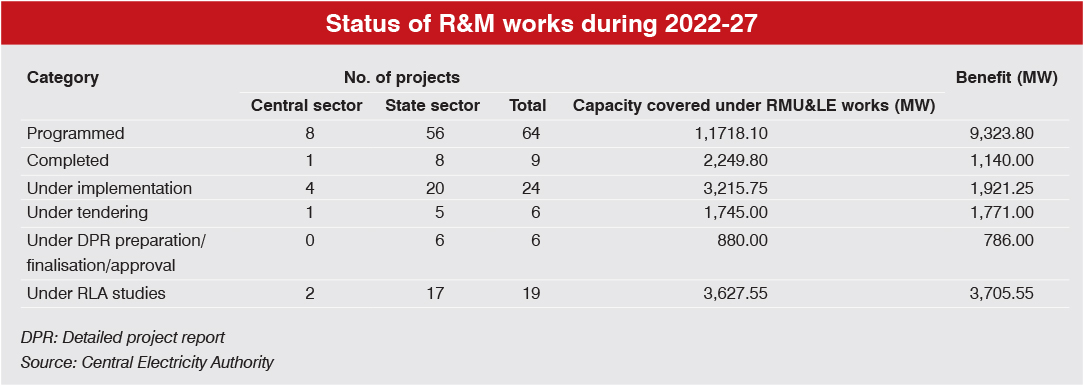
R&M works at 118 HEPs (26 in the central sector and 92 in the state sector) with an aggregate installed capacity of 22,634.7 MW were completed by the end of 2017-22, and a total benefit of 4,139.56 MW was accrued through LE and uprating (LE&U) and restoration. In 2022-23, the Munirabad Dam Power House, Linganamakki Dam Power House and Gerusoppa Dam Power House in Karnataka; the Nagarjuna Sagar Phase II and Nagarjuna Sagar Left Canal Power House in Telangana; the Rihand HEP in Uttar Pradesh; the Tiloth Power House in Uttarakhand; and Bhakra Left Bank Power Plant and the Bhabha Power House in Himachal Pradesh completed R&M works.
RMU&LE works at 64 HEPs, with an aggregate installed capacity of 11,718.1 MW, are programmed for completion during the period 2022-27. The revised aggregate installed capacity after the completion of these will be 11,965.6 MW. Of these, nine works with an aggregate installed capacity of about 2,249.8 MW have been completed as of September 2023, which has resulted facilitated benefit of 1,050 through LE and 90 MW through uprating. RMU&LE works at 21 HEPs with an aggregate installed capacity of 2,879.2 MW is scheduled for completion during 2027-32.
Need for RMU
In regions such as the Himalayas, where excessive silt damages hydraulic structures and turbines, annual repairs and technological innovations are essential to minimise downtime. Silt-prone power stations face numerous O&M challenges, including frequent strainer clogging, cooler tube blockages and punctures, leading to bearing oil contamination, cooling water pump damage, frequent shaft seal damage and issues with drainage and dewatering pumps, valves and piping due to sump siltation.
Critical components such as runners, which suffer significant damage, need renovation efforts every three years. In such cases, projects can opt for partial renovation with technological upgrades. Stations experiencing less damage may not need regular renovations but will require significant resources during major overhauls every 10-20 years, replacing critical items such as turbine runners and guide vanes due to uneconomical repairs. Stations exposed to acidic water or environments should consider replacing underwater parts, cooling systems, drainage and dewatering systems with stainless steel components.
Identification of units
Timely implementation of RMU&LE works is essential to prevent the deterioration and premature retirement of generating units. Identifying plants for R&M should be done well in advance, considering the time required to meet essential prerequisites. Projects should be selected based on performance records and parameters such as frequent breakdowns, efficiency reductions, decreased availability, temperature rise, vibrations, increased O&M costs and equipment obsolescence. Initially, the performance of all projects should be reviewed every 10 years and then every five years after 20 years of operation.
RLA studies
RLA studies are essential for identified HEPs in order to evaluate the health and lifespan of each component, shaping the RMU&LE plan. Hydrology should be reviewed to confirm hydropower potential and potential uprating. The study should address electromechanical, hydromechanical and civil components, with a focus on erosion and water leakages. The RLA report should outline the RMU&LE plan, techno-economic feasibility, as well as the potential to convert baseload to peaking stations. It should also detail modernisation cycles for control systems, clearly define the scope to avoid overruns and specify which components need refurbishment or replacement. Prioritisation should be given to activities with immediate benefits and shorter gestation periods.
 Approach to R&M
In a rapidly changing technological environment, control systems and software become outdated within 10-15 years, and spare parts become unavailable. These components can be modernised with minor modifications for improved reliability and higher yield. Renovations should replace outdated components with advanced alternatives, such as epoxy insulation and SF6 switchgear, and update turbines for higher output. Continuous modernisation using equipment such as static excitation systems and microprocessor-based governors improves reliability. Uprating hydro plants requires a systemic approach, considering all technical, hydraulic and economic factors, to strategically plan renovations and enhancements. Silt measuring instruments with online monitoring/telemetering systems, radiographic equipment for video display of damage inside a machine, etc., could be considered for modernising a silt-affected power station
Advanced techniques such as plasma, high velocity oxygen-fuel and high velocity air-fuel thermal spray coatings are now applied to underwater turbine parts to protect against silt damage, chosen based on cost-effectiveness and silt load analysis. Cupro nickel tubes are replacing admiralty brass in coolers due to their effectiveness against silt damage and prolonged durability. Cyclone separators are integrated into cooling water systems to enhance filtration efficiency, capturing up to 90 per cent of silt particles as small as 20 microns, thus preventing cooler tube punctures. In high silt areas, consideration is given to switching from open loop to closed loop cooling systems or using heat exchangers under the tailrace. Modified runner profiles are adopted to optimise flow conditions in silt-laden environments, including adjustments to blade curvature and length.
Challenges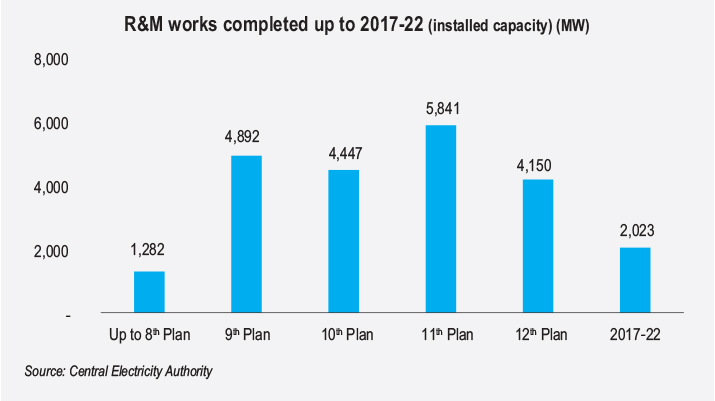
Power plant developers face numerous challenges when embarking on RMU&LE projects. A critical issue is the absence of robust policies and guidelines, often resulting in utilities neglecting these activities. Consequently, inadequate emphasis on detailed project planning by utilities leads to complications in the bidding stage and delays in R&M initiatives. Utilities frequently opt for fragmented interventions rather than comprehensive R&M efforts. Typically, the rehabilitation of an HEP occurs towards the end of its operational life of around 30-35 years. However, due to factors such as silt erosion in regions such as the Himalayas causing forced outages, experts suggest initiating R&M projects much earlier.
Furthermore, the shortage of experienced contractors and consulting firms poses a significant barrier to effective project execution.
Conclusion
With the increasing large-scale integration of renewable energy sources, hydropower is poised to play a crucial role in balancing the grid due to its unique capabilities for fast ramping and black start. Successful R&M implementation hinges on effective project management, meticulous planning, DPR preparation and adequate financial backing. Further, continued investment in R&M is vital to ensure the long-term efficiency and sustainability of India’s hydropower sector. Ongoing research and development in advanced materials, digital control systems and silt management solutions are pivotal for further optimising HEP performance.
Aastha Sharma