
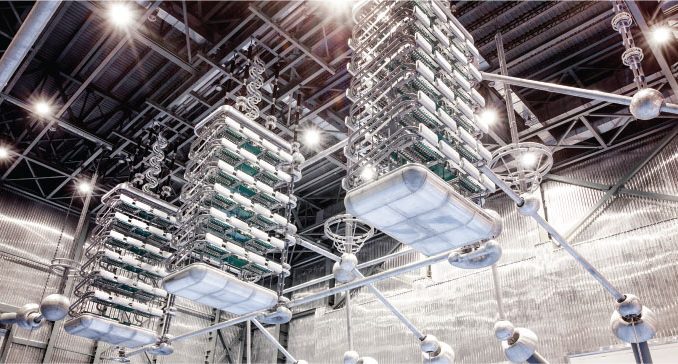
The uptake of high voltage direct current (HVDC) technology in India’s power transmission segment has been quite progressive. Since the 1990s, HVDC has played a pivotal role in the development of India’s national grid, evolving from a zonal division into a unified synchronous grid. HVDC technology enables long-distance power transmission with minimal losses, making it ideal for bulk power transfer and the integration of high-quality power and renewables into regional and national grids. Modern HVDC systems in India are now incorporating advanced control and protection systems, enhancing grid controllability and flexibility. These well-established systems are essential for managing the dynamic changes associated with renewable power sources, ensuring robust and reliable grid operations.
Benefits of HVDC for India’s power sector
Efficient long-distance transmission: HVDC is highly efficient for transmitting large amounts of power over long distances with lower losses compared to AC transmission. It is also ideal for special purpose applications like grid interconnections and renewable power integration. HVDC enables the secure and stable interconnection of power networks that operate on different voltages and frequencies (asynchronous) or are otherwise incompatible. HVDC also provides instant and precise control of power flow and can increase AC grid capacity and resilience through its stabilising features.
Grid stability: HVDC provides enhanced stability, which is crucial for integrating renewable energy
sources and managing dynamic grid conditions.
Flexible power management: HVDC allows for flexible power management and interconnections between regional grids, improving the overall reliability of the national grid.
 Two technologies for different applications: The two HVDC technologies — line-commutated converters technology and voltage sourced converter technology — are suited for different applications. LCC technology offers high transmission capacity and is suitable for traditional bulk transmission and ultra-high-voltage DC (UHVDC) systems. Meanwhile, VSC technology offers greater controllability and flexibility, making it ideal for integrating large-scale renewables and managing more complex grid interconnections. While LCC technology is available at power levels up to 12 GW and 1,100 kV, VSC technology is developed for power levels up to 3,6000 MW and ±640kV.
Reduced environmental footprint: HVDC enables power transmission over long distances, including underground and underwater routes.
Controllability: The digital control system is the brain of HVDC transmission systems. The modular advanced control enables high integration levels, managing all control and protection functions of the installation and supporting grid integration.
 Hitachi Energy’s offering in the HVDC segment
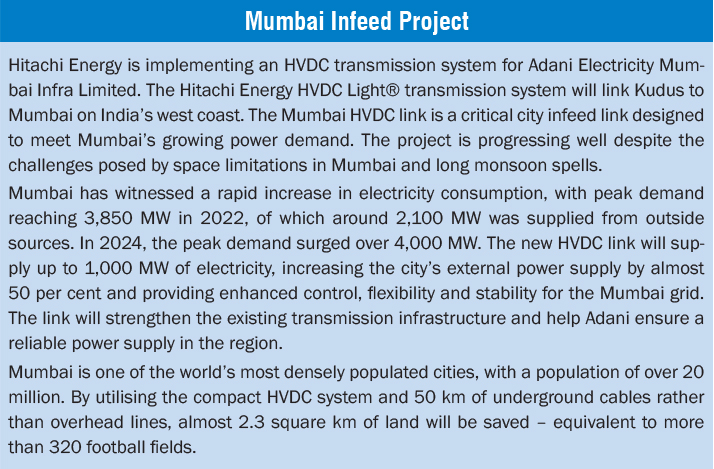
Hitachi Energy has been a key player in India’s HVDC segment since the late 1980s, beginning with back-to-back and transmission projects. The company has successfully executed six HVDC projects, with a seventh currently under execution. Its installed base exceeds 16,000 MW, representing over 50 per cent of India’s HVDC power transmission capacity. Its completed projects are the Raigarh-Pugalur UHVDC link (2019); the North-East Agra UHVDC link (2017); the Vizag II HVDC back-to-back link (2005); the Chandrapur-Padghe HVDC bipole (1999); the Rihand-Delhi HVDC bipolar transmission link (1990) and the Vindhyachal HVDC back-to-back trans mission link (1989) as well as the upgradation of control and protection system, valve cooling system and TCUs at Rihand-Delhi HVDC bipolar transmission link (2021). Additionally, Hitachi Energy is currently executing the Mumbai Infeed HVDC project (refer to the box for details).
Hitachi Energy’s capabilities in the segment include manufacturing key HVDC equipment such as transformers, capacitors, control and protection systems, and switchgear. It also offers comprehensive engineering, execution and service support through its local teams. Hitachi Energy offers a comprehensive suite of HVDC solutions, including new application development, to meet energy transition requirements. The company provides complete equipment from its factories in India, ensuring high-quality, reliable HVDC technology to support the country’s power sector.
Hitachi Energy’s HVDC and power quality factory in Chennai manufactures advanced power electronics for HVDC Light®, HVDC Classic and STATCOM, along with the MACH™ control and protection system. The factory caters to the rising number of high-voltage transmission projects in India and also exports to support global HVDC installations
Measures needed to promote the development of HVDC systems in India
To promote the successful integration and expansion of HVDC systems, several key measures need to be implemented. First, it is crucial to ensure that detailed future network models are available early in the project’s planning phase. By providing these models from the tender stage, stakeholders can significantly enhance the accuracy of system studies and reduce execution time, which is essential for maintaining grid stability. Additionally, a proactive design approach is necessary to anticipate and plan for evolving grid requirements. Considering future scenarios during the design phase, typically 5-10 years ahead, will enable HVDC systems to adapt effectively to changing grid conditions and requirements.
Developing a robust local supply chain is another critical measure. Investing in long-term planning and establishing local manufacturing and testing facilities for HVDC equipment will address the limited supplier base and support the growth of a strong local supply chain. Furthermore, optimising the transportation of heavy HVDC equipment is vital to overcome logistical challenges. Implementing optimised design models and streamlining permission processes will facilitate the efficient transport of equipment and help minimise project delays.
Finally, addressing the shortage of skilled professionals with expertise in HVDC technology is essential. Investing in comprehensive training and development programs will build a knowledgeable workforce capable of supporting the successful implementation and operation of HVDC systems. By adopting these measures, stakeholders can foster a more effective and efficient HVDC integration, advancing the power grid and meeting future energy demands.
Future outlook for HVDC in India
The continued advancement and adoption of HVDC systems will play a critical role in meeting the country’s energy needs and supporting its transition to a more sustainable and resilient power infrastructure. A key opportunity lies in the need for efficient bulk power transmission from remote generation sites to major load centres. As India continues to expand its power generation infrastructure, HVDC technology will be crucial for transporting large amounts of electricity over long distances with minimal losses. Additionally, the rising power demand in India’s large urban areas will require more city infeed projects. HVDC systems can address this demand by ensuring a stable and reliable supply of electricity to densely populated cities with increasing energy consumption.
The development of an interconnected DC grid also presents a significant opportunity for HVDC technology. Such a grid would enhance the integration of renewable energy sources into the national power grid, enabling more efficient distribution of clean energy across different regions. Furthermore, as India strengthens its power transfer agreements with neighbouring countries, the demand for HVDC interconnections will grow. These cross-border links will facilitate efficient power exchange and contribute to regional energy security and stability.


