India’s power sector is undergoing a transformation to meet growing electricity demands, facilitate renewable energy integration and modernise grid infrastructure. Supported by policy-driven initiatives, substantial investments and technological advancements, India is scaling up its transmission and distribution infrastructure in a big way. Substations and switchgear play a key role in the efficient, safe and reliable transmission and distribution of electricity across the country. The advancement of a robust electricity infrastructure is expected to be pivotal in strengthening India’s electricity system, ensuring reliable electricity and driving demand for substations and switchgear.
A look at the key trends, demand drivers and outlook for the substation and switchgear industry…
Overview
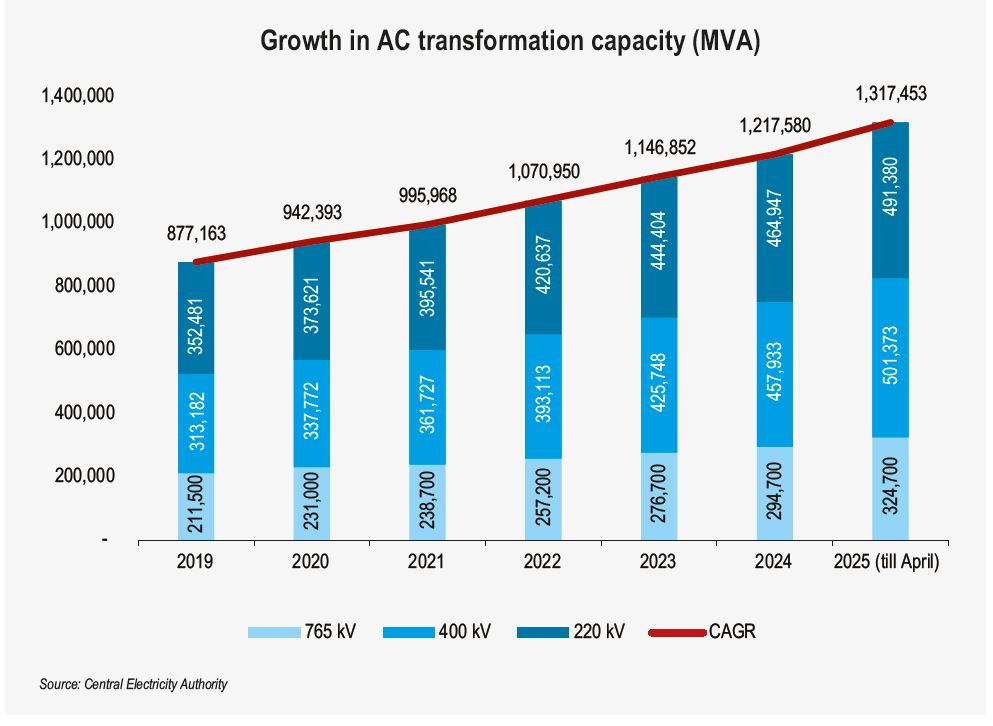
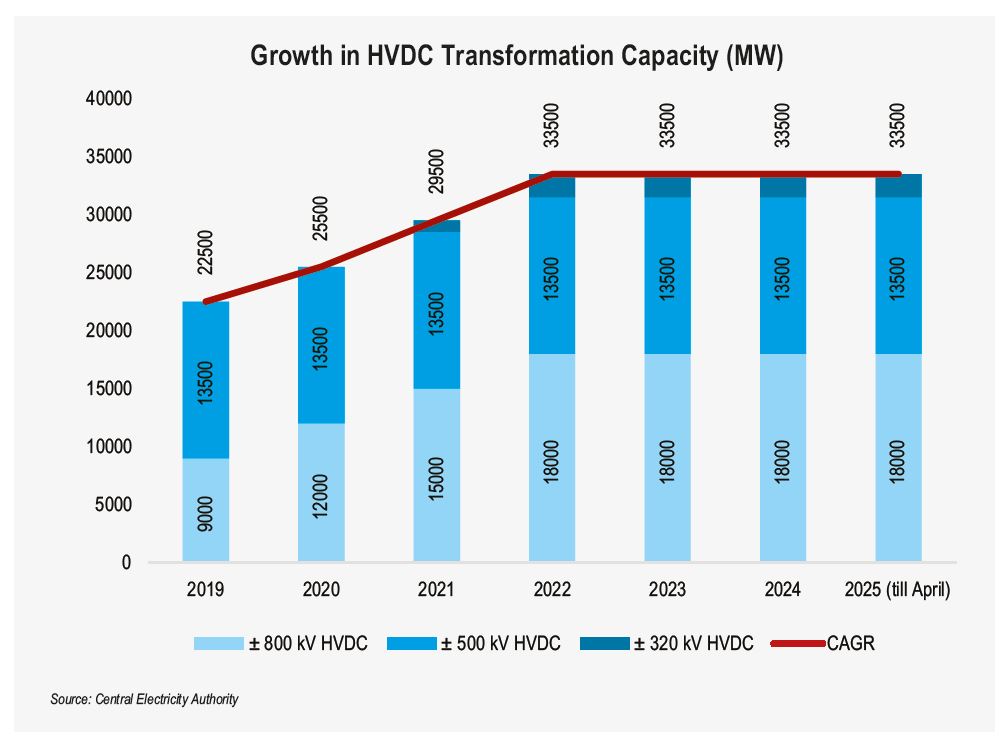
In India, high voltage direct current (HVDC) substation capacities range from ±320 kV to ±800 kV, while alternating current (AC) substation capacities range from 132 kV to 765 kV. In the distribution segment, voltages levels are 33 kV and below. As per the Central Electricity Authority (CEA), the AC substation capacity stood at 1,317 GVA at voltage levels above 220 kV as of April 2025. From 2019 to 2025, the AC substation capacity has grown at a compound annual growth rate (CAGR) of 5.98 per cent. Meanwhile, the HVDC substation capacity reached 33,500 MW, at a CAGR of 5.85 per cent.
Switchgear is classified based on voltage levels such as low voltage (LV), medium voltage (MV) and high voltage (HV) categories. LV switchgear, encompassing switchgear rated up to 1 kV, is used across distribution utilities, residential, commercial and industrial establishments, and other infrastructure projects. LV switchgear is deployed in low voltage applications, such as motor control systems and low voltage switchboard feeding systems. Its primary components are low voltage switches, molded case circuit breakers, micro circuit breakers, relays, isolators and other similar devices.
MV and HV switchgear are deployed to effectively control and transfer electricity between high-voltage transmission lines and lower-voltage distribution networks. The MV and HV segments cover voltage levels ranging from 6.6 kV to 1,200 kV, and are primarily deployed in substations. They serve as critical links between end users and transmission networks. MV and HV switchgear are further classified based on the insulating medium such as air-insulated switchgear (AIS), gas-insulated switchgear (GIS) and hybrid switchgear. They are essential for the safe, reliable and effective handling of high-voltage electricity in substations, large industrial facilities, renewable energy plants and critical infrastructure. In power systems, transmission and generating utilities often use MV and HV switchgear, which are frequently combined due to their similar applications.
Demand drivers
Increasing electricity demand
Electricity usage in the country is rising rapidly, driven by strong economic growth, urbanisation and industrial expansion. Factors such as prolonged summers, increasing economic activity, manufacturing expansion and emerging power-intensive applications such as data centres, electric cars and hydrogen have fuelled electricity demand. Moreover, the increasing use of home end-use appliances has emerged as a contributing factor. As per the CEA, the per capita electricity consumption in 2022-23 stood at 1,331 kWh, an increase of 6 per cent over the previous year. This is projected to increase to 1,700-1,800 kWh by 2031-2032. Hence, the expansion of transmission infrastructure to cater to rising electricity demand is expected to accelerate the growth of the substation and switchgear market in the coming years.
Transmission network expansion
India’s Intended Nationally Determined Contributions (INDCs) signal a big switch towards clean energy sources, with the target of achieving 500 GW of renewable energy generation capacity by 2030. Further, India has promised to reduce the emission intensity of its GDP by 45 per cent by 2030, compared to 2005 levels, as part of its commitment to climate action. These ambitious goals, along with the rapid addition of new energy generation capacity, are expected to transform the country’s electricity infrastructure.
In October 2024, the CEA announced the addition of several thousand circuit kilometres of new high-voltage lines and hundreds of new substations in its National Electricity Plan (Transmission). It highlighted the addition of 1,274 GVA (above 220 kV and above) and 33.2 GW (HVDC) of transformation capacity by 2031-32. The growing emphasis on renewable energy projects and the execution of the transmission plan are expected to drive the deployment of switchgear and substations to support renewable energy integration in the grid.
Interstate transmission system (ISTS) schemes aim to develop new transmission infrastructure (including substations) by connecting multiple areas and states, thereby allowing power generated in one area to be transferred to another. The projects are executed through tariff-based competitive bidding route. In a bid to enhance flexibility, efficiency and feasibility in transmission infrastructure development, the Ministry of Power, in April 2025, notified changes associated with the location of new substations under ISTS. The amendments to standard bidding documents now allow greater flexibility to greenfield substations, such as switching stations, HVDC terminals and inverter stations, in complying with specified radius limitations. For load-serving substations, the permissible location radius has been extended to 5 km, which was 3 km earlier. The amendments are likely to accelerate project execution and alleviate the problems faced by transmission developers in land acquisition. Overall, the amendments aim to provide flexibility, enhance efficiency and drive feasibility in transmission infrastructure development.
Green energy corridors
Government initiatives such as the green energy corridor, aimed at ensuring the efficient transmission of clean electricity from renewable energy projects, have driven the development of new substations and switchgear. The green energy corridor is being implemented in a phased manner in India. For instance, the Intra-State Transmission System Green Energy Corridor Phase II targets the deployment of 10,753 ckt km of intra-state transmission lines and 27,546 MVA of substations in seven Indian states – Gujarat, Himachal Pradesh, Karnataka, Kerala, Rajasthan, Tamil Nadu and Uttar Pradesh. This is expected to help facilitate 20 GW of clean energy in the states by March 2026. These green energy corridor projects will receive financial assistance of Rs 39.70 billion from the Ministry of New and Renewable Energy and Rs 80.60 billion from KfW, REC and PFC. Likewise, the Inter-State Green Energy Corridor Phase II aims to evacuate clean energy from 13 GW of renewable energy projects to ensure reliable power supply in Ladakh and its adjacent regions. The project includes the deployment of about 1,268 ckt km of transmission lines and two HVDC terminals of 5,000 MW each by 2029-30. The financial assistance of Rs 83.09 billion (about 40 per cent of project cost) is expected to support the development of the project.
Network strengthening under the RDSS
The Revamped Distribution Sector Scheme (RDSS) in India aims to strengthen the sub-transmission network, and enhance the reliability and quality of power supply. The construction of new substations and augmentation of existing substations under the RDSS across many states have significantly contributed to the growth of the switchgear and substation market. The loss reduction initiatives under RDSS, particularly for the deployment of substations, have made significant progress although further efforts are needed to ensure comprehensive implementation.
A total of 2,355 substations have been sanctioned under the scheme, with 66 per cent awarded and 23 per cent installed. Madhya Pradesh accounts for approximately 52 per cent of the progress made in total substation installations. For distribution transformer installations, 574,008 units have been sanctioned, with 84 per cent awarded and 17 per cent installed. Bihar has emerged as the largest contributor, accounting for approximately 42 per cent of the progress made in total substation installations. With a financial outlay of around Rs 3.03 trillion and gross budgetary support of Rs 976.31 billion from the central government for five years, up to 2026, the network strengthening initiatives under RDSS are expected to benefit the switchgear and substation market.
Technology trends
Technological innovation has play a central role in the development of substations and switchgear, enabling significant improvements in efficiency, functionality and performance. Utilities today are increasingly adopting compact equipment to address space constraints, and facilitate installation and commissioning. Digital technologies are gaining preference over traditional systems due to their enhanced troubleshooting capabilities, reduced downtime, greater security and improved control.
Hybrid and digital substations have gained popularity in the substation market. Hybrid substations are a technologically and economically viable option, ideal for sites with space constraints or where existing substations require upgrades or expansions. Hybrid substations combine the benefits of air- and gas-insulated technology for small, dependable and flexible power networks. Many hybrid substations employ factory-assembled modules to speed up installation, save construction time and enhance quality.
Digital substations are advanced electrical substations that use automation, digital transmission technologies and intelligent electronic devices to make safer power systems. Data related to protection, control and monitoring of the primary processes is digitised immediately after measurement. The digital substation has many benefits, including reduced wiring costs, improved safety, space savings, interoperability and lower cybersecurity risks.
Substations that are mobile and containerissed are also increasingly gaining traction. They are instant substitutes for conventional substations. These substations are mounted on vehicles or trailers, and can be deployed immediately to restore power in emergencies or calamities.
In the switchgear market, intelligent switchgear, equipped with sensors and microprocessors, enables improved diagnostics, planned repairs and energy savings. Meanwhile, hybrid GIS switchgear combines various insulating methods, such as AIS, GIS and solid-insulated sections or compartments, into a single unit. These systems have fewer components than air-insulated systems, reducing the risk of failure due to environmental conditions. Meanwhile, vacuum switchgear is gaining attention for high voltage applications due to its non-reliance on greenhouse gases, making it an environmentally friendly alternative. It performs reliably in pollution, high humidity and extreme
temperatures.
 Challenges and the way forward
For substations and switchgear, handling high voltages, large currents and complex electrical equipment poses safety issues. Switchgear and substation fires can originate from electrical failures, overheating, or explosions. These flames may spread quickly, inflicting considerable damage and endangering personnel. Substation and switchgear failures can disrupt power delivery, threatening vital infrastructure and public safety. Hence, regular maintenance, monitoring, inspections and troubleshooting becomes crucial. The CEA’s Measures relating to Safety and Electric Supply Regulations, 2023, outlines guidelines on general conditions, clearances, safety requirements, handling and placement for safe and secure operation of electrical equipment such as substations and switchgear, across the entire power sector value chain in India.
Inefficient designs of substations and switchgear can lead to higher energy consumption and greater end-of-life waste. It also poses environmental and operational risks. Poorly engineered substations can leak hazardous compounds, such as SF2 or transformer oil, polluting land and groundwater. Traditional switchgear and substations use a lot of steel, copper and concrete, increasing their environmental impact. In recent years, sustainability has become an integral part of substation and switchgear design. The focus is now on design optimisation, reduction in material use, and adoption of recycled and eco-friendly materials.
Overall, the demand for switchgear and substations is increasing, driven by rising power consumption, renewable integration and grid modernisation . Going forward, the segment is poised for robust growth, supported by a strong pipeline of transmission projects and distribution network upgrades under the RDSS. Furthermore, technological advancements such as digitalisation and automation are expected to play a key role in shaping the future of the sector.