Controlling emissions in coal-based thermal power plants (TPPs) is essential for a successful energy transition. While renewable energy sources are expanding rapidly, coal-based plants are expected to remain crucial for grid stability in the near future, providing reliable power until energy storage solutions become widely accessible and affordable. Therefore, it is imperative that these plants minimise their environmental impact as they continue operating until eventual retirement. As the electricity demand grows alongside stringent environmental standards, the need for continuous advancements in pollution control technologies and environmental management systems becomes increasingly important.
Emission norms
On December 7, 2015, the Ministry of Environment, Forest and Climate Change (MoEFCC) introduced stricter environmental standards for coal-based TPPs under the Environment (Protection) Act, 1986.
The TPPs installed up to December 31, 2016 are required to cap their sulphur dioxide (SO2) at 600 mg per Nm3 for units less than 500 MW and 200 mg per Nm3 for units of 500 MW and above capacity.For units installed from January 1, 2017 onwards, the limit has been set at 100 mg per Nm3.
In September 2022, the MoEFCC extended the deadlines for TPPs to implement sulphur oxide (SOx) reduction equipment by two years up to December 2026, based on the location of the TPP. Category A (within 10 km of Delhi-NCR and cities with over 1 million population) has an extended deadline of December 31, 2024. Category B (within 10 km of critically polluted areas or non-attainment cities) has a new deadline of December 31, 2025, and Category C has until December 31, 2026.
With regard to nitrogen oxides (NOx) norms, power plants commissioned between 2003 and 2016 were initially required to cap their NOx emissions at 300 mg per Nm3. This has now been raised to 450 mg per Nm3. For plants commissioned from 2017 onwards, the limit for NOx emissions has been set at 100 mg per Nm3. For older plants commissioned prior to December 2003, the NOx limit has been set at 600 mg per Nm3.
The particulate matter (PM) emission standards in the revised norms are also based on the installation dates of the plants. A limit of 100 mg per Nm3 has been set for plants commissioned till December 31, 2003. For plants commissioned between January 1, 2004 and December 31, 2016 the limit is 50 mg per Nm3, and for plants commissioned from January 1, 2017 onwards, it is 30 mg per Nm3.
 Progress in emission reduction
SOx reduction
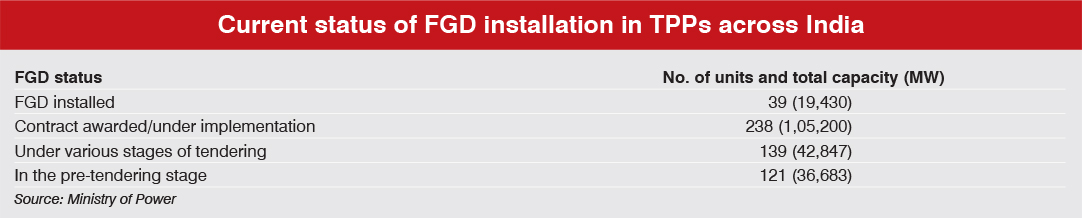
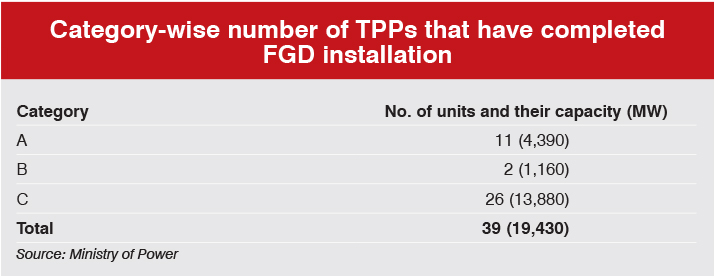
According to the Ministry of Power (MoP), flue gas desulphurisation (FGD) for SOx control is being installed in 537 units across coal-based TPPs as of August 2024. So far, FGD systems have been commissioned in 39 units with a capacity of 19,430 MW. The contracts have been awarded for 238 units with a cumulative capacity of 105,200 MW. Further, 139 units are in the tendering process with a capacity of 42,847 MW.
In India, dry sorbent injection technology is preferred for small unit sizes (60-250 MW) and units operating with low plant load factor and limited remaining operating life. Ammonia-based FGD is suitable for units below 250 MW. Limestone-based FGD is the most versatile and prominent FGD technology option, offering the highest efficiency. Meanwhile, seawater-based FGD is limited to coastal TPPs that use condenser cooling circuits.
Nox reduction
NOx are the primary pollutants emitted by gas turbines, influenced by fuel type and firing temperature. Modifying combustion parameters, such as fuel staging and burner tilt, can lower NOx formation by reducing peak flame temperatures. Combined cycle power plants typically emit less NOx than coal-fired plants, and techniques like overfire air and steam injection further reduce NOX emissions. In addition, plant operators are increasingly installing selective catalytic reduction and selective non-catalytic reduction to meet regulatory guidelines.
According to the Central Electricity Authority (CEA), 62 units (21,339 MW) have completed combustion modification, seven units (750 MW) have planned combustion modification by December 2024 and six units (1,400 MW) have started feasibility studies. At NTPC Limited, specifically, combustion modifications have been completed in 50 units, aggregating around 21 GW, including units located in NCR – two units at Dadri and three units at Jhajjar. Overfire dampers have been installed, allowing precise regulation of the flow and direction of the secondary air injected into the furnace by the overfire air system.
 PM control
Fly ash, a by-product of coal combustion, constitutes a significant portion of PM (about 26 per cent of PM10 and PM2.5). As temperatures rise, fly ash can become airborne, and contaminate air and water due to its content of heavy metals and other harmful substances.
Electrostatic precipitators (ESPs) are widely used in TPPs to control PM emissions by electrically charging ash particles in the flue gas. ESPs are highly efficient, capturing over 99.99 per cent of particles ranging from 0.01 to 100 micrometers. As per the CEA, 57 units (19,794 MW) have upgraded their ESPs, 12 units (1,690 MW) have ESP upgrades planned by December 2024 and six units (2,005 MW) expect PM compliance post FGD installation.
At NTPC, ESP retrofitting is completed for 40 units at over 13 GW of capacity, achieving over 99.8 per cent effectiveness in controlling PM emissions at all stations. Retrofitting for the remaining capacity is ongoing. Renovation and modernisation of ESPs has been completed for 14,220 MW of capacity, with additional reduction expected to be achieved through FGD installations.
Technologies for mitigating carbon emissions
Carbon capture and storage is a technique to reduce emissions by capturing carbon-dioxide (CO2) from power generation and securely storing it underground to prevent atmospheric release. The CO2 is typically captured from combustion flue gases before they can be emitted into the air. Once captured, the CO2 is transported through pipelines and injected into geological formations, where it is securely stored underground. NTPC has commissioned a pilot carbon capture project with a 20 tonnes per day a capacity at the Vindhyachal Thermal Power Station.
Biomass co-firing is a method used by TPPs to reduce emissions and diversify energy sources. It involves burning biomass, such as wood pellets and agricultural residues, alongside fossil fuels in existing boilers. While biomass combustion emits CO2, it is considered carbon-neutral since the CO2 released is offset by what plants absorb during growth. The MoP’s policy on biomass utilisation for power generation through co-firing in coal-based power plants mandates 5-7 per cent co-firing of biomass, primarily agro residue, with coal, after assessing its technical feasibility. As of June 2024, 0.81 million tonnes of cumulative biomass has been co-fired across India, resulting in a reduction of about 0.97 million tonnes of CO2 emissions from TPPs.
The adoption of ultra-supercritical/supercritical units over subcritical thermal units has further reduced emissions and increased energy efficiency. A total supercritical/ultra-supercritical capacity of 65,290 MW (94 units) and 4,240 MW (six units) has been commissioned as of June 30, 2024.
Digital technologies such as sensors, data analytics and machine learning enable real-time monitoring of key parameters such as pollutant levels, combustion efficiency and overall plant performance. This continuous monitoring allows TPPs to identify inefficiencies, optimise combustion and minimise emissions.
Issues and the way forward
Utilities have been facing significant challenges in deploying FGD systems due to a lack of concessional financing, high capital costs, space and infrastructure constraints and delays in tariff adjustments. The vendor capacity is limited, with current capabilities at 16-20 GW (33-39 units) per year, and about 20 per cent of FGD components need to be imported. Design challenges further complicate installation, as site-specific requirements prevent standardisation. Compliance deadline revisions have compounded these delays, impacting vendors and suppliers.
To mitigate air pollution effectively, a clear policy framework with defined timelines, ongoing research and open dialogue are essential. Continuous technological innovation is needed to improve efficiency, reduce water usage and enhance by-product utilisation. Original equipment manufacturers must deliver cost-effective, customisable systems that meet emission norms while ensuring high-quality components and robust after-sales support. The focus should gradually shift from clean energy to green energy.
Aastha Sharma