Among water-intensive industries, the thermal power sector, with a share of 87.7 per cent, stands out as the single largest consumer, with far-reaching implications for both resource security and electricity generation. As a result, thermal power plants (TPPs) that are located in water-stressed regions face risks during operation and often face complete shutdowns during an acute shortage. According to the World Resources Institute (WRI), India had lost about 14 TW hours of thermal power generation due to water shortages in 2016. As India’s economy grows further, we are likely to witness rising demand for water from agriculture, industry and urban centres. This underscores the need for a systematic approach to water management in TPPs such that there is an integration of technological innovation and best practices in operational performance.
Regulatory landscape
In December 2015, the Ministry of Environment, Forest and Climate Change (MoEFCC) first issued specific water consumption (SWC) norms for TPPs, with the mission to curb freshwater use in the sector. As per these rules, plants that were commissioned before January 1, 2017 were required to limit SWC to 3.5 cubic metres per MWh by December 2017. New plants installed after January 1, 2017 faced a tighter limit of 2.5 cubic metres per MWh and were mandated to achieve zero liquid discharge (ZLD). In 2018, the ministry revised these standards and increased the limit for post 2017 plants to 3 cubic metres per MWh, while keeping the ZLD requirement.
In January 2025, the MoEFCC streamlined the environmental consent process by replacing multiple parallel applications with a common consent mechanism, covering “consent to establish”, “consent to operate” and “hazardous waste authorisation” under the air and water acts. For TPPs, the changes are expected to tighten compliance oversight through integrated reporting and higher compliance costs. This shift could potentially enable faster adoption of water-efficient technologies.
 Current consumption patterns
Water use in TPPs is driven primarily by the requirements of cooling systems, ash handling and steam generation. It also encompasses a range of auxiliary processes such as coal handling, firefighting and cleaning. Of these, cooling systems account for the largest share, particularly in coal-based stations, where circulating water is needed to condense the steam exiting the turbine. Plants also use once-through cooling to withdraw a large amount of water, much more than those with closed-cycle systems, in order to reduce evaporative losses. Steam generation also requires high-purity demineralised water in water treatment and conditioning systems. Furthermore, auxiliary uses are in smaller proportion and include service water for equipment washing, potable water for plant personnel and firefighting reserves.
Technological measures for water efficiency
In order to improve water efficiency in TPPs, the process requires a combination of process optimisation, technology upgrades, and systematic reuse and recycling. Cooling system optimisation offers the highest savings potential due to its dominant share in overall consumption. Plants have achieved notable reductions in water consumption by increasing their cycles of concentration (COC) in cooling towers, which allows water to be recirculated more times before blowdown.
Replacing conventional wet slurry disposal with high-concentration slurry disposal or fully dry systems helps reduce water use, while improving operational efficiency. In the short term, recirculation of water in ash handling systems can also save up to 70 per cent in ash-related water use. Wastewater treatment and reuse are central to meeting ZLD requirements. Modern plants employ a mix of sewage treatment plants, effluent treatment plants and specialised systems for flue gas desulphurisation (FGD) wastewater. The best practices for FGD wastewater management include controlling impurities at source through coal quality monitoring, optimising operational parameters to prevent overloading filtration systems and introducing advanced treatment processes such as forward osmosis to handle high-chloride effluents. One of the key technologies for reducing freshwater use is the air-cooled condenser (ACC), which replaces water with air for condensing exhaust steam. Although ACCs involve higher capital costs and slightly lower efficiency in hot climates, they can reduce cooling water requirements more when compared to conventional wet cooling. In India, the adoption has been limited but recent projects such as NTPC’s North Karanpura supercritical plant have demonstrated the feasibility of large-scale deployment. Additionally, the ash water recirculation system (AWRS) is designed to reuse decanted ash water and toe drain water collected from the ash pond. This recovered water is then pumped back to the plant in a closed-loop cycle, where it is utilised for ash slurry preparation. By recycling ash pond water in this way, AWRS significantly reduces freshwater withdrawal for ash handling.
Digital solutions are also being deployed to track and optimise water use in real time. Supervisory control and data acquisition systems, combined with AI and machine learning analytics, help detect early leak detection and enable predictive maintenance of water systems.
Monitoring water consumption
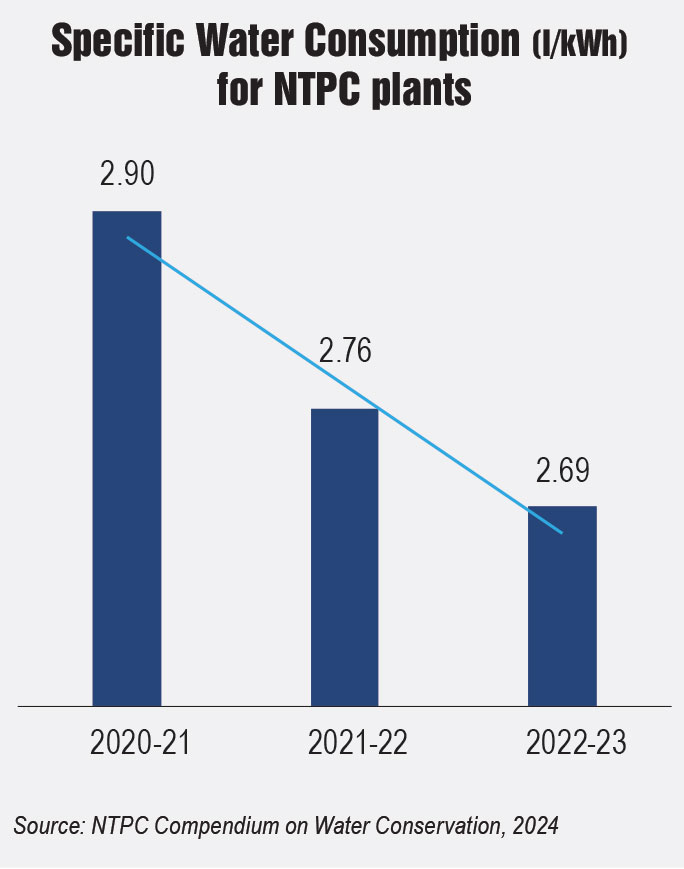
Several utilities have begun adopting on-ground measures to monitor and reduce freshwater use in their operations, with a focus on recycling and reuse of wastewater. For instance, NTPC Limited has undertaken several initiatives to strengthen water efficiency across its plants. At its Rihand plant, water-cooled couplings in the coal handling plant were replaced with air-cooled alternatives, resulting in estimated savings of 15.3 cubic metres per hour. The plant has also optimised jetting nozzles in bottom ash handling and diverted treated sewage water for horticultural use. At the Mouda plant, a ZLD system has been implemented, with complete reuse of STP-treated water for greenery development.
Challenges and bottlenecks
While the technical potential for water savings in TPPs is substantial, implementation faces several persistent challenges. It is still expensive to fit older units with advanced systems such as dry cooling or ZLD and in many cases, even technically complex. In addition, the economics of large-scale upgrades are unfavourable when plants are nearing the end of their design life, which makes them less efficient systems. Even when capital is available, operational risks can be slow to adopt. Increasing the COC in cooling towers raises the risk of scaling, corrosion and biological fouling. Additionally, there are data related issues that compound these operational challenges. Furthermore, the Centre for Science and Environment’s report, “Water Inefficient Power Implementing Norms and Zero Discharge in India’s Coal Power Fleet”, highlights that many thermal units under-report water consumption by omitting cooling or ash-handling volumes from official figures. There is no widely accepted standard in India for defining or reporting water withdrawal versus water consumption in the power sector. In the absence of clear, mandatory reporting guidelines, benchmarking will be inconsistent and progress difficult to track. Finally, enforcement capacity varies significantly among different states. While some integrate specific water consumption limits into environmental clearance and consent conditions, others rely on periodic self-reporting by operators, which can lead to underreporting or data gaps.
Outlook and the way forward
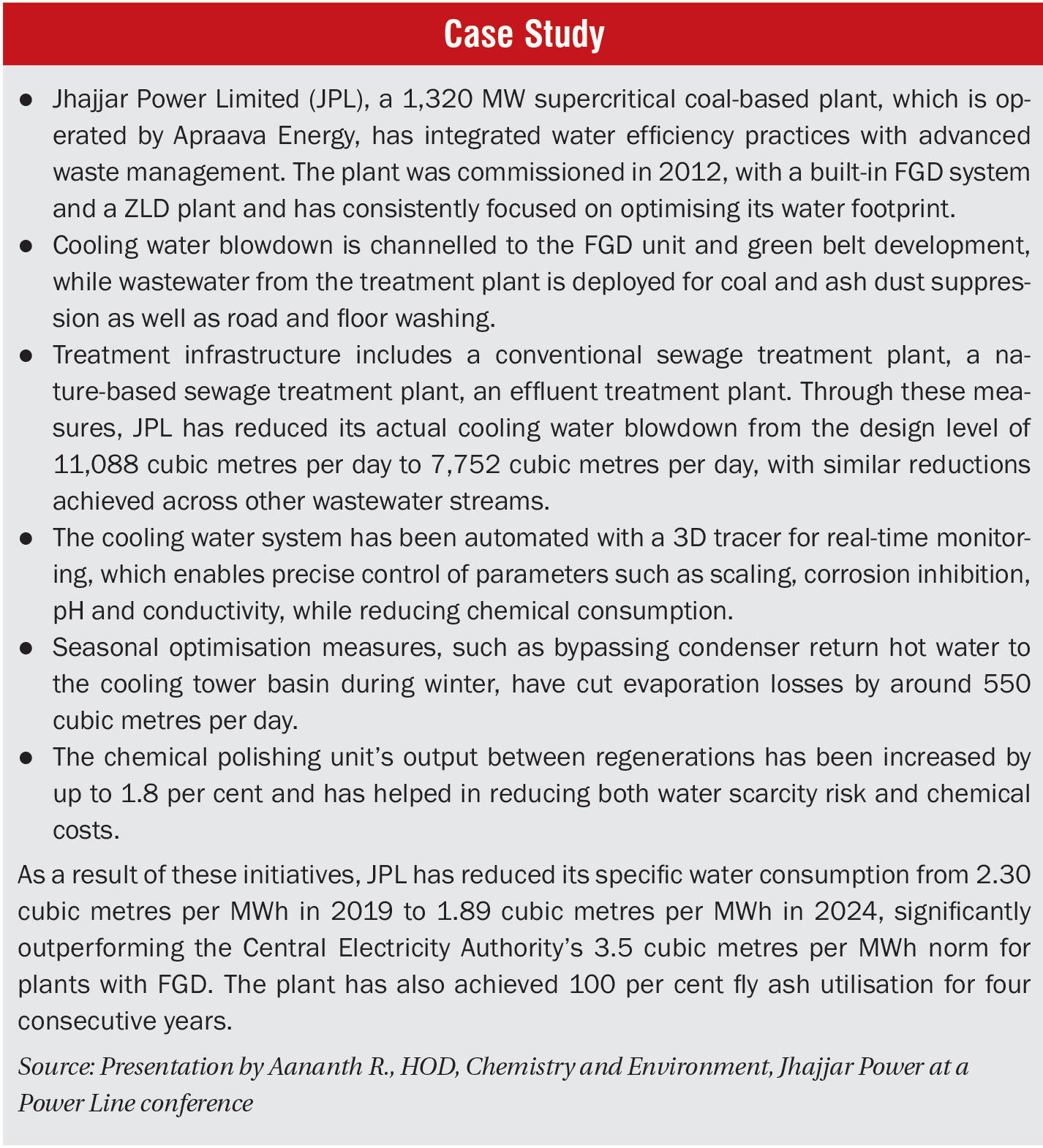
According to TERI’s (The Energy and Resources Institute’s), report titled “Enhancing water-use efficiency of thermal power plants in India” highlights the need for mandatory water audits, specific water consumption across Indian thermal plants ranges from 1.9 cubic metres per MWh to 6.5 cubic metres per MWh, which is driven by cooling system design, ash handling methods and operating practices. In the short term, TERI recommends recirculating about 70 per cent of the ash water, raising COC in cooling systems to six, and implementing aggressive reuse and recycling toward zero discharge. These interventions can save approximately 10 million cubic metres of water annually and generate around Rs 3 billion per year in monetary benefits.