
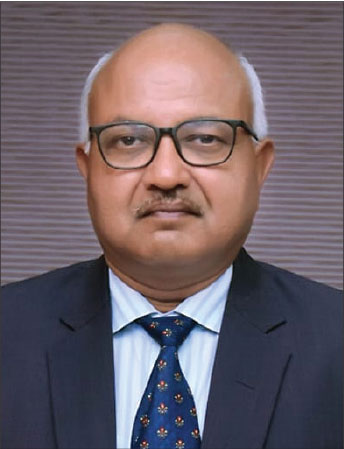
In a recent interview with Power Line magazine, Sanjiv Kumar Katiyar, managing director, Chhattisgarh State Power Generation Company Limited (CSPGCL), spoke about the current state of the power sector in Chhattisgarh as well as CSPGCL’s key operational and financial highlights, upcoming projects, future plans and targets, and top priorities going forward. Edited excerpts…
What is your perspective on the current state of the power sector in Chhattisgarh?
The power generation sector is undergoing a transformative phase. The latest trends indicate a pronounced shift towards renewable energy sources. As we witness the global push for sustainability and decarbonisation, our industry is aligning with these imperatives. We see a growing emphasis on solar, wind, biomass and the emerging potential of green energy. India is committed to achieving 100 per cent renewable energy by 2070. These renewable sources are not just alternatives – they are becoming central to our energy strategies. The same is true for Chhattisgarh, and by 2047 half of the total energy requirement of the state will be met through renewable energy. In Chhattisgarh, the potential of wind energy is negligible, hence more emphasis is on solar and hydro (mainly pumped storage).
Please give us an overview of CSPGCL’s existing capacity and operations.
CSPGCL is currently operating generating plants with 2,978 MW of capacity (coal: 2,940 MW, hydro: 138 MW). Its thermal units consist of :
Thermal stations
- 4×210 MW Hasdeo Thermal Power Station (TPS) (1983-86) + 1×500 MW Korba West TPS Extension (2013)
- 2×250 MW Dr Shyama Prasad Mukherjee TPS, Korba East (2006-07)
- 2×500 MW Atal Bihari Vajpayee TPS, Marwa (2016)
Hydropower stations
- 3×40 MW Hasdeo Bango Hydropower Station (HPS) (1994-95)
- 4×2.5MW Gangrel HPS (2004-05)
- 2×3.5 MW Sikasher HPS (2006)
- 2×850 KW Mini Micro HPS Korba West (2003, 2009) (On return line of cooling water outlet)
Moreover, CSPGCL has been allotted a coal mine, Gare Palma III, in Raigarh district. It has an annual production capacity of 5 million tonnes of coal, dedicated to the 2×500 MW AVB TPS, Marwa, which has been in operation since 2018.
 What have been the key operational highlights of CSPGCL in the past one year or so?
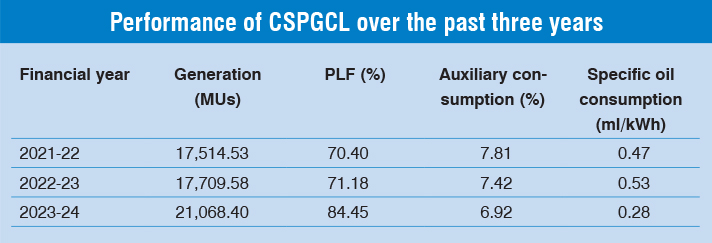
CSPGCL has always emphasised efficient power generation at a reasonable price. Through effective maintenance planning, spare part management and timely completion of the annual overhauling of units, our efficiency has been enhanced, resulting in a better plant load factor (PLF), considerable savings with respect to secondary oil consumption and a reduction in auxiliary power consumption.
During 2023-24:
- We achieved a PLF of 84.45 per cent – the highest among all Indian states, as per a report published by the Central Electricity Authority.
- The DSPM TPS (2×250 MW) achieved a PLF of 92.73 per cent and secured the third position among all central, state and private sector power stations.
- Our specific oil consumption was 0.285 ml per kWh, which was our lowest ever.
- Our auxiliary consumption was 6.92 per cent.
- The Gare Palma III coal mine was awarded with four first prizes by the director general of mine safety in 2023.
How has CSPGCL performed financially?
The annual turnover of CSPGCL in 2023-24 was Rs 75 billion and profit before tax was Rs 8.81 billion – the highest so far.
What have been the noteworthy initiatives of CSPGCL in the areas of emission control, fly ash management, etc.?
CSPGCL is very concerned about environmental compliance. Our emission is within the norms prescribed by the Ministry of Environment/National Green Tribunal. To further reduce emissions, various steps such as the installation of flue gas desulphurisation and modified coal burners, and the use of coal additives for better combustion are
being implemented.
With respect to fly ash management, CSPGCL is committed to achieving 100 per cent ash utilisation. Currently, ash is being utilised at the NHAI, cement plants and abandoned mines, as well as for the filling of low-lying areas, manufacturing of bricks.
CSPGCL has undertaken considerable plantation to build a sustainable environment. We have carried out plantation through Chhattisgarh Rajya Van Vikas Nigam, along with fencing and caretaking for a further three to five years, with a survival rate of 90 per cent. Our effluent water is treated at effluent treatment plants and our sewage water is treated in sewage treatment plants, both at the township and the plants.
What are the key issues and challenges being faced by CSPGCL? How are these being addressed?
Despite the promising trends, our industry faces several challenges. Reducing carbon emissions remains a primary concern. Integrating renewable energy with our existing grids requires advanced technologies and innovative solutions, in order to maintain grid stability. Mor over, the transition to sustainable energy sources calls for significant investments and policy support.
Solar: Ensuring the availability of power from 4-5 p.m. in the evening to 9 a.m. in the morning is a key challenge, requiring storage of green energy. However, battery storage has limitations in terms of cost advantages and dependability of imported material.
Flexi operation of thermal power generation units: Flexi operation requires changes in design and operational practices to achieve required the ramp rate for grid stability when power is being derived from renewable sources.
Hydrogen: Hydrogen entails a high cost (currently Rs 300-400 per kg), more energy than other sources and a large quantity of water. There are also issues with importing material required for the electrolysis process, storage and transportation.
Pumped storage hydro: Pumped storage projects have a long gestation period (six to seven years) and are dependent on imported technology.
What are CSPGCL’s future plans? What is the planned capex for the next three to four years?
In order to meet the future energy demand, CSPGCL has planned an energy mix with thermal, pumped storage hydro and solar power to harness
sustainable energy sources. Our future projects include:
- 2×660 MW Super Critical Thermal Power Project at Korba West, for which bids have been invited. The estimated cost is Rs 129.15 billion.
- 2. 1×660 MW Super Critical Thermal Power Extension Unit at AVBTPS, Marwa. Detailed project report (DPR) preparation is in the final stage.
- DPR has been prepared for the installation of a 30 MW solar power project on an abandoned ash dyke.
- Five pumped storage projects a gregating 7,300 MW of capacity have been identified and are being developed. These are:
-
- 800 MW Hasdeo Bango pumped storage project in Korba district Terms of reference have been received and DPR preparation is in progress.
- 1,200 MW Sikasar pumped storage project in Gariaband district. NTPC has shown interest in developing this through a joint venture.
- 2,100 MW Rouni pumped storage project in Jashpur district. THDC has shown interest in developing this through a joint venture.
- 1,400 MW Dangari pumped storage project in Jashpur district. THDC has shown interest in developing this through a joint venture.
- 1,800 MW Kothpali pumped storage project in Balrampur district. SJVN has shown interest in developing this through a joint venture.
 What is your outlook for Chhattisgarh’s power sector in the near to medium term?
Chhattisgarh is rich in minerals. Coal, iron ore and other minerals are found here in considerable quantities. Hence, coal-based TPSs (operated by state gencos, NTPC and private producers) are major contributors of energy. However, considering the paradigm shift towards renewable energy, there has been a thrust towards the development of solar energy, floating solar and pumped storage HPSs. The share of renewable energy in the state’s total energy consumption shall be enhanced to 50 per cent by 2046 47 and 100 per cent by 2070.
Improving the efficiency and reliability of power generation is a continuous endeavour. Upgrading our existing infrastructure and investing in new, more efficient technologies are essential. These steps are critical to ensure that we can meet the growing electricity demand while maintaining high standards of reliability and sustainability.