
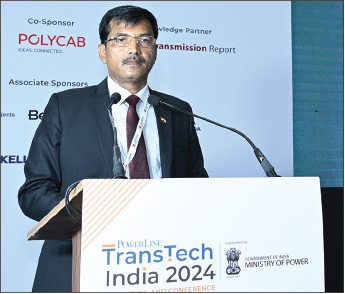
 R.K. Tyagi, Chairman and Managing Director, Power Grid Corporation of India Limited, delivered the inaugural address at the Power Line TransTech India 2024 Conference and Exhibition. He highlighted the need for expanding and strengthening the transmission network, the key issues and challenges facing the sector, and the way forward. Edited excerpts from his address…
The global shift towards cleaner energy is being driven by the urgent need to combat climate change. There is a growing focus on reducing carbon emissions and transitioning towards more sustainable and environment-friendly energy sources. India, being rich in renewable energy resources, especially solar and wind, has the potential to achieve energy security through renewable energy development.
The country is already making significant progress in this direction with renewable energy capacity surpassing 200 GW, and is on track to reach 500 GW by 2030. However, to manage the variability of renewable energy, it is essential to integrate diverse renewable energy sources across regions.
Network growth projections
With the increasing integration of renewable energy into the grid, the need for robust transmission infrastructure that is capable of handling the intermittent and variable nature of these energy sources has become paramount.
Under the new National Electricity Plan, the transmission network is projected to grow from 485,000 ckt km in 2024 to 650,000 ckt km by 2032. Transformation capacity is also expected to increase from 1.25 million MVA to 2.34 million MVA. Nine new high voltage direct current (HVDC) lines with a combined capacity of 33.25 GW are expected to be added to the existing 33.5 GW HVDC network. The interregional transfer capacity will increase from 119 GW to 168 GW, with the expansion costing approximately over $100 billion. This plan is essential for meeting the growing electricity demand and facilitating the integration of renewable energy and green hydrogen into the grid.
Key challenges in expanding transmission infrastructure
Laying transmission lines through difficult terrain such as deserts, forests and mountains while balancing environmental protection and local community concerns are major hurdles. The process of securing right of way often encounters public resistance, and clearances such as environmental and forest approvals take significant time, delaying projects and leading to cost overruns. Additionally, global supply chain disruptions due to the pandemic, geopolitical tensions and logistical bottlenecks have exposed vulnerabilities, particularly in sourcing high-tech components such as transformers, HVDC parts and semiconductor chips.
In view of the manpower-intensive nature of transmission projects, along with the growing number of projects in the pipeline, the need for engineering, procurement and construction contractors and skilled labour for tasks such as tower erection and stringing is growing rapidly.
In order to keep pace with the rising power demand, the ageing transmission infrastructure needs upgrading. Further, condition-based monitoring and predictive maintenance are needed to enhance grid reliability. Drones are revolutionising transmission line inspections, while artificial intelligence and machine learning are enabling predictive maintenance and real-time grid optimisation. Digital twins, real-time simulations and automated decision-making will further enhance grid reliability.
The way forward
The establishment of skill development centres by POWERGRID in West Bengal and Bihar has been a significant step towards addressing the shortage of technicians and fitters for transmission line construction. To further mitigate this challenge, it is essential for utilities to invest in training and capacity building throughout the value chain.
Supply chain strategies must be re-evaluated to secure materials and components for modern transmission systems, focusing on diversifying our sources and fostering regional partnerships to enhance resilience.
The energy transition is a monumental task, and the power transmission sector plays a pivotal role in this process. By embracing innovation and adapting to new technologies while building human capital and robust supply chains, and implementing effective regulatory frameworks, we can ensure sustainable progress. The journey ahead may be challenging, but the potential for a cleaner, more sustainable energy future makes it worthwhile.
Click to read the TransTech Special Section from the October issue.