
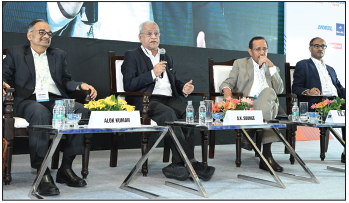
The panel discussion on “Transition to Clean Energy” brought together key sector leaders to discuss the critical role of a robust power transmission system in India’s renewable energy future. The panellists included Alok Kumar, Former Secretary, Ministry of Power; I.S. Jha, former Chief Managing Director (CMD), Powergrid, and Former Member, Central Electricity Regulatory Commission; S.K. Soonee, Former and Founder Chief Executive Officer (CEO), POSOCO (now Grid-India); and S.R. Narasimhan, Chairman and Managing Director, Grid Controller of India (Grid-India). The panellists emphasised the crucial role of a robust power transmission system in overcoming challenges in integrating renewables and supporting the country’s clean energy future.
State of the energy sector
India is steadily progressing towards its ambitious goal of becoming a net zero emitter by 2070. As part of this journey, the country has set a target of achieving 500 GW of non-fossil energy capacity by 2030. Grid-India has been instrumental in connecting regional grids, making regional transmission capability a critical element in supporting renewable energy growth. Considering India’s vast geographical area, it is crucial for transmission planning to grow significantly to cater to future needs. Currently, the country operates with nine planning scenarios, covering three seasons and three times of day, illustrating the complexity of India’s renewable energy integration. To meet its clean energy targets by 2030, the country needs to continue increasing its installed renewable energy capacity. The major renewable energy potential zones in India are located in states such as Rajasthan, Gujarat, Karnataka, Andhra Pradesh, Maharashtra, Tamil Nadu, Uttar Pradesh, Madhya Pradesh and the Leh region. A consensus that emerged during the discussion was that the transmission system will be the backbone of the clean
energy transition.
Challenges
While the transition to clean energy is gaining momentum, several challenges remain. The cost of high voltage direct current (HVDC) lines has risen nearly fourfold, raising questions about the financial feasibility of expanding transmission capacity and making affordability a significant concern. This requires finding cost-effective ways to augment capacity, such as optimally pricing transmission services, to ensure the success of the energy transition.
Although interstate infrastructure has developed well, intra-state systems still lag. To achieve the renewable energy capacity projections laid out by the Central Electricity Authority, more states must participate in tariff-based competitive bidding. Additionally, as transmission technology evolves, there is a need for greater flexibility, resilience and cost optimisation. This necessitates policy certainty and long-term planning to preserve the interests of investors and strengthen local manufacturing ecosystems.
Solutions and the path forward
A key focus is on building resilience to withstand extreme weather events, especially in coastal areas prone to cyclones. Strengthening concession agreements with clear responsibilities and enhancing cybersecurity measures are also crucial steps to secure the power sector. Advanced technologies, such as higher voltage levels and HVDC systems, will play a pivotal role in this transformation.
A key solution highlighted was optimising the existing transmission network through studies on locational marginal pricing, loss factors and congestion pricing. Improved infrastructure use will enhance efficiency and prepare the system for future growth.
The One Sun, One World, One Grid initiative aims to connect regional power grids globally, enabling the transfer of renewable energy such as solar and wind across borders. By enabling the sharing of surplus energy between regions, this initiative enhances renewable energy’s share in power supply and ensures smooth cross-border energy transfers.
Conclusion
The transition to clean energy requires a significant expansion and strengthening of India’s power transmission network. As the country moves towards its clean energy future, the power transmission system will serve as the backbone of this transition, ensuring sustained growth. By optimising the existing network and adopting coordinated planning, India is well positioned to achieve its ambitious clean energy targets.
Click to read the TransTech Special Section from the October issue.