
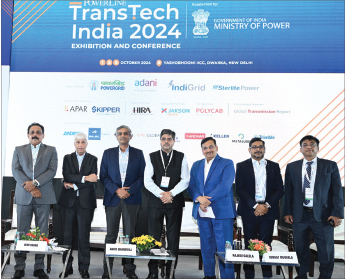
The session on “Engineering, Procurement and Construction (EPC) Perspective” featured a panel discussion among Ankit Bhardwaj, EVP and BD, Global Product and Services, Sterlite Power; Rajeev Dalela, President, Kalpataru Projects International; Venkat Muvvala, CEO Infra and EPC Business, Jakson Group; Jijo Sebastian, VP and head, T&D, Larsen & Toubro; Abhishek Sil, VP, Sales and Tendering, KEC International; and Manish Srivastava, Business Head, Transmission and Distribution, APAR. Edited excerpts…
The session underscored the fact that the power transmission sector is at the cusp of transformation, with significant investments expected in the coming decade. There is significant potential for EPC in the coming years, with transmission lines expected to grow by nearly 30 per cent, adding over 20,000 ckt km annually. Over the past five years, the pace of construction has been around 18,000 ckt km per year. There have been major advancements in the use of drones for surveys, which have significantly reduced the time needed for certain tasks, particularly in challenging areas such as
railway crossings.
However, the sector continues to face several challenges that hamper the expeditious development of transmission infrastructure, such as right-of-way (RoW) constraints, high employee attrition and skill gaps.
Key challenges
One of the biggest challenges facing the sector is the RoW issue. Timely RoW acquisition is critical to maintaining project timelines. Awarding projects through reverse auctions also presents a key challenge for the sector as it impacts the entire value chain. While reverse auction has led to significant tariff reductions, it has affected project quality and has put strain on the value chain. There are issues within the sector’s dispute resolution mechanisms, including identifying the primary causes of disputes as contract execution issues, delays in client obligations and
postponed compensation.
In addition, the industry is struggling with the conventional mode of operations and maintenance. There is an increasing demand for upskilling the workforce as well as addressing the manpower shortage in the sector. Another challenge is contractual disputes, which lead to delays in project execution and commissioning.
Possible solutions
In order to tackle issues in the sector, developers and operators are strengthening their capabilities by hiring and training staff, and leveraging advanced project management tools and analytics. Techniques such as drone surveys and digital assessments are being employed to enable faster decision-making and improve project delivery. There is a demand for on-the-job training to upskill workers.
While managing shutdowns is a key challenge, conducting timely surveys and identifying potential issues during pre-bid meetings helps minimise this problem. Apart from this, innovative technologies, including carbon composite cores for transmission lines, could reduce power losses by 30 per cent and double power transfer capacity at lower temperatures. Furthermore, technological advancements, such as the use of laser surveys, has reduced the time required to survey a 100 km line from 25-30 days to just five-six days.
Private companies such as L&T are playing their own part in addressing challenges. This involves mechanisation and the deployment of drone-based services. Initiatives such as improving worker safety will help lower the attrition rate and enhance productivity. To further address the skills issue and close the skill gap, companies can provide in-house classes and courses, and establish skill development centres.
Future outlook
The National Electricity Plan for transmission formulated by the Central Electricity Authority has set ambitious targets for the future. The objective of the plan is to increase the transmission capacity by 30 per cent over the next eight years. To achieve these goals, it is imperative to re-evaluate of the selection criteria for EPC players and contractors so as to attract top talent in the sector.
Despite all the challenges present in the sector, these are exciting times for EPC players, with ample opportunities for all players as the market expands. The increasing volume of projects will provide growth opportunities in the EPC sector over the next four to five years.
Click to read the TransTech Special Section from the October issue.