
A key government scheme overhauling the power distribution segment is the Revamped Distribution Sector Scheme (RDSS). With a sizeable outlay of Rs 3,037.58 billion over five years (2021-22 to 2025-26), including an estimated gross budgetary support (GBS) of Rs 976.31 billion, the scheme aims to provide result-linked financial assistance to discoms based on
specific pre-qualifying criteria and performance benchmarks.
The RDSS is focused on three main objectives: reducing aggregate technical and commercial (AT&C) losses to 12-15 per cent by 2024-25, eliminating the gap between the average cost of supply (ACS) and average revenue realised (ARR) by 2024-25, and improving the quality, reliability and affordability of power supply through a financially sustainable and operationally efficient distribution sector.
The scheme has made substantial progress so far, in terms of reducing AT&C losses to 15.4 per cent in FY2023 and narrowing the ACS-ARR gap to Re 0.45 per unit. Further, the pace of smart metering projects being implemented through the total expenditure model has accelerated over the past two to three years and is expected to remain strong as initial implementation-related hurdles have largely been overcome.
Progress so far
The scheme comprises two parts: Part A, which provides financial support for prepaid smart metering, system metering and distribution infrastructure upgrades, and Part B, which covers training, capacity building and other supporting activities. The goal of the RDSS is to install prepaid smart meters for approximately 250 million consumers, excluding agricultural users.
Smart metering progress
The RDSS has made steady progress in smart metering, with significant milestones achieved in consumer, distribution transformer (DT) and feeder metering. However, much work remains to reach the full scale of implementation.
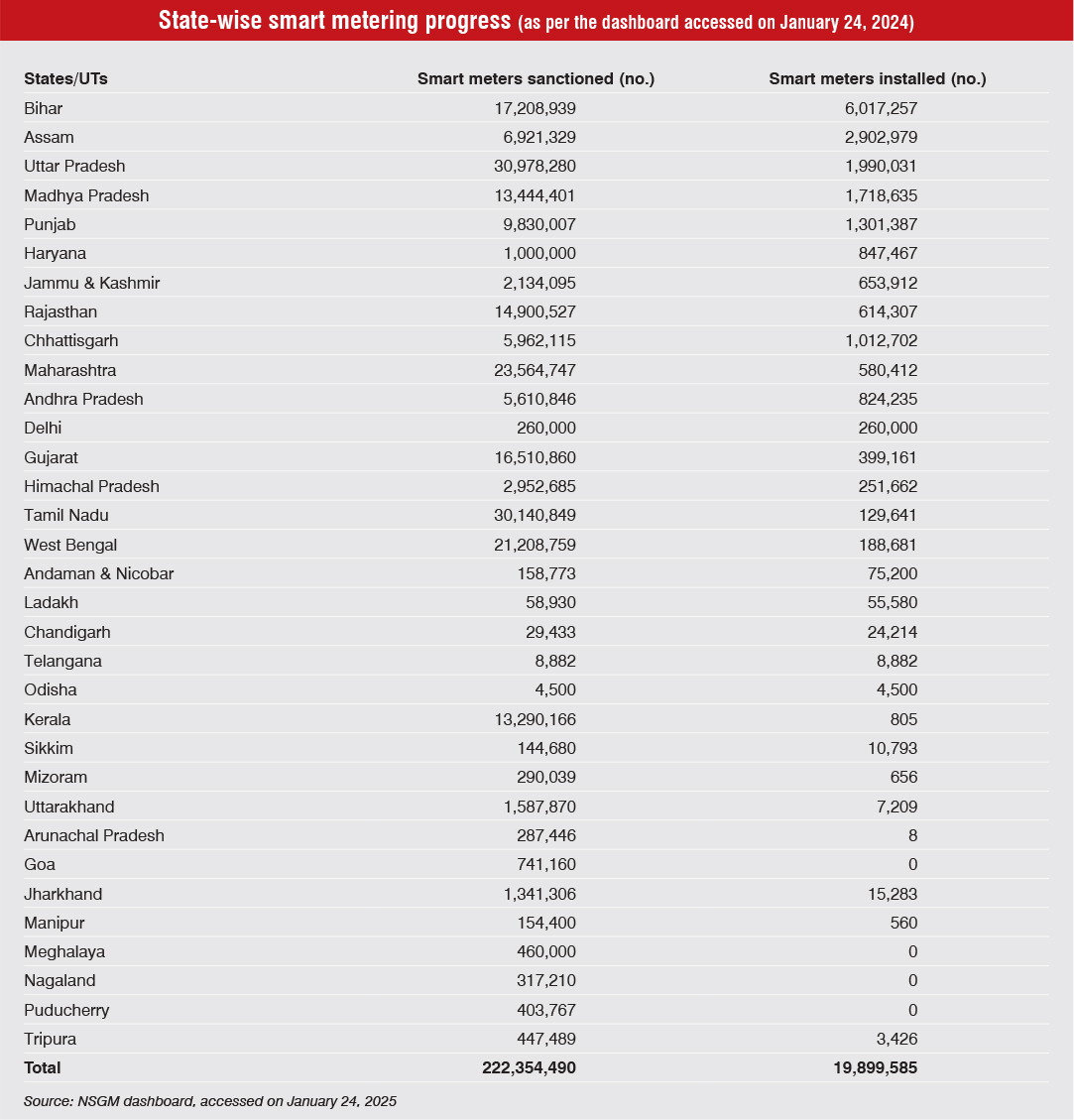
For consumer smart metering, a total of 222.35 million meters have been sanctioned, with 62 per cent (138.02 million meters) awarded and 9 per cent (19.9 million meters) installed. Six states account for 75 per cent of the installed meters, led by Bihar (30 per cent), Assam (15 per cent), Uttar Pradesh (10 per cent), Madhya Pradesh (9 per cent), Punjab (7 per cent) and Chhattisgarh (5 per cent).
In the case of DT metering, 5.3 million meters have been sanctioned, with 86 per cent (4.6 million meters) awarded and 7 per cent (356,335 meters) installed. Maharashtra, Bihar and Assam lead in this category, together accounting for approximately 58 per cent of the installed DT meters, showcasing their proactive approach towards implementation. Progress in feeder metering has also been notable. Of the 205,529 meters sanctioned, 80 per cent (165,026 meters) have been awarded, and 43 per cent (87,971 meters) installed. Maharashtra and Uttar Pradesh are the front runners in this area, jointly contributing about 55 per cent of the installed feeder meters.
On the financial side, gross budgetary support of Rs 240.15 billion has been sanctioned for smart metering projects, with Rs 4.06 billion (1.7 per cent) released to date.
While the progress in awarding contracts and initiating installations reflects significant strides, the current installation rates highlight the need for acceleration. The leadership of states such as Assam, Bihar, Maharashtra and Uttar Pradesh demonstrate the potential for scaling these efforts across other states to meet RDSS objectives effectively.
 Loss reduction update
The RDSS has made notable progress under its loss reduction initiatives, particularly in the installation of low tension (LT) lines, high tension (HT) lines and DTs, although significant work remains to be done to achieve full implementation.
For LT lines, a total of 1,042,000 ckt km has been sanctioned, with 87 per cent awarded and 22 per cent installed. Uttar Pradesh has emerged as the leader in this segment, contributing approximately 82 per cent of the progress made in LT line installations. In the case of HT lines, 836,000 ckt km has been sanctioned, with 77 per cent awarded and 10 per cent installed. Here again, Uttar Pradesh is the front runner, accounting for approximately 50 per cent of the progress in HT line implementation. For DT installations, 521,000 units have been sanctioned, with 90 per cent (469,000) awarded and 10 per cent (49,000) installed. Madhya Pradesh leads in this category, contributing around 65 per cent of the progress made in DT installations.
On the financial front, significant funding has been allocated to these initiatives. The Indian government has sanctioned a gross budgetary support of Rs 907 billion, of which 21 per cent (Rs 192 billion) has been released to support ongoing work.
Impact of the RDSS
The RDSS has had a significant impact on the financial and operational performance of discoms, driving improvements across key metrics.
The ACS-ARR gap (cash adjusted) has decreased from Re 0.85 per kWh in FY2021 to Re 0.45 per kWh in FY2023. However, the ACS-ARR gap in FY2023 stood at Rs 0.55 per kWh, up from Rs 0.33 per kWh in FY2022, primarily due to a steep increase in national power purchase costs driven by rising power demand and global geopolitical challenges. Additionally, subsidy disbursal saw a remarkable improvement, with over 100 per cent of booked subsidies disbursed in FY2022 and FY2023, compared to a shortfall in FY2021. Among the 24 states providing tariff subsidies, 21 states disbursed 100 per cent or more of the booked amounts, resulting in a national aggregate of 108 per cent of the booked subsidy being disbursed during FY2023.
The improvement in ARR was furthersupported by loss-takeover subsidiesdisbursed by some state governments.These grants totalled over Rs 436 billion in FY2023, compared to Rs 232 billion in FY2022, contributing to an increase in the national ARR by Re 0.14 per unit. Overall profitability before tax also improved, largely driven by increases in non-tariff subsidies.
Operationally, discoms demonstrated substantial progress. AT&C losses improved significantly, decreasing to 15.4 per cent in FY2023 from 16.23 per cent in FY2022 and 21.91 per cent in FY2021. This improvement was driven by enhanced billing efficiency, which rose to 87 per cent in FY2023 from 86.1 per cent in FY2022. Additionally, six utilities–Manipur State Power Distribution Company Limited (MSPDCL), Madhyanchal Vidyut Vitaran Nigam Limited (MVVNL), Purvanchal Vidyut Vitaran Nigam Limited (PuVVNL), TP Central Odisha Distribution Limited (TPCODL), TP Western Odisha Distribution Limited, and Ladakh PD–achieved an AT&C improvement of over 10 per cent in FY2023 compared to FY2022.
Billing efficiency has consistently improved, rising approximately 1 per cent from FY2022 to FY2023 and 2 per cent from FY2021 to FY2022. Collection efficiency also remained robust, with a high national average of 97.3 per cent in FY2023. Notably, six utilities, including MSPDCL, TPCODL, PuVVNL, MVVNL, Ladakh PD and Thrissur Corporation Electricity Department, reported a collection efficiency increase of over 10 per cent during FY2023. Furthermore, 23 utilities achieved 100 per cent collection efficiency, while 45 utilities recorded collection efficiencies of 97 per cent
or higher.
Notably, as per the Ministry of Power (MoP), about 44 per cent of the consumers in Assam saved around 50 units per month after the installation of smart meters through the tracking of consumption and accurate billing. It has also helped the discoms of Assam and Bihar to reduce losses, which ultimately benefits consumers.
In addition to the financial and operational turnaround under the RDSS, most utilities are now publishing their annual accounts on time. The majority of states are now paying subsidies and government dues on time. The publishing of tariff and true-up orders by utilities has been streamlined to a large extent.
Challenges and outlook
The transition from post-paid to prepaid metering introduces operational challenges requiring amendments to various standard operating procedures. These include the implementation of check meters and arrear recovery mechanisms, as well as the development of new incentive or rebate frameworks. Although guidance has been provided by the MoP, states continue to face difficulties in executing these changes at the local level.
Technology adoption, especially in initiatives such as smart metering, has raised concerns related to data privacy and cybersecurity. These issues must be addressed comprehensively to build trust and ensure the security of the system. Additionally, the rapid implementation of smart metering has highlighted challenges related to interoperability and vendor lock-in, which are emerging as critical concerns for discoms.
 Outlook
Resolving these issues will be vital to achieving the objectives of the RDSS and ensuring that its benefits are realised across all participating regions. In the next 6-12 months, the programme is expected to focus on resolving bottlenecks through a targeted approach.
In a recent review meeting held by the power minister, the roll-out strategy for smart prepaid meters was discussed. It was suggested that the installation of smart prepaid meters should begin with government establishments, followed by commercial and industrial consumers, and then high-load consumers. Based on the demonstrated benefits for these consumer categories, smart prepaid meters should be installed for other consumer categories. Further, consumers transitioning to smart prepaid meters should be offered rebates on their bills.
Over the past decade, power availability in urban areas has improved from 22 hours to 23.4 hours, while in rural areas, it has increased significantly from 12.5 hours to 22.4 hours. Every census village in the country is now electrified. The focus will now be on providing quality power supply and increasing customer satisfaction. The installation of prepaid smart meters for consumers, along with associated advanced metering infrastructure under the RDSS, will be a game changer for discoms.
Akanksha Chandrakar