
GRIDCON 2025 witnessed an important panel discussion on the “Indian Power Sector in 2047,” which delved into the key factors that are likely to shape the future of the country’s energy infrastructure over the next few decades. Moderated by Padam Prakash, Partner at PwC, the session saw industry leaders from various segments of the power sector discuss a futuristic vision. The panelists included Naveen Srivastava, Director (Operations), Powergrid; Reshu Madan, CEO, Sterlite Power; Hemant Jain, Member of the Central Electricity Authority (CEA); S.C. Saxena, Director (Market Operations), GRID-INDIA Grid India; and Subir Sen, Executive Director, Powergrid. They offered insights into the challenges and opportunities that lie ahead for the power sector, highlighting key areas such as grid stability, transmission development, and the role of new technologies in enhancing the power system’s efficiency.
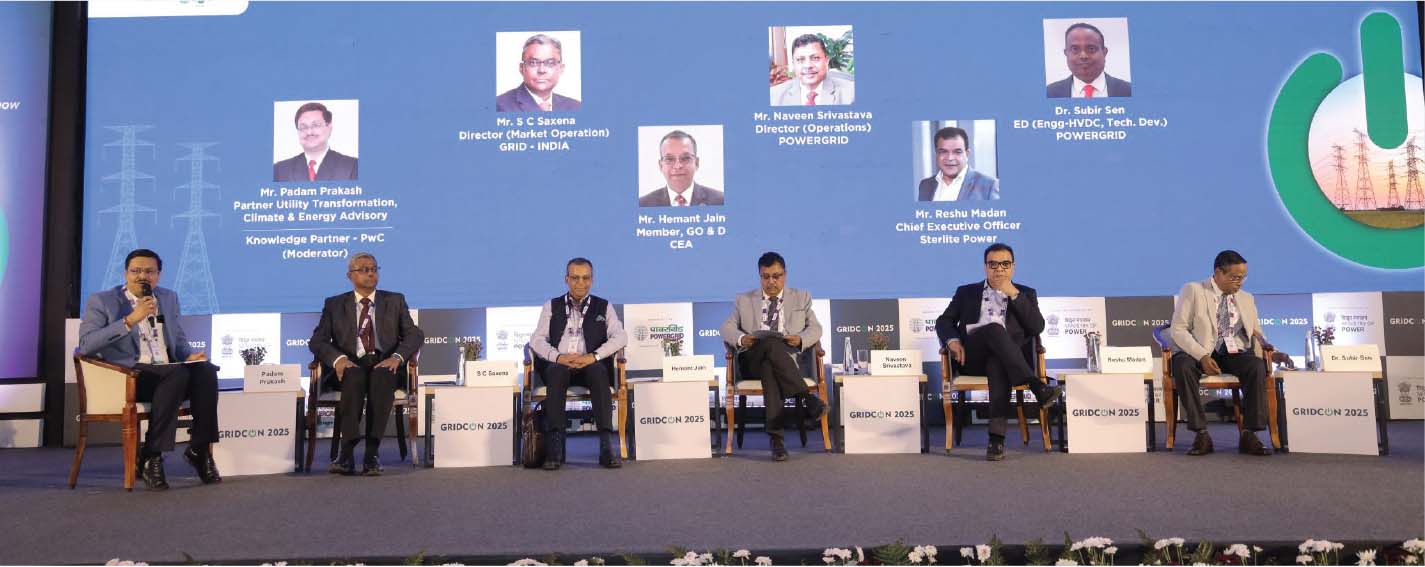 Vision for India’s power infrastructure in 2047
India’s growth trajectory over the next two decades will be closely tied to the robustness of its power infrastructure. As the country approaches the centenary of its independence in 2047, building a resilient, reliable and sustainable energy system will be essential for continued socio-economic development. The panelists shared a bold vision for the future, forecasting that India’s installed power capacity will increase fivefold by 2047, with nearly 90 per cent of this capacity sourced from non-fossil fuels such as renewable energy and nuclear power. This transformative shift towards cleaner energy sources will play a pivotal role in reducing the country’s carbon footprint and ensuring that its power sector aligns with global sustainability goals.
However, despite the rapid expansion of installed renewable energy capacity, the anticipated growth in energy demand and peak load will only increase threefold. This is expected to have far-reaching implications on the stability of the power grid, requiring strategic planning to manage grid reliability. The discussion emphasised the need for collaboration among central, state and private stakeholders to tackle the challenges that lie ahead and ensure that the grid remains stable and efficient as
renewable energy takes a more prominent role.
Challenges in transmission development
While India is making strides in increasing its generation capacity, there remains a significant lag in the development of transmission infrastructure. This gap between generation and transmission capacity poses a serious challenge for the sector. One of the major concerns is the inefficiency of current transmission construction timelines. For instance, building a 400 kV transmission line in India takes between 1,100 and 1,200 man-days, while similar projects take only 600 man-days in Thailand, 400 man-days in Brazil, and 200-250 man-days in the US and Europe. The long construction timelines significantly slow down the process of upgrading the transmission network, hindering the ability of the grid to keep pace with the growing demand
for electricity.
The panelists highlighted that in order to overcome this bottleneck, innovation and technological advancements in transmission infrastructure are necessary. Sterlite Power, for example, has already pioneered the use of heli cranes and drones to speed up the construction of transmission lines, especially in the remote areas of Jammu & Kashmir and the Northeast. These innovations have reduced project timelines considerably, from 48-60 months to 24-36 months, demonstrating that technological advancements can make a significant difference in overcoming the hurdles of transmission development. The problem of shortage of skilled labour in the sector can be met through mechanisation and automation to further develop the transmission infrastructure.
Technological advancements
The panel discussion highlighted that the future of the Indian power sector will depend heavily on the integration of advanced technologies, particularly in the transmission segment. As India moves towards a future dominated by renewable energy, maintaining grid stability and efficiency will require a technological leap.
The future grid will be AI-driven, IoT-enabled, and largely unmanned, capable of self-optimising based on real-time data from smart transmission lines and substations. Powergrid is already taking steps in this direction by operating 281 substations remotely from its National Transmission Asset Management Centre (NTAMC). The goal is to transition to fully digital substations by 2047, and utilise predictive maintenance technologies to monitor the health of transformers and circuit breakers. These digital substations will enable the efficient management of resources, faster response times during faults, and ensure reduced operational costs. Moreover, integrating these systems will help avoid transmission losses and ensure that electricity is distributed where it is needed the most.
Another significant aspect of these technological advancements is the integration of cybersecurity measures into the power grid. With the growing dependence on digital technologies, securing the transmission network from cyber threats will become a top priority. Investments will need to be made in strengthening cybersecurity protocols, ensuring that both operational technology (OT) and information technology (IT) systems are kept separate to reduce vulnerability. As the transmission grid becomes more connected, the risk of cyberattacks will grow, making cybersecurity an integral part of the planning process for the future power sector.
Renewable energy integration and storage systems
India’s solar power capacity has reached new peaks, with solar generation crossing 65 GW during daytime hours. However, a significant challenge pertains to the intermittency of solar power, which can cause instability in the grid. As more renewable energy sources are integrated into the grid, it will become increasingly important to manage fluctuations in generation, especially during periods of low renewable energy output.
The transition to a predominantly renewable energy-based grid will require new strategies for peak load management. While meeting daytime demand may become easier with more solar capacity, ensuring grid stability during non-solar hours will be more complex. The introduction of resource adequacy studies and reserve planning is already under way, ensuring that there are backup mechanisms in place to meet demand when renewable generation falls short. New regulatory frameworks are also being introduced, requiring utilities to plan for resource adequacy up to a 10-year horizon, accounting for both expected and contingency power requirements.
Managing shifts in power flows across the transmission grid is also important for maintaining grid stability. Traditionally, power flow was east to west or east to north, based on the location of conventional power plants. However, with the rise of renewable energy in the western, northern and southern parts of India, power flows have become bidirectional, with regions that once imported power now exporting electricity during daylight hours. Managing these dynamic flows will require significant upgrades to the transmission network and more sophisticated grid management strategies.
As renewable energy continues to dominate India’s energy mix, energy storage technologies will become critical to ensuring grid stability. Current storage capacities in India are relatively low, with pumped storage hydropower at 4.7 GW and battery storage systems at a nascent stage. However, by 2047, the country is expected to ramp up storage capacities significantly, with pumped storage hydro estimated to grow to 116 GW and battery storage systems to 47 GW by 2032.
Energy storage will provide the necessary flexibility to meet peak demand and balance supply with demand fluctuations. In particular, pumped storage hydro will be essential for balancing the intermittent nature of solar and wind power. Similarly, advancements in battery storage will enable faster response times and more flexibility in grid management.
Outlook
To build a sustainable and resilient power sector, India must address several key challenges: adequacy, accessibility and affordability. These three pillars–often referred to as the “three As” – will serve as the foundation for future policy and infrastructure planning. Expanding transmission infrastructure at both the interstate and intra-state levels will be crucial to meeting these challenges. The increasing decentralisation of power generation will require localised, efficient distribution networks that can manage the supply and demand for electricity at the regional level. The use of AI, IoT and machine learning will enable these networks to optimise themselves, respond quickly to fluctuations in demand and minimise downtime.
Further, the role of nuclear energy in India’s power sector will be pivotal as the country works to reduce its reliance on fossil fuels. By 2047, nuclear energy is expected to account for a significant portion of the country’s energy mix, with an estimated 100 GW of nuclear capacity coming online. Nuclear power will play a crucial role in balancing the grid as it provides stable, non-intermittent energy, unlike solar and wind power. Offshore wind energy will also become an important part of the country’s energy landscape, with significant potential in coastal states such as Tamil Nadu and Gujarat. Projects in these states are expected to provide 10 GW of offshore wind capacity by 2032, which will further contribute to India’s clean energy goals. However, offshore wind energy will require new transmission infrastructure, including undersea cables and transnational grid connections, to ensure that the power generated can be integrated efficiently into the national grid.
In sum, the future of India’s power sector will be shaped by a combination of technological innovations, policy reforms and strategic investments. To achieve energy security, net zero emissions by 2070, and a sustainable, reliable power grid by 2047, the country must prioritise the modernisation of transmission infrastructure, the integration of smart grid technologies, and the expansion of energy storage systems. Moreover, collaboration between the public and private sectors will be critical in driving innovation and the deployment of emerging technologies.