
A critical pillar of the energy transition is energy efficiency. There are significant opportunities in large, energy-intensive industries and other enterprises engaged in manufacturing and services, for which energy is a considerable cost. The typical energy end uses in industry include, but are not limited to, process heating, process cooling, drying, motors and drives, electrochemical processes and process-specific technologies.
The Bureau of Energy’s report titled “Strategic Plan for Advancing Energy Efficiency Across Demand Sectors by 2030” highlights the expected rise in investments in energy efficiency globally from $300 billion to $840 billion across key sectors, including industry. It also pointed out that the energy efficiency market is set to nearly triple by 2026 and 2030, driven in part by the increased adoption of energy-efficient motors.
India’s industrial sector contributes around 25.92 per cent to its GDP, making energy efficiency critical for sustainable growth. Electric motors play a crucial role in converting electrical energy into mechanical motion, enabling essential operations across both domestic and industrial applications. They prove to be cost-effective in the long run since the primary expenditure associated with them is their operational cost, which is lesser and improves efficiency.
Market drivers and efficiency standards
As pointed out, the global electric motor is expected to grow significantly due to several market drivers. As industries across manufacturing, logistics and power generation seek greater efficiency and precision, the demand for high-performance electric motors continues to rise.
In the Indian market, several key factors contribute to the rising adoption of electric motors. A growing focus on energy conservation has encouraged industries to transition toward high-efficiency motors that comply with stringent energy-saving norms. Additionally, the rapid adoption of electric vehicles (EVs) has spurred the demand for specialised electric motors, both for vehicle propulsion and for use in EV charging infrastructure. Sector-specific and regulatory influences also play a critical role in shaping market trends. The rising demand for HVAC (heating, ventilation, and air conditioning) technology leads to an increased demand for energy-efficient motors that power air handling systems and compressors. Further, factors such as rapid urbanisation, along with the construction boom, have also contributed to higher electricity consumption, necessitating the deployment of efficient motor-driven systems across various applications.
Governments worldwide are pushing stricter regulations on power consumption and motor efficiency, ensuring that industries replace outdated motors with high-efficiency variants that comply with energy conservation standards. In 2022, around 57 countries had set minimum energy performance standards (MEPS) for industrial electric motors, covering about 50 per cent of the global electricity consumption of industrial motors, up from 20 per cent 10 years ago. These MEPS are predominantly based on International Efficiency (IE) standards that define five distinct performance levels, ranging from IE1 (least efficient) to IE5 (most efficient) motors. Many developed economies, such as the European Union, the US, Canada and Japan, have switched to higher efficiency motors (IE3) as MEPS.
In India, IE2 motors, representing “high efficiency” in the IE efficiency classification, are the minimum standard, with IE1 motors banned since October 2017 to promote energy savings and reduce emissions. However, with the rising awareness of energy efficiency in India, Tier 2, 3 and 4 cities such as Ahmedabad, Indore, Raipur and Jamshedpur are increasingly adopting high-efficiency IE3 and IE4 motors across industries. According to industry statistics, IE3 motors have approximately 20 per cent lower losses than IE2, and IE4 motors have about 20 per cent lower losses than IE3. However, IE3 and IE4 motors make up only 18 per cent of the total
motor production.
Manufacturers in India are also offering higher-efficiency motors, such as IE4 and IE5 motors. These motors provide several superior performance features and achieve high efficiencies in the same frame size as a standard motor, enabling the replacement of older inefficient motors with short payback periods.
As per industry data, transitioning to higher efficiency motors is crucial. Replacing IE2 with IE3 as MEPS could save over 1 TWh annually from one year of production, while replacing IE2 with IE4 could save up to 2.1 TWh annually. Therefore, the widespread adoption of higher efficiency motors is crucial for India to achieve its net zero goals, as over 70 per cent of electricity consumed by industries is from motor-driven systems.
To encourage the uptake of energy-efficient motors within industries, Energy Efficiency Services Limited launched the National Motor Replacement Programme. The primary objective of this programme is to finance the voluntary replacement of inefficient motors with IE3 motors, as per IS-12615 standards. The programme has helped micro, small and medium enterprises (MSMEs) and non-MSME industries.
Industry growth trends
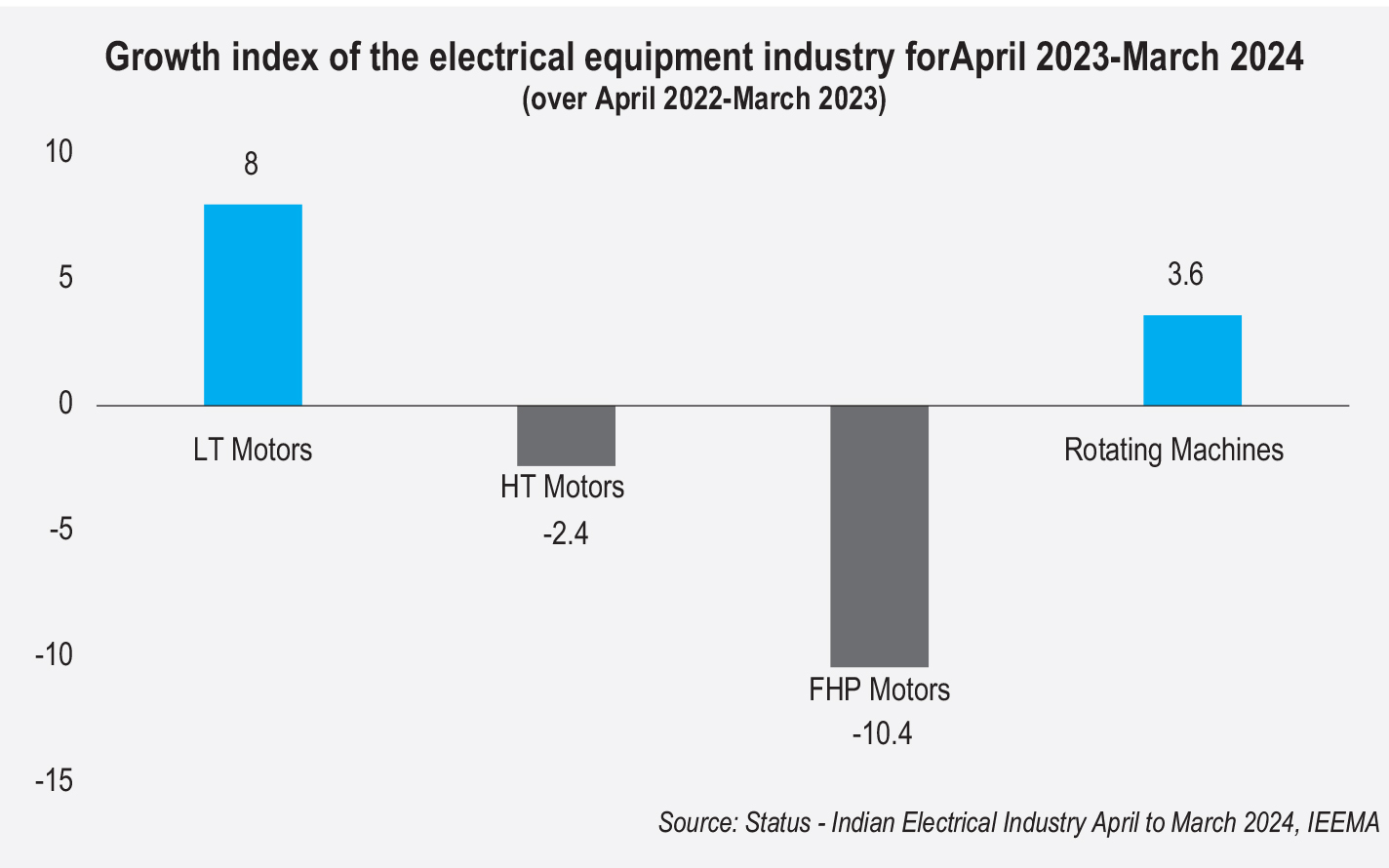
As per the Indian Electrical and Electronics Manufactures’ Association (IEEMA) statistics, the growth index for the overall electrical equipment industry from April 2023 to March 2024 showed a growth rate of 17.6 per cent as compared to April 2022 to March 2023. Meanwhile, the rotating machines segment, which includes industrial motors and drives, has recorded a relatively modest growth of 3.6 per cent.
While the overall category of rotating machines grew by 3.6 per cent, this growth was primarily driven by low tension (LT) motors, which saw an 8 per cent increase. In contrast, high tension (HT) motors experienced a 2.4 per cent decline and fractional horsepower (FHP) motors saw a 10.4 per cent drop. Industrial demand has been shifting towards high efficiency LT motors, indicating a growing preference for LT motors.
 Technology trends
The integration of artificial intelligence (AI), digitalisation and internet of things (IoT) is transforming the industrial power sector by enhancing the performance, reliability and efficiency of motors and drives, leading to significant operational improvements and cost savings.
Predictive maintenance is one of the key applications, where AI and IoT-enabled sensors in motors continuously collect real-time data from motors and drives, allowing AI algorithms to predict potential failures, thereby reducing downtime and maintenance costs. Machine learning models further enhance this by detecting operational anomalies, enabling early intervention before major issues arise.
Energy efficiency is another critical area where AI-driven smart grids predict energy demand fluctuations, optimising the operation of motors and drives to align with energy availability and minimise wastage. Process optimisation through AI analytics helps industries identify inefficiencies in motor-driven processes, ensuring optimised energy consumption and improved overall performance.
The adoption of remote monitoring and control is further improving industrial operations, with IoT connectivity enabling continuous monitoring of motors and drives for timely maintenance and diagnostics, reducing unexpected failures.
By integrating cloud platforms, IoT-enabled motors can transmit data to AI-driven systems that analyse performance metrics and generate actionable insights for maintenance and optimisation. In quality control and automation, AI plays a pivotal role in enhancing automation, predictive maintenance and quality control processes in industrial settings, simultaneously driving demand for specialised electronic components that support AI-based systems. The use of digital twins, which create virtual replicas of motors and drives, allows industries to simulate, analyse and proactively improve motor efficiency and reliability before real-world issues arise.
Safety enhancements in industrial power applications are also significantly improved through AI and IoT. Real-time monitoring with IoT sensors enables the immediate detection of hazardous operating conditions, triggering automatic shutdowns to prevent accidents, while AI-driven risk assessment models analyse data from motors and drives to predict potential safety hazards, allowing for preventive measures to be implemented proactively. In supply chain optimisation, IoT devices track motor and drive usage and condition, facilitating efficient inventory management and the timely procurement of spare parts, while AI-based demand forecasting ensures better production planning and resource allocation.
AI, IoT and digitalisation are enabling seamless integration with renewable energy sources, where smart energy management in IoT-enabled motors and drives allows operations to be adjusted based on the availability of renewable energy, thereby optimising energy consumption and supporting sustainability goals. AI algorithms further assist in maintaining grid stability, ensuring the balanced operation of motors and drives, even in grids with a high penetration of variable renewable energy sources.
Conclusion
As the energy efficiency market is projected to nearly triple between 2026 and 2030, industries have a significant opportunity to modernise their power systems and reduce emissions. With electric motors and drives consuming 60-70 per cent of industrial power, improving their efficiency is one of the most impactful steps toward achieving global energy efficiency goals.
To meet these ambitious targets, industries must take decisive steps to optimise motor efficiency and overall energy use. Transitioning to higher efficiency motors not only offers several economic advantages such as savings in energy costs, but also contributes to their sustainability by reducing their carbon footprint.