
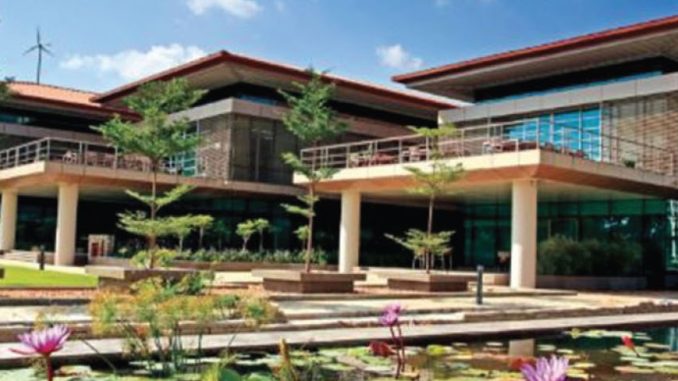
Green buildings have long been a key point in discussions around net zero and decarbonisation, and for good reason. In India, buildings consume 30 per cent of the total electricity generated, account for more than 60 per cent of carbon emissions in cities, and contribute to nearly 40 per cent of global emissions.
The green building concept
According to the US Green Building Council, “green building” is a holistic concept based on the understanding that the built environment can have a significant impact, both positive and negative, on the natural environment and the people who inhabit buildings every day. Green building is an effort to amplify the positive and mitigate the negative effects throughout a building’s life cycle.
While there are various definitions of green building, it is generally accepted as the planning, design, construction and operation of buildings with key considerations such as energy use, water use, indoor environmental quality, material selection, and the building’s impact on the site.
In India, the Green Rating for Integrated Habitat Assessment (GRIHA) is a tool that assesses how well a building performs against national benchmarks. The Government of India adopted GRIHA in 2007 as its national rating system for green buildings. As per this rating system, a green or sustainable building is healthier, more energy-efficient and eco-friendly. Such buildings consume 40-50 per cent less energy and 20-30 per cent less water than standard buildings, generate less waste, and provide healthier environments for occupants. GRIHA was conceived by TERI and developed jointly with the Ministry of New and Renewable Energy, Government of India. It is a green building design evaluation system and is suitable for all building types across different climatic zones in the country. If all structures in the world are constructed with the ecosystem and energy efficiency in mind, the adverse impacts on the environment, such as the greenhouse effect, ozone layer depletion and global warming, can be significantly reduced or avoided.
Eco-friendly practices include adopting energy-efficient practices and technologies, achieving energy self-sufficiency through on-site/off-site renewable energy sources and using sustainable building materials.
In contrast, a smart building uses advanced technologies, such as internet of things (IoT) devices, sensors, data analytics and artificial intelligence (AI), to optimise operations, enhance experience, and improve energy efficiency, security and overall building performance. As per Cisco Systems, Inc., an American multinational digital communications technology conglomerate corporation, a smart building converges various building-wide systems, such as high voltage alternating current (HVAC), lighting, alarms and security, into a single IT-managed network infrastructure. It is often enabled by foundational technologies such as Power over Ethernet (PoE), which deliver DC power to devices over copper Ethernet cabling, eliminating the need for separate power supplies and outlets. While PoE does not add to Ethernet data capabilities, it does offer more options for the placement of Ethernet end devices.
 Key technology trends
With advancements in AI/Generative AI and IoT in 2024, there will be a marked shift towards building management systems, building information modelling, HVAC and security systems in 2025 onwards, resulting in enhanced energy efficiency. Buildings will also increasingly incorporate renewable energy sources as they become more accessible. We see solar power in particular leading this trend, right at the building design stage itself. Innovations such as building-integrated photovoltaics and advanced solar panel technologies will enable structures to generate their own clean energy.
As information and knowledge become widely accessible and policy frameworks continue to evolve in support of India’s net zero vision, these technologies will see greater adoption, particularly across new building stock that is currently under construction or yet to be developed. With the rapid growth of modern commercial buildings (hospitals, educational institutions, etc.), industrial parks and smart cities, the integration of advanced building technology and renewable energy will play a key role in enhancing sustainability and improving the overall experience of these built environments. In the residential sector, consumers are much more conscious of their choices and “green haven” residential buildings have witnessed rapid sales.
Green building materials
Builders are increasingly using bamboo, recycled concrete and fly ash bricks in construction projects to reduce the environmental impact. These materials offer several benefits, including reduced waste, lower energy consumption in production, and less reliance on non-renewable resources. These materials are gaining popularity due to the following reasons:
- Bamboo: This fast growing renewable resource can be used for various structural and aesthetic elements, offering a sustainable alternative to traditional materials such as steel and concrete. Bamboo also effectively sequesters carbon, contributing to climate change mitigation and reducing the need for using timber.
- Recycled concrete: Utilising concrete that has been recycled from demolition or construction waste reduces the need for virgin aggregates and the amount of waste sent to landfills. Recycling concrete also consumes less energy than extracting and processing natural aggregates.
- Fly ash bricks: Fly ash, a by-product of coal combustion, can be used to make bricks that require less energy to produce and have a lower carbon footprint compared to traditional clay bricks. Fly ash brick production also reduces the need for natural soil, a resource often used in clay brick production.
Lower energy consumption and reduced dependence on traditional materials result in smaller carbon footprints for buildings constructed with these sustainable materials.
What is LEED?
Leadership in Energy and Environmental Design or LEED is the world’s most widely used green building rating system. LEED certification provides a framework for healthy, highly efficient and cost-saving green buildings, which offer environmental, social and governance benefits. LEED certification is a globally recognised symbol of sustainability achievement, and it is backed by an entire industry of committed organisations and individuals paving the way for market transformation.
As per the U.S. Green Building Council (USGBC), currently, there are 197,000 LEED projects globally across 186 countries and territories. LEED v5 is the newest version of LEED. It marks a transformative milestone in the built environment’s alignment with a low-carbon future and addresses critical imperatives such as equity, health, ecosystems and resilience.
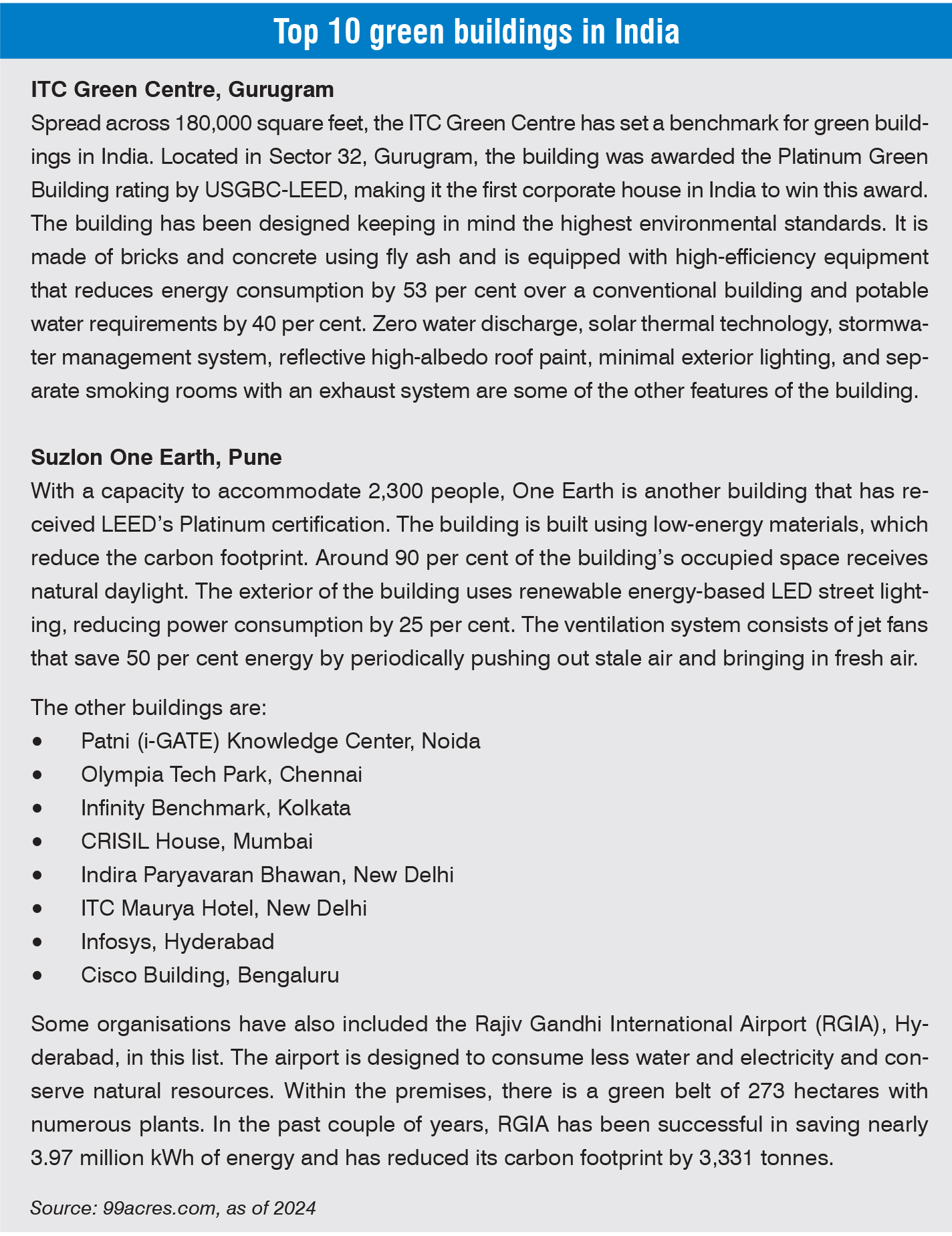
The LEED green building rating system provides a baseline for decision-making for project teams in the sector, rewarding best practices and innovation, and recognising exemplary building projects with different levels of LEED certification. The first LEED platinum-rated green building in India was the Confederation of Indian Industry building in Hyderabad.
In 2018, the Indian Green Building Council (IGBC) launched the IGBC Net Zero Energy Rating System, enabling designers to apply energy efficiency concepts and adopt appropriate renewable sources to achieve net zero energy status. In the case of existing buildings, the system enables the implementation of energy-efficient measures to reduce energy consumption and meet the balance energy requirements through renewable energy sources. IGBC’s net zero rating systems cover energy, water, waste-to-landfill and carbon ratings.
 Net zero energy rating systems
Net zero energy concepts and techniques encourage the use of renewable energy sources to meet the energy requirements of buildings. This leads to:
- Improvements in energy efficiency and hence, reduction in annual energy consumption of 25-30 per cent with respect to the national baseline.
- Overall reduction of about 30 per cent in energy cost.
- Reliable power supply if combined with energy storage devices.
The rating system evaluates buildings on a performance-based approach and assesses the following:
- Energy performance
- Simulation approach
- Prescriptive approach
- Energy-efficient building envelope
- Air conditioning
- Lighting
- Appliances
- Renewable energy usage
- Thermal comfort, indoor temperature and relative humidity
Notably, the mandatory requirements and credits earned at the preliminary review are only considered “as expected”, and will only be awarded once the final documents are submitted, along with additional documents demonstrating the implementation of design features.
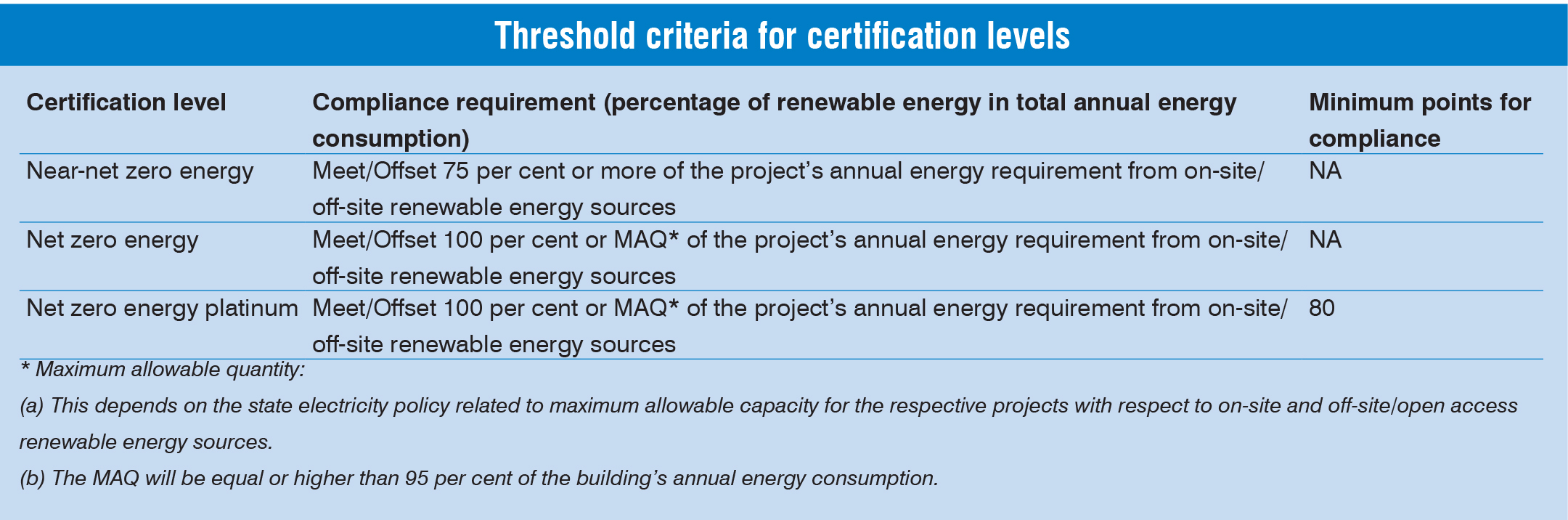
The IGBC Net Zero Energy Rating System is designed for both new and existing buildings/projects across air-conditioned and non-air-conditioned spaces. The Net Zero Energy Building rating is applicable to commercial, industrial as well as residential building projects that are able to offset 100 per cent of their annual grid energy use by renewable energy sources (either on-site or off-site). These buildings include, but are not limited to, offices, banks, IT parks, shopping malls, hotels, hospitals, airports, convention centres, educational institutions (schools, colleges, university campuses), warehouses and railway stations.
The IGBC Net Zero certification is offered in the following categories:
- Design certification: For projects in the design and construction phase.
- Operations certification: For projects in the operations stage for at least one year. These projects must have implemented the required measures and provide recent annual performance data for validation.
- Pre-certification: For projects in operation for at least three months. Such projects must have implemented the measures and must provide recent three-month performance data for validation.
The ratings assigned under IGBC Net Zero Energy for the design and construction phase or the operations phase will be valid for a period of three years. Additional certifications can be applied for as the projects progress.
Looking ahead
The green buildings market in India is expected to reach $39 billion in 2025, according to the president and managing director of Johnson Controls India. Another report by Resurgent India and the National Real Estate Development Council confirms that the smart homes market in India is projected to grow by 9.14 per cent from 2024 to 2028, reaching a market volume of $9.2 billion. This growth is attributed to the increasing integration of IoT devices in homes, which enhances security, energy efficiency and convenience. Start-ups specialising in smart home solutions are expected to see substantial growth during this period.
The green building sector in India requires a multifaceted approach, with concerted efforts at the technology, policy and community levels. From integrating renewable energy sources and smart building technologies for enhanced energy efficiency to implementing waste and wastewater management strategies and adopting localised, sustainable materials, the path to decarbonising buildings must be tailored to the diverse and evolving needs of India’s construction sector and complex climate conditions. A consultative approach is required to recommend customised solutions on a case-by-case basis.
Anita Khuller