Incorporated on July 1, 2002, Madhya Pradesh Paschim Kshetra Vidyut Vitaran Company Limited (MPPKVVCL) oversees electricity distribution and retail supply in the Indore and Ujjain divisions. MPPKVVCL secured an “A” rating during 2023–24, reflecting its strong performance. As per Power Finance Corporation Limited’s report, the utility reduced its aggregate technical and commercial (AT&C) losses from 12.6 per cent in 2022-23 to 12.33 per cent in 2023-24.
MPPKVVCL has implemented several initiatives, including the roll-out of smart meters to enhance billing accuracy, enable data-driven operations and improve revenue collection. Other key initiatives include feeder separation to reduce losses, a new vigilance information system (NVIS) for real-time monitoring, and advanced billing software integrated with analytics tools to ensure transparency and operational efficiency.
Network growth and operational performance
MPPKVVCL operates an extensive power distribution network, with a total line length of 326,280 ckt km at 66 kV and below voltage levels, as of March 2024. The company’s HT-LT line ratio stood at 0.88 during the same period. As of March 2024, MPPKVVCL had 328,567 distribution transformers (DTs) and 2,905 power transformers, with a total installed power transformer capacity of 14,704.6 MVA.
In terms of operational reliability, the national average electricity supply in 2023–24 was 21.57 hours per day for rural consumers, while urban and industrial consumers received higher supply at 23.53 hours and 23.64 hours, respectively. In comparison, MPPKVVCL performed better, providing an average of 22.3 hours in rural areas and 23.8 hours in both urban and industrial areas during the same period. The utility recorded a DT failure rate of 6.1 per cent.
With regard to supply interruptions, the national average interruption index stood at 77.88 for rural feeders, 126.72 for urban feeders and 70.90 for industrial feeders. MPPKVVCL reported a higher interruption index rural feeders at 191.6, but lower figures for urban (121.2) and industrial (120.5) feeders, compared to the national average.
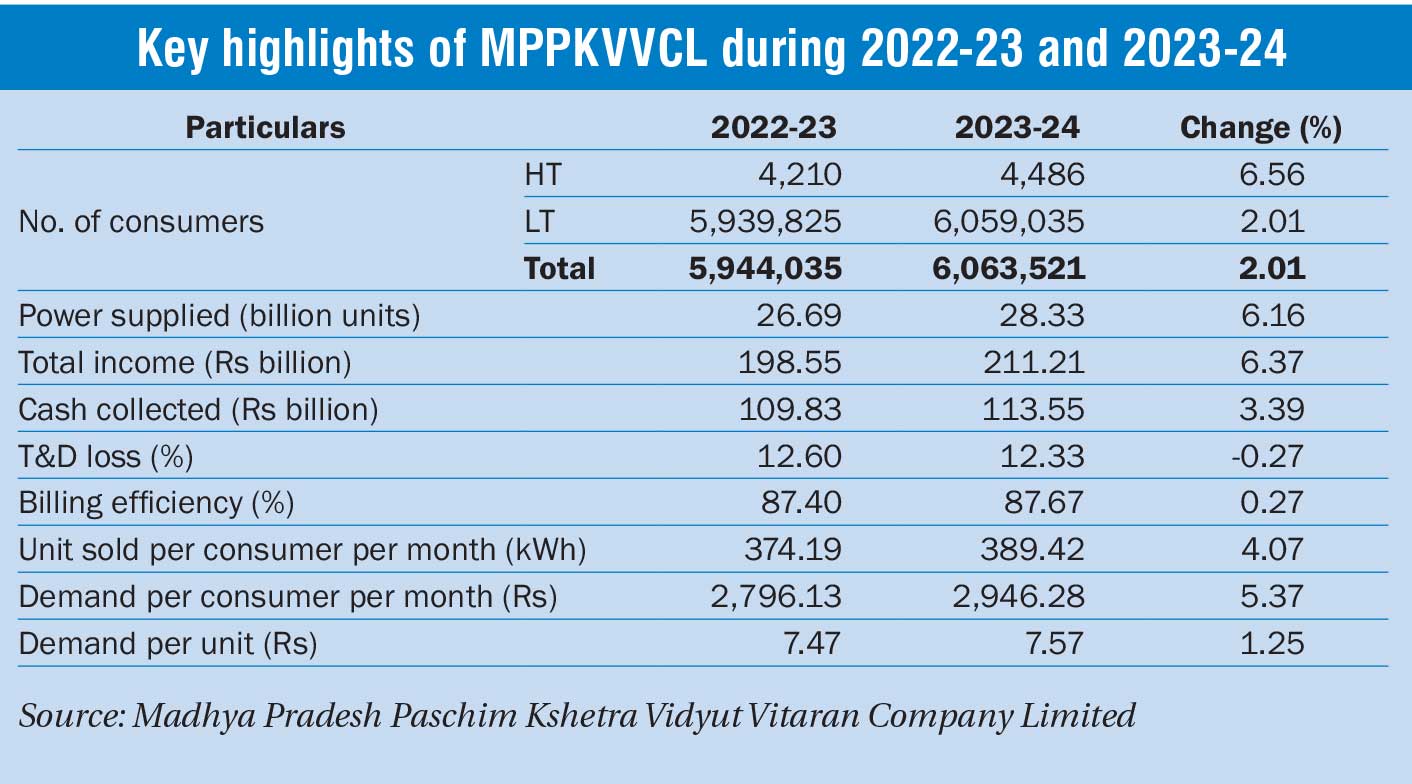
As of March 2024, the company served a total of 6,063,521 consumers. Of these, domestic consumers accounted for a majority share at 66.85 per cent (4,053,415), followed by agricultural consumers at 23.57 per cent (1,428,911), commercial and industrial consumers in the LT category at 8.89 per cent (538,989), and HT commercial/industrial consumers at 0.06 per cent (3,887). Other categories, including public lighting and government connections, constituted the remaining 0.63 per cent (38,319).
During 2023-24, total energy sales rose to 28,335 million units (MUs) from 26,690 MUs in the previous year. The total energy purchased stood at 33,719.35 MUs, while net input energy at the discom periphery stood at 32,321.5 MUs. Of this, 28,335.04 MUs were billed to consumers. The average monthly consumption per consumer during the year was 389.42 kWh.
MPPKVVCL achieved a collection efficiency of 101.65 per cent in 2023–24, reflecting strong revenue recovery performance. Billing efficiency also improved marginally, from 87.40 per cent in 2022–23 to 87.67 per cent in 2023–24. The company’s AT&C losses declined from 12.60 per cent in 2022–23 to 12.33 per cent in 2023–24, significantly lower than the national average of 16.3 per cent. Notably, the utility outperformed the AT&C loss target of 16.09 per cent set under the Revamped Distribution Sector Scheme (RDSS).
Financial performance
In terms of financial performance, MPPKVVCL has significantly improved its average cost of supply (ACS)-average revenue realised (ARR) gap. In 2020–21, the ACS-ARR gap was Rs 1.47 per unit, indicating significant financial stress. By 2022–23, this gap had been effectively closed, with the utility reporting a marginal surplus of Rs 0.11 per unit. The positive trend continued in 2023–24, when MPPKVVCL not only eliminated the gap but achieved an ACS-ARR surplus of
Rs 0.33 per unit. In 2023-24, MPPKVVCL reported a total income of Rs 211.21 billion, an increase of 6.37 per cent from Rs 198.55 billion in the previous year. Further, the company significantly reduced its loss to Rs 1.25 billion from Rs 11.30 billion in the previous year.
Progress under RDSS
Sanctions and disbursal
As per the RDSS portal (accessed on July 24, 2025), the total sanctioned cost for MPPKVVCL under the scheme stands at Rs 51.33 billion. Of this, the total sanctioned gross budgetary support (GBS) is Rs 19.23 billion, while Rs 5.76 billion has been released so far. For smart metering projects under the scheme, the sanctioned cost is around Rs 26.03 billion, with a sanctioned GBS of Rs 4.34 billion. Meanwhile, the loss reduction component of the RDSS has a sanctioned cost of Rs 24.82 billion, with a GBS of Rs 14.89 billion, of which Rs 5.76 billion has been released.
Smart metering
Approximately 3,879,733 smart consumer meters, 102,036 DT meters and 9,811 feeder meters have been sanctioned. Of these, 10,63,603 smart consumer meters, representing 27 per cent of the sanctioned quantity, have been awarded. In comparison, the entire sanctioned number of around 102,036 million DT meters and 9,811 feeder meters have been awarded. Under the smart metering component of the RDSS, financial progress remains at zero per cent, while physical progress stands at 20.94 per cent.
Loss reduction
In the LT segment, a total of 11,844 ckt km has been sanctioned, with 93 per cent awarded and 27 per cent installed. In the HT segment, 18,673 ckt km of HT lines have been sanctioned, with 91 per cent awarded and 36 per cent installed. For DT installations, 13,110 units have been sanctioned, with 81 per cent (10,719) awarded and 50 per cent (6,641) installed. Under loss reduction, financial and physical progress stands at 38.68 per cent and 42.84 per cent respectively.
Key initiatives
Smart meter project: The roll-out of smart meters has been a transformative initiative for MPPKVVCL. It enabled the development of a data analytics system that generates 63 types of reports, and led to a 13.63 per cent rise in average monthly units billed and a 21.46 per cent increase in the average monthly bill per consumer. The smart meters have helped detect 18,196 meter anomalies, resulting in additional billing of Rs 219.6 million, power factor penalties of Rs 74.6 million and incentives worth Rs 256.8 million. The system enabled around 657,000 remote disconnections/reconnections, assisting in the recovery of arrears worth Rs 3,086.3 million. Additionally, 3,707 smart meters were converted to net meters, supporting a connected load of 25.9 MW. MPPKVVCL also launched a door-to-door mobile app-based collection drive to enhance transparency and convenience. Following implementation, billing efficiency in Indore improved from 67 per cent to 91 per cent, while AT&C losses dropped from 46 per cent to 9 per cent in Indore and from 39 per cent to 9 per cent in Mhow. Collection efficiency reached 100 per cent in Indore and Mhow, and 103 per cent in Khargone.
Feeder separation: MPPKVVCL undertook a feeder separation project, which helped shift agricultural power usage to off-peak hours, contributing to reduced AT&C losses and reduced power purchase costs. As a result, non-agricultural feeders received an average supply of 23 hours and 39 minutes daily, while agricultural feeders averaged 9 hours and 34 minutes of power supply.
Revenue collection improvement: To enhance revenue realisation, MPPKVVCL monitors feeder-wise revenue per unit and adopts targeted strategies for improvement. A key focus area has been the recovery of long-pending arrears through enforcement measures such as property attachment (Japti/Kurki) and bank account seizures.
NVIS: The NVIS is a digital platform developed to strengthen enforcement and monitoring activities. NVIS provides real-time data and actionable insights to detect irregularities and minimise losses. By integrating with smart meters and advanced analytics tools, it enhances compliance, optimises resource allocation and builds consumer trust by curbing power theft and improving service quality.
Rental DTR scheme: To serve temporary agricultural consumers, MPPKVVCL introduced a rental distribution transformer (DTR) scheme. The utility also identifies irrigation DTRs without authorised connections to prevent unauthorised usage.
 Billing software: MPPKVVCL uses an advanced, centralised billing system for both HT and LT consumers. HT billing is managed by the HT billing cell, with meter readings collected remotely via SIM- and modem-enabled meters, or manually using MRI when needed. Data is uploaded to the new generation billing software and bills are issued via email. LT billing uses photo meter reading through a mobile app or automatic meter reading (AMR). Validated data is uploaded to the billing system, and bills are sent via SMS with a link to view the bill. MPPKVVCL also uses analytics tools such as customer master data management and AMR portals to monitor billing accuracy.
Conclusion
As per the Central Electricity Authority’s Distribution Perspective Plan, MPPKVVCL has outlined an infrastructure expansion roadmap to meet growing demand and enhance service reliability by 2029-30. The utility plans to add 1,717 new substations with a total capacity of 14,306 MVA, along with 142,773 ckt km of HT lines and 249,780.97 ckt km of low-tension (LT) lines. Additionally, 308,102 new DTs with a combined capacity of 20,664 MVA are planned.
This forward-looking expansion plan aligns with the substantial progress MPPKVVCL has made in strengthening its power distribution infrastructure, improving operational efficiency and enhancing financial performance. Through focused initiatives, the company has reduced AT&C losses, improved billing and collection efficiency, and narrowed the ACS-ARR gap, achieving a surplus for the first time.