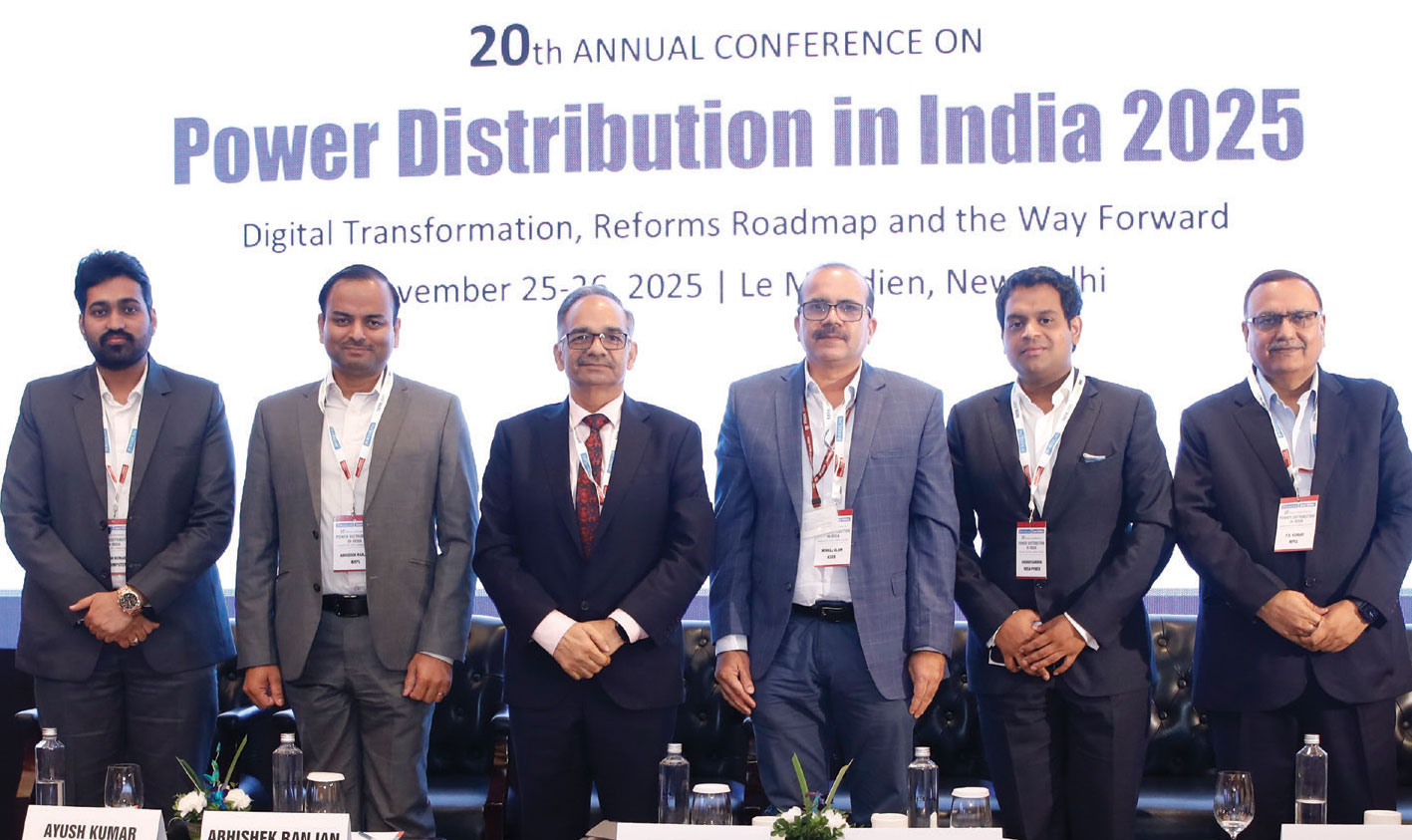
At the 20th edition of the Power Distribution conference organised by Power Line, the session on “View from the Top” featured a panel discussion among Alok Kumar, DG, All India Discoms Association (Session Chair); Minhaj Alam, Chairman and Managing Director, Kerala State Electricity Board; Raghav Kanoria, Managing Director, India Power; Ayush Kumar, CEO, Sai Computers; P.R. Kumar, Managing Director and CEO, Noida Power Company; and Abhishek Ranjan, Chief Executive Officer, BRPL. The panellists discussed how distribution priorities are increasingly being shaped by three parallel shifts. First, states that have already achieved near-universal electrification are now focusing more on reliability, safety and efficient service delivery. Second, the accelerating uptake of rooftop solar and other distributed energy resources is making distribution networks more bidirectional, increasing the need for stronger forecasting, automation and active network management. Third, as renewable penetration rises, cost recovery and tariff design issues are becoming more prominent, particularly in relation to rooftop solar and open access, alongside the need to manage evening supply deficits that often require higher-cost balancing power.
Sector overview
Improving system reliability and safety are among the primary focus areas. Insulated systems, particularly aerial bunched cables and covered conductors, are being deployed extensively. Efforts are also underway to improve service availability, including the consideration of live-line maintenance for both high tension and low-tension networks. E-governance has been implemented across processes such as service delivery, file movement, hazard reporting, human resource management, and litigation.
The Revamped Distribution Sector Scheme is a key anchor for the modernisation of distribution networks and systems. The scheme provides opportunities for grid modernisation, including strengthening sub-transmission systems, introducing automation, and integrating supervisory control and data acquisition systems, distribution management systems, and outage management system platforms. Smart metering is recognised as a key priority, and is being undertaken under the scheme in a major way. Consumer interface systems are also being strengthened, with call centres being upgraded to handle higher volumes and provide improved escalation analytics.
Technology adoption is being aligned with affordability and consumer mix. In areas where the majority of consumers are rural and industrial load is minimal, the cost realised per consumer is very low, and hence any technology investment has to be cost-efficient. In such contexts, utilities have implemented customer outreach programmes under which they regularly engage with consumers, address bill revision issues, in turn, building trust. Artificial intelligence-based systems are also being deployed to identify potential billing anomalies.
Across geographies, digitalisation of operations and data analytics are central to modern distribution operations. Existing networks are being planned for geographic information system (GIS) tagging with detailed retail attribute data. Utilities also use metadata analytics, preventive maintenance practices, and image-based asset health monitoring to improve operational efficiency. Distribution automation through supervisory control and data acquisition systems and distribution management system platforms will be extended to additional consumers, along with comprehensive revamping of existing systems. Notably, in West Bengal, a pilot project connecting approximately 120 distribution transformers using internet of things devices has already been completed, providing continuous operational data. Plans are also on to scale this across all distribution transformers and distributed assets in the state.
Renewable energy integration is another major thrust area. Rooftop solar is being implemented in a big way under the PM Surya Ghar scheme. Significant time, effort, and resources have been invested over the past five to six years in areas such as scheduling, power management, and demand-side and supply-side optimisation. More recently, utilities have started deploying rooftop solar, solar pumps, and other distributed energy resources, which help reduce drawal from the grid. Appropriate investments on the transmission and distribution sides have been essential to enable large volumes of renewable energy to flow into the grid safely and reliably.
Further, consumer-side flexibility is being pursued. Another focus area relates to consumer behaviour, where there is significant potential to improve demand-side flexibility and load shifting. Efforts are being made to work closely with customers, particularly commercial and industrial customers, to encourage responsiveness to the renewable energy supply curve. Even in industries such as steel and metals, which typically have rigid demand profiles with high load and power factors, some success has been achieved. Two to three large industrial customers have shifted consumption to solar hours, supported by incentive mechanisms linked to renewable availability. Disaster-resilience methods are being strengthened through proactive planning to ensure uninterrupted power supply.
Key challenges and mitigation strategies
Integrating rooftop solar into the grid presents operational and economic challenges because generation is high during periods of low demand, while evening demand remains elevated. To address this imbalance, battery energy storage systems are being implemented. These storage projects are expected to deliver savings on two fronts: power procurement and energy arbitrage. High renewable energy penetration brings greater volatility, making accurate forecasting critical. Multiple software systems are being implemented for accurate forecasting. The utilities are developing algorithms for renewable generation prediction. In parallel, discussions are underway with external technology providers to deploy advanced predictive analytics on the supply side. Throughout the year, excess solar energy is available during daytime hours, while evening periods experience deficit that must be met through high-cost exchange power or thermal contracts.
Another issue is the interaction between rooftop solar, open access consumers, and fixed-cost recovery. Regulatory definitions of fixed cost typically include capital expenditure, depreciation, operations and maintenance, and related expenses. When customers adopt rooftop solar or open access, the energy supplied by the distribution utility reduces, but fixed costs remain unchanged. Consequently, fixed costs increase on a per-unit basis for such customers. There is also an indirect or hidden fixed-cost impact arising from reduced offtake under legacy power purchase agreements. As rooftop solar and open access penetration increases, the utilisation of both thermal and renewable power purchase agreements will decline, adversely affecting fixed-cost recovery. Regulatory assessments of fixed-cost recovery, therefore, need to account for both direct fixed costs and the indirect impact of under-utilised power purchase agreements. A data-driven, state-level exercise could be undertaken to assess these impacts. Using current data and future projections for rooftop and open access adoption, models can be developed to estimate the additional fixed-cost burden on the system.
Outlook
Looking ahead, power requirement is projected to increase and planning is underway to meet this growth.
At the same time, several innovative models are emerging globally and within India to manage large volumes of distributed energy resources such as rooftop solar, electric vehicle charging infrastructure, smart appliances, and responsive industrial assets. Distribution networks are no longer unidirectional systems. They are becoming increasingly bidirectional, requiring active management of multiple decentralised assets. In this context, models such as virtual power plant agreements, aggregator platforms, and peer-to-peer trading mechanisms are expected to become more prevalent. Some states are already leading initiatives in this area.
Two broader observations were also highlighted in relation to tariff structure and system discipline. First, fixed-cost allocation for domestic and small commercial consumers remains low, while industrial consumers bear a higher fixed cost per kVA. Given that rooftop solar adoption is largely driven by domestic consumers, particularly under schemes such as the PM Muft Bijli Yojana, an increase in the overall fixed-cost allocation may be necessary. At present, fixed costs account for roughly 20 per cent of tariffs across India, and this share may need torise to 30–35 per cent in the coming years to support a high-renewable power system.
Second, there is scope to introduce greater demand-side discipline among large industrial consumers. While distribution utilities face strict deviation settlement mechanism (DSM) requirements, large industrial customers such as those with loads above 5 MW or 10 MW often face fewer constraints. Strengthening the DSM obligations for large industrial consumers could help manage variability and contribute to more equitable fixed-cost sharing as renewable penetration increases.