India’s power sector is undergoing a rapid transformation, with the increasing integration of renewable energy sources such as solar and wind into the grid. While coal currently accounts for around 47 per cent of installed capacity, its share is expected to fall to 39 per cent by 2027 and 29 per cent by 2032. In contrast, solar and wind are projected to rise to 30 per cent and 12 per cent, respectively, by 2027, and further to 40 per cent and 14 per cent by 2032. This transition highlights the critical need for flexibilisation in coal-based power plants, which must adapt to variable load conditions while maintaining grid reliability.
The demand curve is also changing. Today’s moderate variations will give way to sharper peaks and troughs as renewable penetration increases. Conventional coal plants, designed for steady base-load operation, will be required to ramp up and down more frequently to balance intermittent generation. Hydro and gas can provide flexibility but face constraints of potential and fuel supply, while battery storage remains commercially limited. Hence, the flexibilisation of existing thermal plants emerges as the most immediate and scalable solution for energy security.
Recognising this, the Central Electricity Authority issued regulations in January 2023, mandating thermal units to achieve 55 per cent minimum load and 2 per cent ramp rates by 2024, progressing to 40 per cent load with ramp rates of 1-3 per cent. Achieving this transition will require technical upgrades to boilers, turbines and control systems, as well as commercial mechanisms to compensate for higher operations and maintenance (O&M) costs and incentivise part-load operations.
Issues and challenges
Boilers face some of the most severe challenges under flexible operations. Fast ramping and frequent load variations cause temperature fluctuations, thermal stress, creep and fatigue, leading to irreversible material deterioration. Low-load operation poses risks such as poor combustion, unstable flame, coal pipe choking and high furnace exit gas temperatures. These problems result in reduced efficiency, high oil support requirements, greater risk of forced outages and difficulties in meeting emission norms.
Turbines are equally vulnerable during frequent load changes. Issues include high vibration of rotor trains, increased casing ovality, potential low-pressure blade failure, steam valve damage and excessive deposition on turbine blades. High metal temperatures in turbine structures can lead to distortion and creep damage. Mitigation measures include frequent inspections, advanced monitoring systems like blade vibration monitoring systems, remaining life assessment of components, and periodic replacement of casings and rotors. The inspection cycle is being shortened, such as reducing low pressure blade crack inspections from four years to two years, to cope with increased stress.
Operational challenges include high ash deposition, difficulty in soot blowing (which requires sustained high load), flame instability due to variable coal quality and higher chances of outages from auxiliary equipment failures. Chemistry parameters also fluctuate under frequent cycling. To address these, operators must adopt new operational practices, relying on training, simulations and knowledge-sharing. Control systems face challenges in handling load ramps, automatic generation control and frequency response. Solutions involve loop tuning, advanced monitoring and policy advocacy for updated grid codes.
Supercritical and ultra-supercritical plants face additional challenges due to higher operating pressures and temperatures. These units are more prone to thermal fatigue and creep damage during frequent cycling. Once-through boilers are sensitive to rapid load changes, demanding precise control to avoid overheating and tube failures. Longer startup and shutdown times, complex water-steam flow management and high startup energy requirements further complicate flexibilisation. Advanced alloys, improved designs and sophisticated control systems are required, though these increase costs.
Cost of flexibilisation
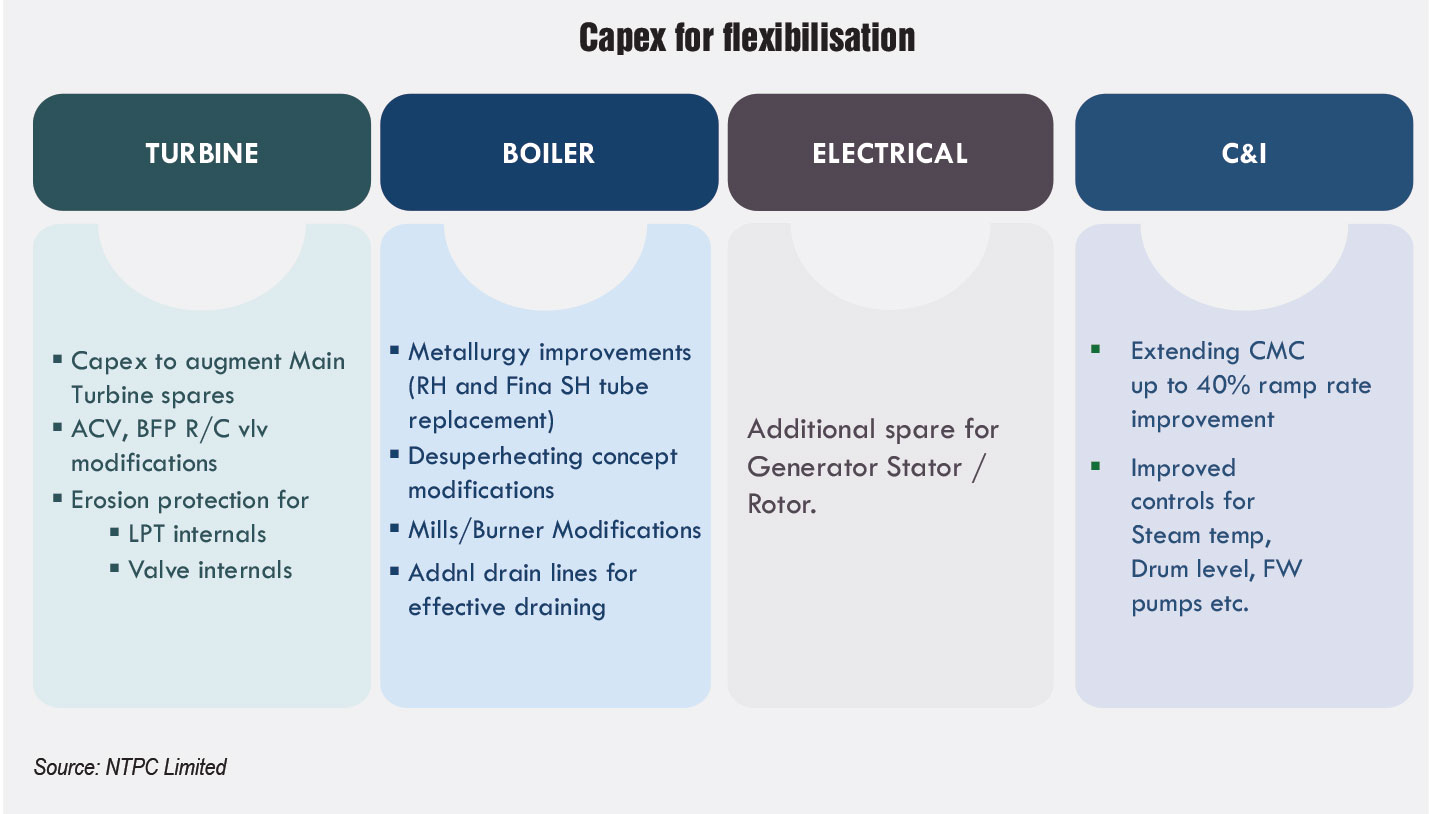
Making a coal plant “flex ready” involves both significant capex and opex. Capex typically covers modifications to boilers, turbines and control systems. For boilers, this includes tube replacements, burner upgrades, metallurgy improvements and additional drain line installations. Turbine-related costs involve valve and rotor modifications, erosion protection for low-pressure turbine internals and upgrades to auxiliary components such as boiler feed pump recirculation valves. Control and instrumentation upgrades focus on extending condition monitoring, improving ramp rate performance and enhancing control of parameters such as steam temperature, drum levels and feedwater pumps. On the electrical side, additional spares for generator stators and rotors may be required.
Opex rises substantially with flexibilisation. Plants experience increased frequency of inspections, overhauls and premature equipment damage, leading to higher maintenance costs and larger spare parts inventory. Operator training, refresher workshops and the use of advanced condition monitoring tools also add to ongoing expenses. Moreover, flexibilisation tends to reduce plant efficiency, leading to heat rate deterioration, higher auxiliary power consumption and greater specific oil use.
The major cost components of flexibilisation can be classified into three categories. First, flex-ready modifications are required to ensure safe and reliable operation at low loads, minimise equipment damage and support effective monitoring and control tuning during startup, shutdown and ramping operations. Second, O&M expenses rise due to accelerated equipment wear and tear, increased inspection scope and frequency, a need for higher maintenance inventories and the requirement for continuous operator training. Third, deterioration costs arise from higher heat rates, auxiliary power consumption and specific oil consumption. These costs are highly unit-specific and depend on plant design, age (vintage), existing controls and current O&M practices.
To support flexible operations, advanced monitoring systems are essential. For turbines, systems such as equivalent operating hours tracking, vibration monitoring systems and rotor stress calculators are used. Boilers require fatigue monitoring systems to assess component life, while electrical equipment may employ rotor flux monitoring to detect early faults. At the operational level, software-based tools assist in early fault detection and guide operators during startup, shutdown and load ramping.
On the O&M side, these monitoring systems translate into higher overhaul expenditures, frequent life assessments, increased spares requirements and expanded inspection regimes. For boilers, additional costs arise from more frequent chemical cleaning of final superheater and reheater tubes, along with greater maintenance of fans and pumps. Electrical systems such as generators, stators and high-tension motors also demand increased maintenance. From an operational perspective, enhanced operator training, refresher programs and additional consumption of water chemistry treatment chemicals become necessary.
NTPC initiatives
NTPC Limited has adopted a three-pronged strategy, known as TPP – technology, process and people – to enable variable load operation of its thermal power plants. On the technology front, NTPC is focusing on upgrading control and monitoring systems to ensure early warning and smooth operation. The company is also working on deploying artificial intelligence (AI)-based monitoring systems to further strengthen predictive capabilities. In addition, schematic modifications, technological enhancements and metallurgical upgrades are required. These include improvements in boiler combustion systems, introduction of boiler fatigue monitoring systems and optimisation of control systems. While collaboration with original equipment manufacturers (OEMs) is ideal, many international manufacturers have exited the business, posing a challenge. To address this, NTPC is partnering with domestic OEMs such as Bharat Heavy Electricals Limited (BHEL) and other suppliers to carry forward the required upgrades. Significant improvements have also been made in operational processes. NTPC has increased the frequency of overhauls, optimised overhaul intervals and adopted modified O&M practices based on over a decade of experience in flexible operations. As a result, a large portion of its non-pitted plants is now capable of operating in flexible mode. The third strategy is workforce preparedness. Operators are being extensively trained for the new regime of flexible operations. A centralised tuning group has been formed, tasked with visiting projects and optimising control tuning based on detailed analysis. NTPC has also collaborated with international agencies to expand knowledge-sharing and technical expertise. Simulator-based training has been identified as a critical component for preparing operators to handle flexible operations effectively.
Several initiatives have been undertaken by NTPC to assess and enhance the flexibilisation potential of coal-based power plants. NTPC has already achieved 55 per cent load operation and is working towards 40 per cent. A key step was the flexibilisation study carried out at NTPC’s Dadri and Simhadri stations under the Indo-German Energy Forum. This initiative focused on demonstrating the technical and economic feasibility of flexibilisation, analysing the legal framework and building the capacity of coal plant operators to manage flexible operations.
Further studies have been conducted at NTPC’s Unchahar and Farakka stations by Engie Lab, evaluating the cost implications and operational impacts of cyclic loading. Similarly, under the United States Agency for International Development programme, studies were undertaken at NTPC’s Ramagundam and Unchahar plants. At Vindhyachal, a dedicated flexibilisation study was carried out by Japan Coal Energy Centre, while OEMs such as BHEL and General Electric have also undertaken station-level assessments.
In addition to these studies, test runs have been conducted across different units to determine existing flexibilisation capabilities and identify technical limitations. These include examining two-mill operations at Dadri, testing single-stream operation at part load, confirming technical minimum load levels, assessing the adequacy of part-load compensation and evaluating achievable ramp rates.
To ensure continuous improvement, each plant startup is closely monitored by experts in Antariksh, with detailed feedback provided to stations. Moreover, systematic analysis of operating data under both full and partial load conditions is being carried out to better understand plant behavior and enhance flexible operation strategies.
Innovative solution: Way of mitigation
Beyond conventional mitigation measures, NTPC is exploring innovative, out-of-the-box solutions to enhance flexibility in thermal power operations. One such approach is the integration of thermal energy storage systems with thermal power plants. In this arrangement, when demand is low, the additional energy generated from the boiler can be stored in a thermal storage system. During peak demand, the stored heat can be used to generate steam, which is then fed into the turbine to produce electricity. NTPC is actively working on this solution, which offers significant operational benefits.
The key advantage of thermal energy storage is that it allows the boiler to operate consistently above its technical minimum load. Most operational challenges arise when boilers are forced to run below this limit, leading to instability and higher risk of outages. By keeping the boiler stable, the risk of forced outages is reduced, equipment life is extended and overall efficiency improves as the plant operates at higher loads.
Another solution is integrating long-duration energy storage systems at the generator terminal. Under this model, when power demand is low, excess electricity from the generator can be used to charge the storage system. When demand rises, the stored electricity can be discharged back into the grid. Such storage-linked strategies not only provide flexibility but also enhance plant reliability, efficiency and lifespan while supporting grid stability in a renewable-heavy power system.
Conclusion
Flexibilisation at scale requires coordinated support from multiple stakeholders. All units, including state-owned generating companies, must uniformly implement the 55 per cent minimum load mandate. OEMs are needed to provide technical support and upgrades. Regulators must design compensation mechanisms for life consumption and incentivise flexible operation. Grid operators should update procedures to reduce frequency fluctuations and improve forecasting. The Indian government’s role lies in providing policy support, low-cost funding and ensuring balanced capacity expansion.
Flexibilisation of thermal power plants is critical to India’s energy transition journey. While renewables will dominate the future energy mix, coal will continue to play a balancing role for at least the next two decades. By adopting technical upgrades, improved O&M practices and innovative solutions such as thermal energy storage, coal plants can operate flexibly without compromising reliability. However, this transition comes with higher costs and operational challenges, requiring strong regulatory, policy and financial support. Overall, thermal power is set to transform from being a base-load workhorse to a flexible enabler of India’s renewable-led future.
Based on a recent presentation by NTPC Limited at a Power Line conference