It is essential to recognise that while enhancing renewable sources is crucial, thermal energy remains necessary to support the country’s growing power demand and maintain a stable and secure grid. As of April 2024, coal accounts for 48.36 per cent of the country’s installed capacity, highlighting a significant reliance on coal. Therefore, a shift towards greater flexibility in thermal power generation is necessary.
Flexibility, in technical terms, involves minimising start-up and shutdown times and ensuring rapid ramp-up capabilities. In order to achieve affordable, reliable and sustainable power, power plants need to be prepared to undergo flexible operations. Common issues during flexibility operations include excessive fluctuations at lower loads, steam temperature variations and instability in ramp levels, which can result in flame disturbances. Successfully implementing flexible operations requires a multifaceted strategy, including advanced control systems, technological upgrades and global partnerships. Regulatory measures involve compensation mechanisms, incentives for flexibility and uniform implementation across all grid-connected entities.
While several options exist to support renewable energy variability, each faces significant limitations. Gas turbines and hydro offer fast ramping but are constrained by fuel availability and limited capacity. Emerging energy storage technologies show promise but have not yet been proven at scale and involve high costs. As a result, coal plants are being forced to adopt flexibilisation strategies to manage renewable energy variability.
Adapting to flexible operations involves both technical and commercial considerations. Technically, achieving faster ramps, stable lower loads, safe operation and environmentally friendly practices are crucial. Commercially, power plants must prepare for flexible operations by ensuring adequate compensation for increased operations and maintenance (O&M) costs, obtaining incentives for part-load operations and addressing the financial implications of these changes. To achieve these objectives, interventions are required in the boiler, turbine, operations and
control systems.
 Issues and challenges in flexible operations
Flexible operations present several issues and challenges, particularly at the boiler level, where fast ramping and frequent load variations below design limits cause significant temperature fluctuations and thermal stress. This leads to problems such as creep, fatigue, irreversible damage, high boiler tube leakage, permanent deterioration of material properties and difficulties in maintaining drum level control. These issues increase forced outages, reduce availability and reliability, and shorten plant life. Additionally, low load operations can result in poor combustion, flame instability and low coal pipe velocity, leading to choking, high furnace exit gas temperature and eco steaming, all of which negatively impact efficiency and emission compliance. Supercritical and ultra-supercritical boilers experience detrimental effects, such as a sharp rise in evaporator metal temperature during wet-to-dry changeovers, affecting other boiler parameters.
Turbines also face challenges, including high rotor train vibration, increased ovality and decreased casing hardness, a higher potential for low pressure (LP) blade failure, severe turbine blade deposition and damage to turbine valves. Excessive exhaust hood spray can lead to LP blade erosion, further complicating operations. Other issues include the potential for high-pressure casing cracks, LP turbine blade fluttering and damage to steam valve internals.
The cost of transitioning to flexible operations encompasses several components. Modifications to accommodate lower loads, ensure safe operation and minimise equipment damage are necessary. Monitoring systems are essential for condition assessment, and control tuning is required to manage parameter excursions. Additionally, operator training becomes critical to effectively handle these changes. It increases O&M expenses (including operator refresher training costs) due to premature equipment damage, more frequent and extensive maintenance inspections, additional overhauls, preventive maintenance and the need for higher inventories of spare parts. Furthermore, flexible operations also cause deterioration in heat rate, aux power consumption and specific oil consumption.
 Approach to flexible operations
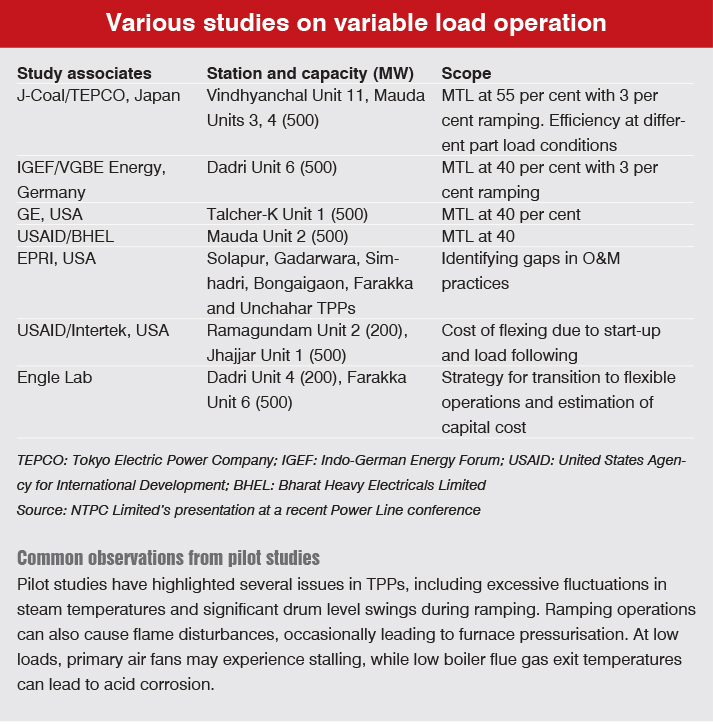
To successfully implement flexible operations, a multipronged strategic approach is required. This includes investing in advanced control and monitoring systems for early warning and smooth operations, schematic and technological upgrades, and building partnerships on a global and national scale. Support from original equipment manufacturers (OEMs) and experts is essential for enhancing the boiler combustion system, implementing fatigue monitoring systems and installing vibration monitoring systems. Optimising control systems is also crucial for overall efficiency. Process improvements involving reducing capital overhauls from every six years to every four years and optimising overhauling intervals are crucial steps. Engaging with OEMs and experts for insights and improvements will also aid in adapting to flexible operations. Comprehensive training and development programmes, the establishment of a centralised tuning group and collaboration with international agencies such as the Electric Power Research Institute (EPRI) and the Japan International Cooperation Agency are essential. Simulator training should be adopted to prepare personnel for the demands of variable load operations.
At the regulatory level, there are compensation mechanisms for low load operation, incentives for making units flex-ready and higher incentives for voluntary low load contributions. Additionally, there is a focus on ensuring the uniform implementation of these measures for all grid-connected entities, regardless of ownership.
Conclusion
Achieving effective and flexible operations in thermal power plants (TPPs) requires a concerted effort from all stakeholders. Adhering to the 55 per cent minimum thermal load (MTL) requirement is crucial for industry players, with collaboration among OEMs and industry partners being key to successful implementation. Regulators must establish comprehensive compensation mechanisms and incentivise flexible operation standards. The grid operator plays a vital role in ensuring stability and enhancing forecasting capabilities. Meanwhile, the Indian government must provide essential policy support, low-cost funding options and strategies to maintain a balanced grid capacity. Together, these collaborative efforts are vital to enhancing operational efficiency and reliability in the energy sector.
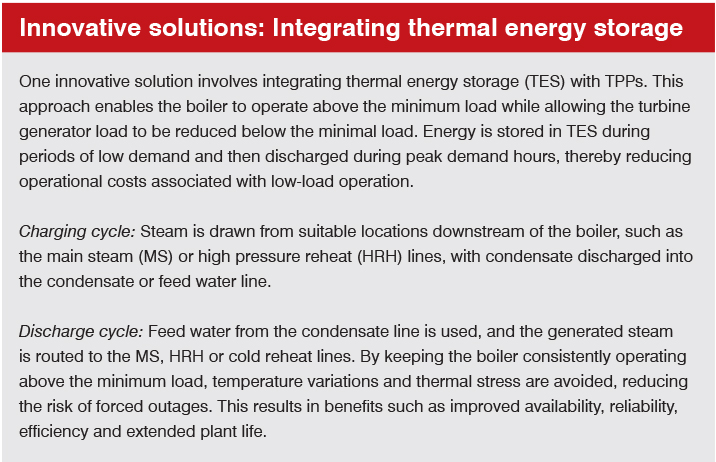
As the energy sector evolves, the shift towards flexibility is not just a necessity but an opportunity to enhance operational efficiency and sustainability. By understanding the regulatory landscape, addressing technical and commercial requirements and adopting innovative solutions such as thermal energy storage, the sector can navigate the complexities of flexible operations. Collaboration among industry peers, regulators, grid operators and the government will be key to driving this transition successfully and ensuring a resilient energy future.
Based on a presentation by Pankaj Kumar Gupta, General Manager (Energy Transition and Policy Research), NTPC Limited, at a recent Power Line conference