India’s power trading landscape has been evolving steadily, driven by policy reforms, greater renewable energy integration and wider market participation. Power exchanges have played an important role in ensuring transparent price discovery, real-time balancing and efficient resource utilisation. With market coupling on the horizon, further gains in transparency, competition and integration are expected. In this context, market experts share their perspectives on key developments, challenges and the way forward for India’s power trading segment…
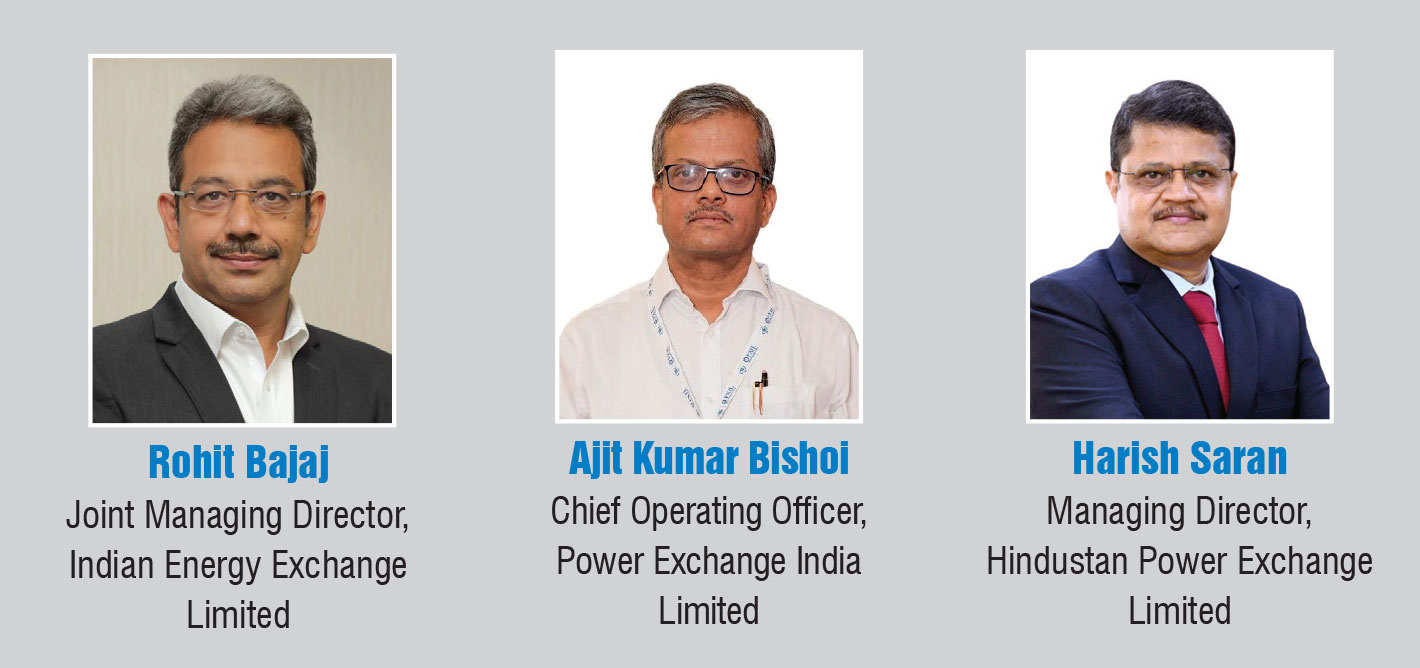
What is your assessment of the current state of the power sector? What have been the key achievements over the past year?
Rohit Bajaj
India’s power sector continues to show robust growth, ably backed by consistent macroeconomic expansion and progressive policy initiatives. The nation’s energy basket is being diversified away from thermal to wind, solar and hydro sources. In this shift towards renewables, India has already exceeded 50 per cent of its installed capacity from non-fossil sources, five years ahead of the 2030 Paris Agreement target. As the share of renewable energy rises in India’s overall energy basket, grid stability will become vital. The Ministry of Power’s (MoP) viability gap funding mechanism for battery energy storage systems (BESSs) is poised to facilitate cost-effective renewable energy integration with the grid. Moreover, BESS prices have dropped by 75 per cent in the last three years and are now comparable to thermal generation. Power exchanges are at the centre of facilitating this shift as intermittencies in renewable energy are optimally handled through the exchanges.
Targeted policy interventions by the Government of India in financial year 2025, most notably increasing domestic fuel production, have enhanced power market liquidity and efficiency within the sector. Overall, the year was characterised by ample fuel supply, with domestic coal production rising 5 per cent to nearly 1 billion tonnes, and coal-based generation rising more than 2 per cent, with enough supplies in hand. The e-auction coal premium eased by 10-20 per cent, and inventory levels increased to a multiyear high of 23 days. To minimise import dependence, the MoP encouraged blending of domestic and imported coal for eligible units. These steps ensured fuel supply despite a 4.4 per cent rise in electricity consumption in financial year 2025. Enhanced fuel supply provided adequate liquidity on the exchange platforms, leading to a 15 per cent reduction in average day-ahead market (DAM) prices to Rs 4.47 per unit, allowing discoms and industrial consumers to reap significant cost savings.
Furthermore, the MoP directive with regard to selling unrequisitioned surplus (URS) power in the DAM, the real-time market (RTM) and other segments of the power exchanges added to their liquidity and kept prices competitive.
Ajit Kumar Bishoi
India has made significant progress in strengthening its energy sector in recent years. The country is successfully balancing the twin goals of meeting rising electricity demand and promoting sustainability. According to the International Energy Agency, 85 per cent of the increase in global electricity demand over the next three years will come from emerging and developing economies. As one of the fastest growing major economies, India plays a central role in the global energy transition. Its energy demand is expected to grow at the fastest rate among major economies, driven by sustained economic growth. Consequently, India’s share in global primary energy consumption is projected to double by 2035.
Over the past decade, India’s power sector has seen robust expansion driven by rising demand, infrastructure development and strong policy support for both conventional and renewable energy sources. The installed capacity reached 495 GW as of August 2025, and electricity generation stood at 1,824 BUs in 2024-25. Non-fossil fuel sources now contribute 251 GW (50 per cent) of the total capacity, including 242.6 GW from renewables and 8.8 GW from nuclear sources.
Harish Saran
Current state of the power sector
India’s power sector today stands at a pivotal stage of transformation. With a total installed capacity of 496 GW, the country has achieved near-universal electrification, rapid demand growth and unprecedented renewable energy integration, now accounting for around 50 per cent of the total capacity.
Power demand has surged in line with industrial expansion and economic recovery, with record peak demand reaching 241 GW in mid-2025. The market framework has matured significantly, with power exchanges playing a central role in ensuring transparent price discovery and efficient power procurement.
A series of policy initiatives, such as the Revamped Distribution Sector Scheme (RDSS), green energy corridors and the proposed market coupling framework, have further strengthened the foundation for a modern, competitive power ecosystem.
However, financial stress among discoms, along with the need for grid flexibility to accommodate rising renewable penetration, continues to pose critical challenges. Addressing these issues is key to ensuring long-term sustainability and sectoral resilience.
Key achievements over the past year
The past year has witnessed strong progress and structural strengthening across the power sector value chain.
- Renewable energy expansion: India’s renewable capacity has crossed 242.6 GW, with solar power at 123 GW and wind at 52.6 GW, positioning the country among the world’s top renewable energy markets.
- Universal electrification and supply reliability: Electricity shortages have declined from 4.2 per cent a decade ago to just 0.1 per cent, following the successful electrification of every village and over 28 million new household connections.
- Grid and transmission strengthening: Ongoing expansion under the green energy corridors initiative and development of new interregional transmission links have improved renewable evacuation and system reliability.
- Policy and market reforms: Implementation of time-of-day tariffs, payment discipline mechanisms and smart metering initiatives under the RDSS have driven operational efficiency and digital transformation. Metering initiatives under the RDSS have driven operational efficiency and digital transformation.
- Domestic manufacturing momentum: Under the Make in India initiative, domestic manufacturing of solar PV modules has grown from 2.3 GW in 2014 to 100 GW in 2025, and the annual wind turbine manufacturing capacity has reached 18 GW, cementing India’s role as a clean energy manufacturing hub.
Together, these developments underscore India’s emergence as a global leader in clean energy transformation, combining growth with sustainability.
What are the biggest challenges facing the sector, and how can these be addressed?
Rohit Bajaj
India’s power sector is undergoing a remarkable transformation, driven by rapid economic growth, industrial expansion and an ambitious clean energy agenda. While steady progress has been made, certain structural challenges call for continued focus and reform.
The distribution sector remains central to this transformation, and strengthening the financial health of discoms remains key to ensuring sector efficiency. Encouraging timely tariff revisions, improving billing and collection mechanisms, and promoting cost-reflective pricing will help enhance discoms’ operational sustainability and service delivery. The large-scale deployment of smart meters will also go a long way in strengthening their financial health.
Even with a rapid increase in renewable energy capacity, coal-based power generation still dominates India’s energy mix and contributes to emissions. This highlights the need for further efforts to promote renewable energy for sustainable growth. As the share of renewables grows, the shift from coal to variable sources such as solar and wind will require strong transmission infrastructure. Concrete steps to improve grid modernisation, storage solutions and flexibility mechanisms will be essential for seamless renewable integration and maintaining system reliability. Since renewable energy projects take about 18 to 24 months to reach the commissioning stage, it is crucial that transmission projects are completed within a similar time frame.
It is also important that there is increased focus on implementing cost-reflective tariffs. While solar generation has grown significantly over the years, the time-of-day tariff system currently offers only a 10-20 per cent reduction in tariff during solar hours. To leverage this growing solar capacity, a further reduction in tariffs during solar hours needs to be considered. Currently, there is a significant difference in the prices during solar and non-solar hours on the exchanges, with prices during the solar hours being around Rs 2 per unit and the evening peak prices being close to Rs 10 per unit. A further deepening of power markets will ensure more effective utilisation of solar energy and reduce power procurement costs.
It is also pertinent to highlight that despite the sector’s phenomenal growth, driven by proactive government policies and initiatives, power markets still account for only around 8 per cent of the overall electricity market. There is a pressing need to expand these markets by introducing new contracts and innovative products that align with India’s evolving power requirements. Such steps will be essential to deepen market participation and improve overall sector efficiency.
Overall, a collaborative approach combining policy stability, technological innovation, deepening of power markets, market-friendly reforms and public-private partnerships will be instrumental in addressing these challenges. With continued reforms and innovation, India will be well positioned to build a resilient, sustainable and future-ready power ecosystem that supports its long-term growth and net zero ambitions.
Ajit Kumar Bishoi
The power sector is critical for a country’s development and well-being. In India, having a robust transmission and distribution (T&D) system, including last-mile connectivity, is crucial for the economy to grow. The goal is to ensure everyone can sustainably afford clean and green electricity.
To address the challenges of transitioning to sustainable and clean energy sources, a diversified energy strategy – including a mix of renewables combined with storage systems, nuclear, biofuels, and the combined use of thermal power – is essential to ensure energy security while minimising operational risks.
To combat climate change, the government is implementing various measures to meet India’s Nationally Determined Contributions (NDCs) under the Paris Agreement. By June 2025, the country reached a major milestone in its energy transition by achieving the NDC goal of 50 per cent of its installed electric power capacity from non-fossil fuel sources, five years ahead of the committed timeline of 2030.
With rapid capacity expansion in the renewables segment, efforts are being made to ensure the smooth integration of renewables into the grid. These efforts focus on ensuring grid stability and uninterrupted power supply, even during periods of low renewable generation, such as in the evenings and at night.
Power discoms continue to be the weakest link in the power sector supply chain. Early turnaround of discoms is vital to meet consumer demand and sustain the country’s economic growth.
In the power exchange space, the Central Electricity Regulatory Commission’s (CERC) recent order directing the implementation of coupling in the DAM from January 2026, to be followed by coupling in the RTM, coupling of RTM with security constrained economic despatch (SCED) and coupling in term-ahead market (TAM) contracts after completing the pilot study is a welcome step.
Market coupling will eventually bring in increased transparency in the power sector. DAM/RTM products, being major volume contributors on the power exchanges, will, post market coupling, enable exchanges to analyse the bidding behaviour of buyers/sellers, and design more innovative products to meet the changing requirements of market participants.
Overall, market coupling can help create a more integrated and efficient electricity market, promoting price convergence, enhancing competition, reducing the power purchase cost of discoms, and enabling the optimum utilisation of installed capacity. A single uniform price and healthy competition between power exchanges will benefit consumers and help achieve the “One Nation, One Grid, One Price” vision.
In the foreseeable future, we expect a significant increase in digital transactions and the introduction of many new contracts, resulting in a deepening of power markets. The power exchanges will introduce new contracts related to peer-to-peer trading, capacity markets, and contracts for difference in the form of virtual power purchase agreements (PPAs) (where brown attributes would be transacted through the power exchanges), as well as the aggregation of distributed energy sources, market-based economic despatch (MBED), secondary reserves ancillary services, carbon markets, etc., thereby adding diversity and scale to existing offerings. The expanding role of power markets will go a long way in ensuring clean, reliable and quality power supply to consumers at affordable costs.
Harish Saran
While the power sector’s growth trajectory is robust, several deep-rooted challenges continue to demand strategic attention.
- Financial stress of discoms: High aggregate technical and commercial losses of 15-18 per cent, delayed subsidy disbursals and tariffs below the cost of supply have strained discom finances. The way forward lies in tariff rationalisation, reforms-linked financial assistance and performance-based funding, which are critical to restoring viability.
- Grid and infrastructure gaps: T&D losses of 15-20 per cent undermine efficiency, while ageing infrastructure limits renewable integration. To address these issues, there is a need for accelerated grid modernisation, energy storage deployment and digitalisation through smart meters and advanced analytics.
- Renewable integration and variability: The rapid expansion of solar and wind energy increases intermittency risks. Therefore, increased investment in battery storage, flexible thermal operations and real-time balancing markets are vital.
- Policy and regulatory coordination: Land acquisition hurdles, project delays and policy inconsistencies across states hinder investor confidence. There should be greater centre-state coordination, streamlined approvals and long-term policy stability to foster investor trust and sustained private participation.
A cohesive regulatory and institutional approach, anchored in financial discipline, digital transformation and market efficiency, will be key to overcoming these challenges.
What is your outlook for the sector in the near to medium term?
Rohit Bajaj
India’s rapid urbanisation is expected to significantly increase energy consumption by 2040. The Central Electricity Authority forecasts that energy demand will hit 3,776 BUs by 2042. This increase will be a derivative of industrial expansion, quick digitalisation, the rise of data centres, and the increasing use of electric vehicles and cooling solutions.
On the supply side, renewable capacity is expected to expand at a record pace, supported by policy initiatives that promote round-the-clock and firm renewable energy projects. As the share of renewable energy increases in India’s energy basket, power exchanges are bound to play a much larger role. Globally, power exchanges have played a crucial role in reducing the cost of renewable integration and providing efficient price signals for new capacity addition.
Power markets in India too are poised to serve as catalysts for achieving our net zero targets. Already, regulatory and policy initiatives such as the sale of URS power on the exchanges and the availability of ample fuel at competitive prices are increasing market liquidity. The next few years are likely to see significant advancements in hybrid projects, smart metering and new market models such as battery storage arbitrage through exchanges, firm and despatchable renewable energy contracts, capacity contracting, and virtual power purchase agreements. These developments are likely to create new growth opportunities for power exchanges and the wider power market.
Ajit Kumar Bishoi
The power sector is at a very interesting stage, with significant policy initiatives being taken to drive growth forward. In addition to the series of steps being taken, there is also a focused drive to enhance the efficiencies of the sector by utilising market frameworks. The power markets, especially power exchanges, are an important instrument in this drive towards enhancing efficiency. Many power sector reforms are being introduced by the government to bring efficiency, promote decarbonisation and ensure 24×7 reliable and affordable power supply.
The introduction of electricity derivatives is a major development in India’s evolving power market architecture. The core utility of electricity derivatives is to hedge against the business risk emanating from frequent price changes. All active players in physical markets (such as independent power producers, discoms, open access consumers, traders, and large load retail consumers in the commercial and industrial segment) can now hedge their physical positions through financial derivatives to safeguard themselves against frequent price changes.
To achieve a net zero energy transition, where distributed and intermittent sources of power generation such as solar and wind contribute more than 50 per cent of the installed capacity by 2030, the introduction of long-duration electricity derivative products will help power market participants to hedge their capex risks.
To move towards a greener economy, the Carbon Credit Trading Scheme was notified by the MoP in June 2022 with the objective of involving the corporate and private sectors in energy saving and carbon emission reductions. Similarly, the CERC has notified the draft regulations for carbon credit certificates, and the final regulations are expected to be notified soon. With the successful operation of the renewable energy certificate and energy savings certificate markets by power exchanges over the years, the exchanges are now poised to play a significant role in the development of the carbon market.
Policymakers and regulators have taken significant steps by notifying the resource adequacy (RA) framework, which lays emphasis on maintaining an optimal capacity mix to meet the projected demand at the lowest cost. The RA exercise assesses the required capacity to be contracted on a long-term, medium-term and short-term basis. To meet the RA capacity, the short-term requirement can be met by a mix of TAM contracts with tenures ranging from up to three months ahead to 11 months ahead after they are introduced on the power exchange platform. The medium-term requirement can be met through an optimal mix of TAM contracts and electricity derivatives, while the long-term requirement can be met through a combination of the proposed capacity market contracts and electricity derivatives.
A key aspect of RA planning is ensuring that adequate generation capacities are available round the clock to reliably meet demand under various scenarios. Going ahead, new generation capacities, energy storage and other flexible resources needed to reliably meet future demand at an optimal cost will be assessed.
Today, policymakers and regulators are taking steps to deepen the short-term market, aiming to enhance liquidity and enable more efficient price discovery, which is expected to increase the short-term market size from the current 10 per cent to nearly 25 per cent in the near future.
The introduction of new reforms, such as MBED, is the need of the hour, which can now be implemented after the successful roll-out of market coupling, with the coupling of DAM scheduled for January 2026, followed by the coupling of RTM and the coupling of RTM with SCED. This market-based despatch envisages the despatch of the cheapest power from generators across the country through bidding on the power exchanges, followed by a common uniform price. This single day-ahead price across India will lead to better price signals, power procurement planning and indication for capacity addition. In the global context, in Europe, market coupling systems have been functioning in both the DAM and intra-day markets, leading to increased liquidity, efficient utilisation of transmission infrastructure and maximisation of economic surplus.
Today, we have a highly supportive policy and regulatory environment, providing significant opportunities for power exchanges to serve the marketplace through a wide range of contracts of various tenures and catering to diverse market segments.
Ultimately, power exchanges are the marketplaces where buyers and sellers can efficiently and transparently manage their portfolios. PXIL continues to strive to make that experience better for all market participants.
Harish Saran
The outlook for India’s power sector is decidedly positive, defined by strong demand growth, digital transformation and a clear shift towards a low-carbon energy future.
- Demand and capacity growth: India’s electricity demand is projected to triple by 2035, driven by industrialisation, urbanisation and electric mobility. Installed capacity is expected to reach 610 GW by 2027, with renewables contributing nearly half.
- Market coupling and reform momentum: The upcoming market coupling mechanism will integrate the power exchanges, promoting market liquidity, competition and cost-efficient despatch. Advanced short-term market products and ancillary service mechanisms will further deepen market efficiency.
- Green energy transition: India’s push for green hydrogen, battery storage and electric mobility, backed by initiatives like the National Green Hydrogen Mission, will redefine the energy landscape and cut carbon intensity.
- Digital and smart grid transformation: The roll-out of smart meters, AI-driven predictive grid management and blockchain-based trading systems will enhance transparency and empower consumers.
- Investment and global leadership: Stable regulatory frameworks and investor-friendly policies will continue to attract private and foreign investment, reinforcing India’s position as a global clean energy powerhouse.
From scarcity to self-sufficiency, and now to sustainability, India’s power sector has evolved into one of the world’s most dynamic and future-ready ecosystems. With clear policy direction, continued market reforms, and a relentless push towards clean and digital energy, India is well on track to emerge as a global leader in the energy transition – powering its economy, empowering its citizens and inspiring the world.