Cross-border interconnections are becoming increasingly important as countries seek to strengthen energy security and integrate renewables into their grids. These links allow surplus power to flow across national boundaries and thus help balance seasonal and daily variations in demand and generation, thereby ensuring efficient use of regional resources. India, located at the centre of South Asia, plays a pivotal role in this process. Due to its geographical proximity to Nepal, Bhutan, Bangladesh, Myanmar and Sri Lanka, India has a natural advantage in coordinating power exchanges and enabling grid integration across the region.
Existing, under-construction and planned infrastructure
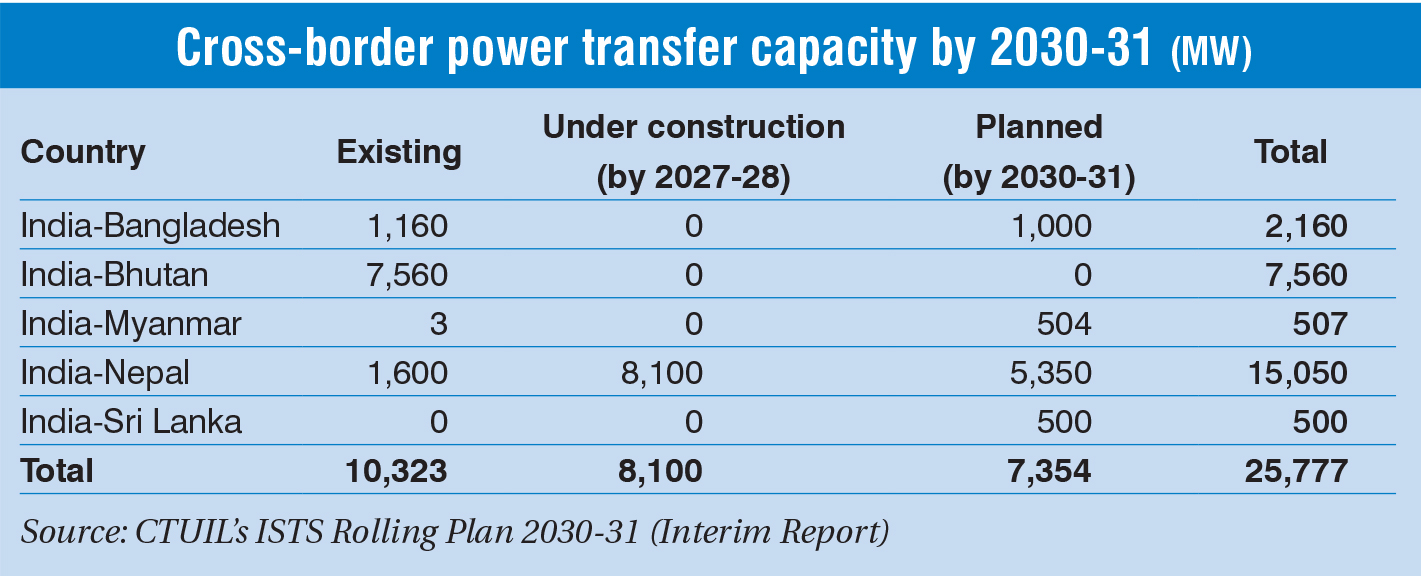
India’s cross-border transmission network currently links the national grid with Nepal, Bhutan, Bangladesh and Myanmar through a mix of synchronous and asynchronous interconnections at the 11 kV, 33 kV, 132 kV and 400 kV levels. As per Central Transmission Utility of India Limited’s (CTUIL) Interstate Transmission System (ISTS) rolling plan 2030-31 (Interim Report), at present, these interconnections have an installed transmission capacity of 10,323 MW, facilitating operational power transfer of about 5,414 MW. By 2027-28, installed capacity is expected to increase by another 8,100 MW through interconnections under construction, enabling a rise in operational power transfer to 9,194 MW.
India-Bhutan
India’s and Bhutan’s cross-border transmission network has been developed primarily to facilitate hydropower imports from Bhutan. At present, the two countries are connected through synchronous interconnections with a total transfer capacity of about 7,560 MW. The network includes links such as the 132 kV Kurichu hydroelectric plant (HEP) (Bhutan)-Geylephu (Bhutan)-Salakati (India) single-circuit (S/C) line, the 132 kV Deothang/ Motonga (Bhutan)-Rangia (India) S/C line, the 220 kV Chukha HEP (Bhutan)-Birpara (India) double-circuit (D/C) line, the 220 kV Malbase (Bhutan)-Birpara (India) S/C line, and the 400 kV Tala HEP (Bhutan)-Siliguri (India) two D/C lines. A major high-capacity corridor, namely, the 400 kV Mangdechhu HEP (Bhutan)-Jigmeling (Bhutan)-Punatsangchhu I and the II HEP (Bhutan)-Alipurduar (India) D/C line, serves as the main route for evacuating power from central Bhutan to India. Currently, power generation from the Punatsangchhu-I (1,200 MW) plant is delayed due to geological challenges. In November 2025, the Punatsangchhu-II (1,020 MW) plant was inaugurated by the Prime Minister of India and the King of Bhutan, following its full commissioning in August 2025.
Of the total transfer capacity, 2,651 MW of hydropower is currently being transferred from Bhutan’s Tala, Chukha, Kurrichhu and Mangdechhu plants. The existing transmission network has also been designed to accommodate upcoming power from the Punatsangchhu-I project, which is expected to be fully commissioned by 2026-27. Once operational, the total power transfer between the two countries is projected to increase to around 4,531 MW.
India-Nepal
India and Nepal currently share a total transfer capacity of 1,600 MW through multiple low voltage links, as well as the 400 kV Dhalkebar (Nepal)-Muzaffarpur (India) D/C line, which is the first high-capacity interconnection between the two countries.
Several major power transmission projects are under construction to further expand this network. These include the 132 kV Kohalpur (Nepal)-Nanpara (India) D/C line, which is targeted for completion by December 2025. Further, the 400 kV Dhalkebar (Nepal)-Sitamarhi (India) D/C line, associated with Nepal’s Arun-3 HEP, and the 400 kV New Butwal (Nepal)-Gorakhpur (India) D/C line are expected to be completed by March 2026 and May 2026, respectively.
Notably, in October 2025, Power Grid Corporation of India Limited (POWERGRID) and the Nepal Electricity Authority (NEA) signed joint venture (JV) and shareholder agreements to advance high-capacity cross-border transmission infrastructure between the two countries. As part of the agreement, one JV company will be incorporated in each country to implement the 400 kV Inaruwa (Nepal)–New Purnea (India) and 400 kV Lamki (Dododhara) (Nepal)–Bareilly (India) D/C lines. The agreements were formalised in November 2025. Under the ownership structure, in the Indian JV, POWERGRID will hold a 51 per cent stake and the NEA will hold 49 per cent, while the shareholding will be reversed in the Nepal JV. These projects are expected to significantly boost power exchange capabilities between the two countries, strengthening energy security and grid stability. With these additions, the total operational transfer capacity between the two countries is expected to more than double to around 3,500 MW in the coming years.
Recently, both countries agreed to develop three additional cross-border links: the 220 kV Chameliya (Nepal)-Jauljibi (lndia) D/C line, the 400 kV Nijgad/Harnaiya (Nepal)-Motihari (India) D/C line, and the 400 kV Lamahi (Nepal)-Lucknow (India) D/C line. For the Lamahi–Lucknow line, a joint study will first determine whether the Nepali termination point will be at Lamahi or Kohalpur, after which a detailed project report will be prepared. Apart from these, the Dhalkebar (Nepal)-Muzaffarpur (India) line is expected to be reconductored using high-temperature low-sag conductors to enhance its transmission capacity.
India-Bangladesh
At present, Bangladesh imports around 1,160 MW of power from India through two interconnections. The first is the 400 kV Baharampur (India)-Bheramara (Bangladesh) two D/C lines, supported by two 500 MW HVDC back-to-back terminals at Bheramara. The second is the 400 kV Surjyamaninagar (India)-North Comilla (Bangladesh)-South Comilla (Bangladesh) D/C radial line, which operates at the 132 kV level. In addition, Adani Power has commissioned a 1,600 MW thermal power plant at Godda in Jharkhand to supply electricity to Bangladesh through a dedicated 400 kV D/C radial line that operates independently of India’s main grid.
Looking ahead, a new 765 kV D/C line connecting Katihar (India), Parbotipur (Bangladesh), and Bornagar (India) is under planning. The project will enable an additional 1,000 MW of power transfer to Bangladesh. India will be undertaking the financing and construction of the entire project.
India-Myanmar
At present, power exchange between India and Myanmar is limited to about 2-3 MW, supplied from Moreh in Manipur to Tamu in Myanmar through an 11 kV radial line. Now, both countries are exploring options to scale up this capacity through multiple new interconnections, which together could enable the transfer of up to 504 MW of power from India to Myanmar. The proposed projects include a high-capacity Imphal (India)-Tamu (Myanmar) AC transmission line, supported by a 500 MW HVDC back-to-back system. Additionally, several low-capacity 11 kV radial links are being planned from Arunachal Pradesh, Manipur, Mizoram and Nagaland to supply electricity to border villages in Myanmar.
India-Sri Lanka
A 1,000 MW HVDC interconnection between Madurai, in India, and Mannar, in Sri Lanka, is at an advanced stage of discussion. The project will be implemented in two phases of 500 MW each, using voltage source converter technology. The transmission corridor will span about 285 km, including a 50 km submarine cable section across the Palk Strait. Recently, in October 2025, both countries held a virtual meeting to discuss implementation modalities and reaffirm their commitment to the project. Once operational, the interconnection is expected to enhance Sri Lanka’s energy security by allowing it to import power during shortages and export surplus renewable energy.
India-Saudi Arabia and the UAE
Beyond South Asia, India is looking to expand its grid connectivity to the Gulf region. Plans are under way to establish subsea transmission links with Saudi Arabia and the United Arab Emirates (UAE), for which JVs have already been signed. The proposal involves constructing a 1,400 km line to Saudi Arabia and a 1,600 km line to the UAE, each with a capacity of 2 GW. Together, these projects are expected to entail an investment of around Rs 900 billion and will enable the export of clean electricity from India to both countries.
Challenges and outlook
The expansion of cross-border transmission linkages remains constrained due to several challenges. Chief among these is the absence of a harmonised regional legal, regulatory and policy framework, which heightens investment risks for developers and financiers undertaking such projects. Additionally, technical coordination, covering grid codes, system security, scheduling, metering, and despatch are still managed bilaterally, making it challenging to ensure seamless and reliable operation of regional power networks. Beyond these technical hurdles, the lack of regional institutions for joint planning, dispute resolution and regulatory coordination, coupled with political sensitivities and the absence of a multilateral electricity trading platform, continues to slow down the pace of deeper grid integration across South Asia.
Even so, momentum is building. Under the One Sun, One World, One Grid initiative, India is exploring transmission linkages beyond South Asia, particularly with the Gulf and Southeast Asian regions. Notably, a 2,000 MW transmission link connecting India’s renewable energy sources to Singapore’s grid is under active consideration. The project is expected to advance both countries’ decarbonisation efforts while strengthening regional energy security. Looking ahead, such collaborations could lay the groundwork for a broader ASEAN-India green energy corridor, potentially extending to Malaysia, Thailand and Indonesia.
Ultimately, the development of new cross-border interconnections will play a crucial role in enhancing energy security and optimising regional resources. India’s leadership in driving these initiatives remains central to building a robust, resilient, and interconnected power network that benefits the entire South Asian region.