

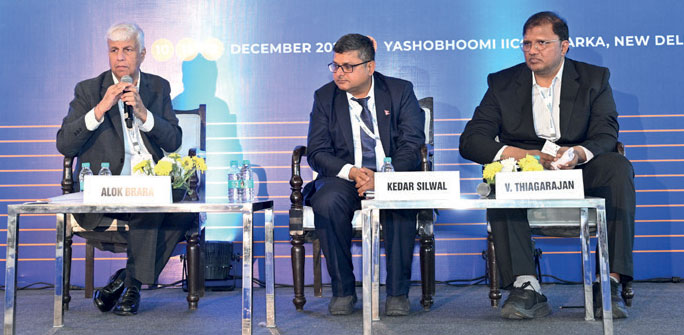
The session on “Cross-border Transmission” featured a discussion between Kedar Silwal, Director, Nepal Electricity Authority, and V. Thiagarajan, Senior General Manager, Power Grid Corporation of India Limited (Powergrid). They spoke about India’s expanding cross-border electricity interconnections and the growing role of regional power trade in South Asia. They also discussed the economic rationale for interconnections, ongoing and planned transmission links with neighbouring countries, and the regulatory and operational framework enabling cross-border power exchanges. Edited excerpts from their interaction…
As larger, interconnected grids are more efficient, reliable and cost-effective, India has been focusing on strengthening cross-border electricity links. Expanding the power system across borders also supports the development of a regional electricity market in South Asia.
India’s cross-border interconnections are being built using three main configurations: HVDC links, AC synchronous connections and radial links. HVDC systems are typically deployed for very long distances, undersea cables, or where electrical isolation between grids is required. Back-to-back HVDC stations are used to prevent disturbances in one grid from affecting another. AC synchronous interconnections, on the other hand, are preferred where multiple links and large power transfers are required. Nepal, for instance, is being connected to India largely through AC interconnections.
India, Bhutan and Nepal interconnections
Bhutan was India’s earliest and most significant cross-border power partner. The Tala Hydropower Project, which allocated about 1,000 MW of generation to India, marked a major milestone. This was supported by the double-circuit Tala-Siliguri transmission line. Over time, additional projects such as Chukha and newer developments including Punatsangchhu have expanded bilateral capacity. Today, interconnections between India and Bhutan can carry around 2,300 MW of capacity, with further expansions under consideration to support future hydropower development in the Himalayan nation.
Nepal is blessed with an estimated hydropower potential of 83 GW – about 42 GW of which is technically and financially viable. The country has so far developed only a fraction of this resource. Its current installed capacity stands at roughly 4 GW, but power purchase agreements totalling about 11.4 GW have been signed. The installed capacity is expected to grow by about 1 GW each year, creating significant surplus power in the near term.
Nepal currently exports about 1.2 GW of electricity to India, primarily through the Dhalkebar-Muzaffarpur 400 kV transmission line, supplemented by the Tanakpur-Mahendranagar 132 kV line. The Dhalkebar-Muzaffarpur line is operated through a joint venture between the Nepal Electricity Authority and Power Grid Corporation of India Limited, and has been functioning smoothly. Several new interconnections are under construction or at advanced planning stages. These include the Butwal-Gorakhpur 400 kV line, expected to be operational by mid-2026, and additional 400 kV corridors such as Duhabi-Purnia and Dodhara-Bareilly, scheduled for commissioning by 2029. Each of these lines will be capable of transferring up to 2,500 MW, significantly strengthening cross-border capacity.India’s power exchanges with Bhutan and Nepal benefit from seasonal complementarity, with hydropower peaking in summer when India’s demand is highest and imports rising in winter, improving grid stability and resource use. In 2024, this cooperation expanded further with the signing of a tripartite agreement between Nepal, India and Bangladesh. Since November 2024, Nepal has been exporting power to Bangladesh through the Indian grid.
Towards “One Sun, One World, One Grid”
India’s expanding network of cross-border interconnections represents more than just infrastructure development; it is a strategic move toward regional energy integration. By building a strong South Asian regional grid, India is taking steps towards the broader vision of “One Sun, One World, One Grid”.
A 500 MW to 1,000 MW HVDC undersea cable linking India and Sri Lanka is under detailed study, with an estimated project cost of Rs 127 billion. While the technical feasibility has been established, work is ongoing to finalise a viable business model. Further studies are also under way for undersea cable connections to Saudi Arabia and Singapore, reflecting a longer-term vision of intercontinental power trade. As technical studies progress and regulatory frameworks evolve, cross-border power trade is poised to become a cornerstone of sustainable energy cooperation in the region.


