

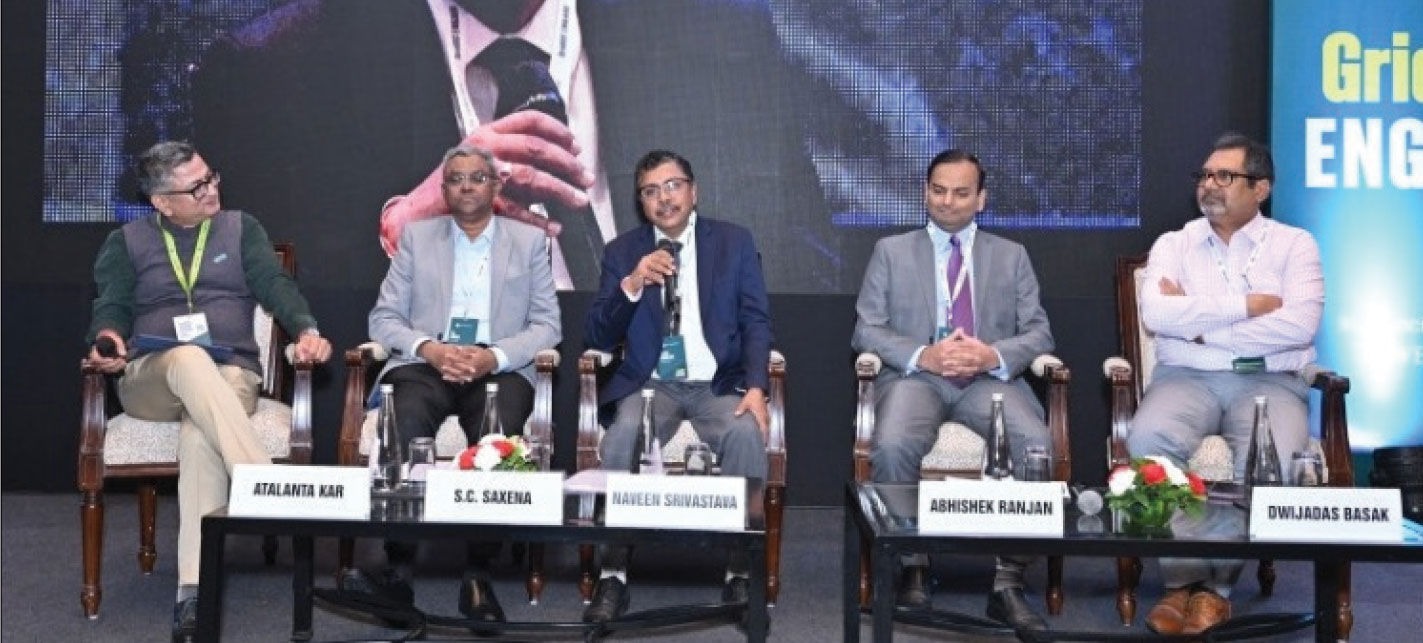
GridOS Engage, organised by Grid Software division of GE Vernova T&D India Limited, brought together stakeholders from across the power sector to deliberate on the evolving requirements of grid planning, operations and control amid rapid renewable integration, growing distributed energy resources (DERs) and increasing system complexity. The event featured interaction and remarks by Ghanshyam Prasad, Chairperson, Central Electricity Authority; Atalanta Kar (AK), General Manager – Grid Software – GE Vernova; Sandeep Zanzaria, Managing Director and Chief Executive Officer (CEO), GE Vernova T&D India Limited; Naveen Srivastava, Director, Operations, Power Grid Corporation of India Limited; S.C. Saxena, Chairman and Managing Director, Grid Controller of India Limited (GRID-INDIA); Dwijadas Basak, Chief Executive Officer, Tata Power Delhi Distribution Limited; and Abhishek Ranjan, CEO, BSES Rajdhani Power Limited, among others. The key sessions focused on policy and regulatory perspectives, grid modernisation, geospatial network intelligence, DER management, IT-OT integration and digitally dynamic transmission assets. Key takeaways from the sessions…
Key drivers for grid transformation
India’s power grid is undergoing a structural transformation driven by rapid capacity growth, growing share of renewables and increasing digitalisation. Higher renewable penetration has made grid operations more variable and complex, increasing the need for advanced control systems, automation and real-time visibility. Traditional approaches to grid management are no longer sufficient as demand peaks rise and system expansion accelerates.
Automation is increasingly being embedded across the value chain. Remote operation and unmanned substations are becoming common. In transmission, utilities are moving away from static designs towards more flexible and optimised use of assets. Technologies such as dynamic line ratings, sensor-based monitoring and digital asset management are enabling better utilisation of existing infrastructure, particularly where right-of-way (RoW) constraints limit new line construction. Policy measures related to land compensation, along with the use of monopole towers, multicircuit lines and high-capacity conductors, are expected to further ease expansion challenges.
Transmission planning is also becoming more dynamic, with national and state-level plans now being updated more frequently to reflect changes in generation and demand. Intra-state networks are also being strengthened to reduce congestion. Moreover, while transmission systems have good visibility up to the state load despatch centre level, significant gaps remain in distribution networks. Digitising distribution networks down to the consumer level is therefore essential for effective system control and planning.
At the same time, rising data centre demand is emerging as a major challenge. Deeper digitalisation is also increasing cybersecurity risks. Utilities are therefore focusing on system resilience, backup control centres and stronger data protection.
DERs
The growth of DERs, including rooftop solar, batteries and electric vehicles (EVs), is rapidly changing distribution network behaviour. Power flows are no longer unidirectional, and customer-owned assets now have a direct impact on voltage, frequency and congestion at the local level. As DER penetration increases, distribution networks need to be actively managed.
Utilities face several challenges from high DER penetration. Intermittent generation leads to rapid changes in net load, while reverse power flows can cause voltage violations and protection issues. Electrification of transport and rapid EV charging can create coincident demand peaks, increasing stress on distribution networks. Low demand during high solar generation periods is emerging as a system-level concern, particularly for frequency control. To address these issues, DER management platforms are being adopted. These systems provide utilities with the ability to register DERs, monitor their status, forecast their output and, where permitted, control or influence their behaviour.
Coordinated DER control can support both peak and minimum load management. Utilities can curtail generation selectively, charge batteries or shape demand to maintain frequency and voltage within limits. Forecasting engines that combine weather data, network models and machine learning (ML) allow utilities to identify potential variations in advance and take corrective action.
Additionally, consumer participation through DERs is increasing, with mechanisms such as demand response and time-of-day tariffs influencing local network behaviour. Regulatory frameworks are gradually evolving to enable better integration and coordination of DERs. As a result, distribution utilities are beginning to shift from network operators to system operators. As utilities evolve, DERs are increasingly viewed as a source of flexibility rather than a risk.

AI in grid operations
Changing grid operations are also affecting grid planning, real-time operations and control systems, making digitalisation essential for maintaining reliability and stability. At the system level, operational upgrades are being implemented to improve visibility and response time. GRID-INDIA’s work with central and state load despatch centres, utilities and technology providers has focused on strengthening supervisory control and data acquisition (SCADA) systems and energy management systems (EMSs), wider deployment of phasor measurement units and transition to five-minute scheduling and settlement. These steps are improving situational awareness and enabling faster operational decisions. At the same time, cybersecurity is increasingly being treated as a critical aspect, with utilities deploying security operation centres and adopting zero-trust principles as part of routine grid management.
From a transmission perspective, a key challenge is synchronising fast-paced renewable additions with longer transmission development cycles. RoW constraints, land acquisition issues and climate-related risks add to this complexity. Digital tools are being used to address these challenges. Satellite data and geospatial tools support terrain analysis and climate risk assessment, while AI-based models are being applied for weather forecasting and disaster prediction. Drone-based inspections are reducing manual intervention, improving asset monitoring and strengthening network resilience.
In distribution, the focus has shifted from basic supply availability to high quality, interruption-free power. Achieving this requires digitisation across the distribution network.
Combining advanced metering infrastructure, outage management systems, geographic information system (GIS) and analytics can deliver tangible gains in loss reduction, power procurement efficiency and customer service.
AI is also becoming central to grid operations as data volumes grow. Control rooms today receive multiple alarms from different grid devices, making it difficult for operators to identify the root cause of problems. ML can group related alarms and isolate the underlying issue. This is being enabled through tools such as virtual operators, which are decision-support systems that retain institutional knowledge, assist operators and automate routine analytical tasks. By embedding generative AI and ML into grid operations, utilities can shorten operator training cycles and allow human operators to focus on critical, real-time decisions.
AI is also reshaping system planning and simulation. Conventional power-flow and contingency analysis tools struggle with large, unbalanced distribution networks, incomplete asset data and the sheer size of modern grids. Now, ML-based digital twins are emerging as a practical alternative. These models enable faster simulations, identification of non-standard contingencies and near-real-time risk assessment. In both transmission and distribution, AI-driven contingency analysis can reduce study times from days to minutes.
AI applications are also being used to convert high-volume data from smart meters, feeders, sensors and weather systems into actionable insights. These capabilities are improving demand forecasting, feeder-level monitoring, outage reduction and capex optimisation. AI is also supporting customer-centric applications, including predictive maintenance, EV and rooftop solar planning, and improved billing and service workflows.
IT-OT integration
IT-OT integration has been discussed in the power sector for many years, yet it remains a major challenge. As networks digitise and data volumes grow, siloed systems make it difficult to get a complete view of operations.
To address this, many leading utilities are moving from system-level integration to unified data platforms. By bringing OT, IT and consumer data into common platforms, they can enable faster analytics, better operational decision-making and improved customer communication. Functions such as outage intelligence, predictive maintenance and customer experience management depend increasingly on this convergence of data across domains.
Moreover, as integration deepens, cybersecurity becomes critical. Systems are increasingly designed around controlled data sharing architectures that provide operational visibility while limiting direct system exposure and preserving grid security. The growing use of AI, ML and edge computing further heightens the need for secure and scalable integration, as these technologies rely on access to historical and real-time data across systems for asset health monitoring, fault diagnostics and predictive maintenance. In this context, utility-specific platforms that support plug-and-play integration, translate proprietary data formats, and provide analytics-ready data are increasingly seen as essential enablers rather than optional tools.
Geospatial network models
Geospatial network management is evolving from a mapping and design function into one of the core digital capabilities for utilities. Network models are increasingly being treated as enterprise-wide assets that provide a consistent view of the network for planning, operations, analytics and field execution. This shift reflects the growing need for accurate, shared network data across multiple utility functions.
A shared network model reduces long-standing data silos. When geospatial and network information is managed as standardised data products and shared through common integration layers, components such as planning tools, field systems, analytics platforms and AI applications can leverage the same trusted network model. Over time, the goal is to provide a more unified model spanning GIS, EMSs, advanced distribution management systems and outage management systems, thereby improving data consistency and decision-making.
Network model lifecycle management is essential for utilities. Beyond geospatial mapping, it covers planning, construction, commissioning, operations and refurbishment. The network model tracks both as-built and as-operated states, maintains version history and integrates data from field systems, SCADA, smart meters and other operational sources. This approach ensures accurate system studies, traceable decisions, and reliable operational outcomes while reducing duplication and improving governance.
Visual intelligence is a tool that further strengthens network accuracy by applying AI and ML to imagery, LiDAR, drone data, advanced metering infrastructure and outage records. These tools help identify data gaps, validate network connectivity and improve asset visibility.
Utility experience across electricity and gas networks highlights common priorities: integrating diverse data sources, maintaining high data accuracy for billing and operations, meeting regulatory requirements and demonstrating clear returns on investment. Strong geospatial data, validated network models and secure data sharing directly support reliability, resilience and customer service, while enabling advanced analytics and digital twin applications for future network planning.
DLR
Traditionally, utilities have addressed capacity constraints by building new lines or upgrading conductors. However, these solutions are capital-intensive, face RoW challenges and often take three to five years to implement. Dynamic line rating (DLR) offers an alternative to increase transfer capability by using existing infrastructure.
Conventional line ratings are based on conservative assumptions about ambient temperature, wind and solar conditions. In practice, these assumptions leave significant unused margin on transmission assets. DLR replaces static limits with ratings calculated using real-time and forecasted weather parameters such as ambient temperature, wind speed, wind direction and solar radiation. By reflecting actual operating conditions, DLR can typically deliver 10-35 per cent additional transfer capability without physical modification of the line. A software-based approach to DLR further reduces deployment complexity. Instead of installing sensors on conductors, digital DLR platforms use geospatial network models, line characteristics and high-resolution weather data to calculate real-time and forward-looking ratings. These ratings can be used across planning, operations and maintenance, creating a common, transparent database for utilities and system operators.
DLR supports multiple use cases beyond congestion relief. During planned outages, higher dynamic ratings on adjacent lines can help maintain transfer capability. Over time, DLR data can also inform investment decisions by identifying corridors where capacity augmentation can be deferred. While DLR does not eliminate the need for new transmission, it provides a fast and cost-effective tool to improve flexibility and reliability.
In sum, the future grid will be defined by its adaptability, intelligence and customer focus. By integrating real-time data, predictive insights, flexible operations and coordinated distributed resources, utilities can enhance reliability, optimise assets and deliver more value to consumers, preparing the system to meet growing complexity and evolving energy demands.