
Europe’s energy transition has reached a critical juncture where the availability, resilience and integration of energy infrastructure have become as vital as large-scale deployment of renewable energy generation itself. In the dynamic geopolitical and economic milieu of the Russia-Ukraine conflict, intensifying global competition and persistently high energy prices as well as the scale of the decarbonisation challenge, the European Commission (EC) recognises electricity grids as a core determinant of Europe’s energy security, industrial competitiveness and social cohesion. Without faster, smarter and more coordinated investments in the electricity, gas and hydrogen networks, Europe’s targeted Energy Union cannot be achieved, climate targets will be missed and the region’s economic position will weaken further.
The EC estimates that without any decisive action, 45 per cent of cross-border electricity needs (or 41 GW of 88 GW) as well as the 15 per cent interconnection target of many member countries will remain unmet by 2030. This, in turn, will increase costs from grid congestion to Euro26 billion (from Euro5.2 billion in 2022), and renewable energy curtailment may reach up to 310 TWh by 2040 – almost half of the European Union’s (EU) electricity consumption (in 2023). Conversely, enhanced market integration could generate annual cost savings of over Euro40 billion and contribute positively to EU GDP growth (a 50 per cent increase in cross-border electricity trade could raise the annual GDP by Euro18 billion in 2030).
In this backdrop, on December 10, 2025, the EC announced the European Grids Package along with accompanying legislative proposals for the revised Regulation on trans-European energy infrastructure (TEN-E) and a revised directive for accelerating permitting procedures, which together mark a strategic shift in how the EU plans its energy system. Additionally, the EC announced the Energy Highways initiative as part of the State of the Union address. Under this, it has identified eight energy highways to address the most urgent infrastructure needs that require additional short-term support and commitment for implementation. The new package and energy highways are designed as a comprehensive response to structural bottlenecks in infrastructure planning, permitting, financing, implementation and security. It complements the EC’s other flagship initiatives such as the Affordable Energy Action Plan (2025), Grid Action Plan (2023) and REPowerEU (with recent agreement to completely phase out all remaining Russian fossil fuel imports of gas and oil by the end of 2027).
The EC also adopted the “Guidance on Efficient Grid Connections”, which is a legally non-binding document with recommendations for countries and national regulatory authorities (NRAs) that can be applied to reduce grid connection queues, accelerate electrification, and make the most efficient use of existing grids. These include applying the “first-ready first-serve” principle, transparent maturity criteria for all connection requests, establishing clear project development milestones with associated penalties for non-compliance and conducting regular monitoring and cleaning of the connection queues. Further, the EC adopted the “Guidance on Contracts for Difference (CfD)”, another legally non-binding document with recommendations on designing two-way CfDs for renewable energy and nuclear generation, as required under the revised Electricity Regulation (2024).
Power Line presents the Global Transmission Report’s key highlights of the EC’s latest package for tackling structural bottlenecks in infrastructure development…
 Proposed changes to TEN-E framework
The current grid planning framework under the TEN-E Regulation has served its purpose with 124 Projects of Common Interests (PCIs) and Projects of Mutual Interests (PMIs) advancing with the backing of Euro8.4 billion from the Connecting Europe Facility (CEF), unlocking at least Euro15.8 billion in private investments. However, further action is imperative to ensure a seamless coordination across the national, regional and EU governance levels as well as across sectors, to ensure a fully optimised and interconnected grid.
The revised TEN-E Regulation represents a departure from the predominantly bottom-up, project-driven approach of existing frameworks. While maintaining country sovereignty over energy choices, it introduces stronger EU-level steering to ensure that infrastructure development aligns with EU-wide climate, energy and competitiveness objectives.
The key objectives of the revised regulation are ensuring that projects included in the network development plans and selected as PCIs/PMIs effectively address identified infrastructure needs, including through non-wire and digital solutions; accelerating the deployment of cross-border infrastructure by improving cost-sharing mechanisms and reducing implementation delays; simplifying and speeding up permitting procedures for cross-border energy infrastructure; and enhancing the physical and cybersecurity resilience of critical cross-border energy assets.
A key aspect is the introduction of a binding central EU energy scenario, developed by the EC with inputs from member countries and stakeholders, within two years of the enactment of the package. This scenario is expected to provide a common analytical foundation for infrastructure planning across the electricity, hydrogen and gas networks. It will guide the identification of infrastructure needs by the European Network of Transmission System Operators of Electricity and Gas (ENTSO-E and ENTSOG) as well as the European Network of Network Operators for Hydrogen (ENNOH).
Most importantly, the EC will be empowered to intervene where planning gaps persist. If cross-border needs are identified but no corresponding project proposals emerge, a “gap-filling” process would be launched, inviting system operators and promoters to develop solutions. This mechanism reflects a recognition that market-driven and national approaches alone are no longer sufficient to deliver timely cross-border capacity.
The revised framework broadens the definition of energy infrastructure beyond physical transmission assets. It explicitly recognises non-wire solutions, demand response, storage, digital optimisation and grid-enhancing technologies (GETs); digital and monitoring equipment essential for system stability and congestion management; physical and cybersecurity installations that protect critical network elements; and hybrid and offshore grid configurations, including energy islands and meshed offshore networks. Most of these measures will help maximise the use of existing infrastructure to achieve an affordable and sustainable energy transition and also ensure energy security. The EC estimates that GETs alone could increase effective network capacity by 20-40 per cent by 2040, at substantially lower cost than that incurred for traditional expansion. Embedding these solutions in the planning and eligibility criteria marks a fundamental evolution in the EU infrastructure policy.
Financing the grid transition
The investment challenge facing Europe’s energy infrastructure is unprecedented. By 2040, electricity grids alone will require around Euro1.2 trillion, including Euro730 billion for distribution networks. Hydrogen infrastructure will add a further Euro240 billion. Given that grid investments are largely recovered through network tariffs, there is a clear risk that insufficient coordination and cost allocation could translate into higher consumer prices. The revised TEN-E framework, therefore, places strong emphasis on fair and transparent cross-border cost-sharing. Key reforms include:
- Mandatory participation in cost allocation for countries receiving significant benefits (at least 10 per cent);
- Greater transparency through the ACER Guidance and a central repository of cross-border cost allocation decisions taken by NRAs;
- The possibility to bundle multiple PCIs/PMIs to facilitate multicountry cost-sharing and financing;
- Stronger links between congestion revenues and reinvestment in interconnection capacity. Particularly, it requires TSOs to set aside 25 per cent of the congestion income for PCI investments.
The EU funding instruments, particularly the CEF, are positioned as catalysts rather than substitutes for private investment. The EC’s broader Clean Energy Investment Strategy and the reinforced CEF proposed under the next Multi-annual Financial Framework (MFF) are intended to de-risk projects and crowd in institutional capital. Under the MFF 2028-34, the EC plans to increase the CEF energy budget from Euro5.84 billion to Euro29.91 billion.
Security and resilience by design
The EC recommends the integration of security and resilience considerations into infrastructure planning from the outset. Recent incidents in the Baltic Sea and elsewhere have demonstrated that energy infrastructure is exposed to physical sabotage, cyberthreats and climate extremes. The revised TEN-E framework requires enhanced risk assessments for PCIs and PMIs, greater transparency on ownership structures, and eligibility of resilience-enhancing investments for EU funding. These measures are aligned with broader initiatives such as the EU Cable Security Action Plan and aim to ensure that Europe’s energy backbone is secure not only during normal operations but also under stress.
Accelerating permitting reforms
If planning defines what must be built, permitting determines when it actually happens. Slow permitting remains the single most important barrier to the timely deployment of energy infrastructure and generation in the EU.
Electricity transmission projects currently take around five years to permit, with permitting accounting for more than half of the total implementation time. The European Grids Package establishes an EU-level framework to simplify and accelerate permitting procedures for all grid infrastructure, renewable energy projects, storage projects and recharging stations, and further strengthens the provisions for PCIs/PMIs. The key features are:
- Automatic presumption of overriding public interest for electricity PCIs and PMIs;
- Streamlined environmental assessment procedures for projects with limited impact, without weakening Natura 2000 protections;
- Clear maximum time limits, typically two years and no more than three years for complex projects; further tacit approval applies in case authorities fail to act within the deadline, except for environmental decisions;
- Digitalisation of permitting processes and clearer procedural milestones. Countries are required to establish a single national digital portal for the permitting procedure for renewable energy, storage and grid projects;
- Stronger cross-border coordination between permitting authorities.
- Public acceptance is addressed not as an afterthought but as a structural component of acceleration.
The Energy Highways initiative
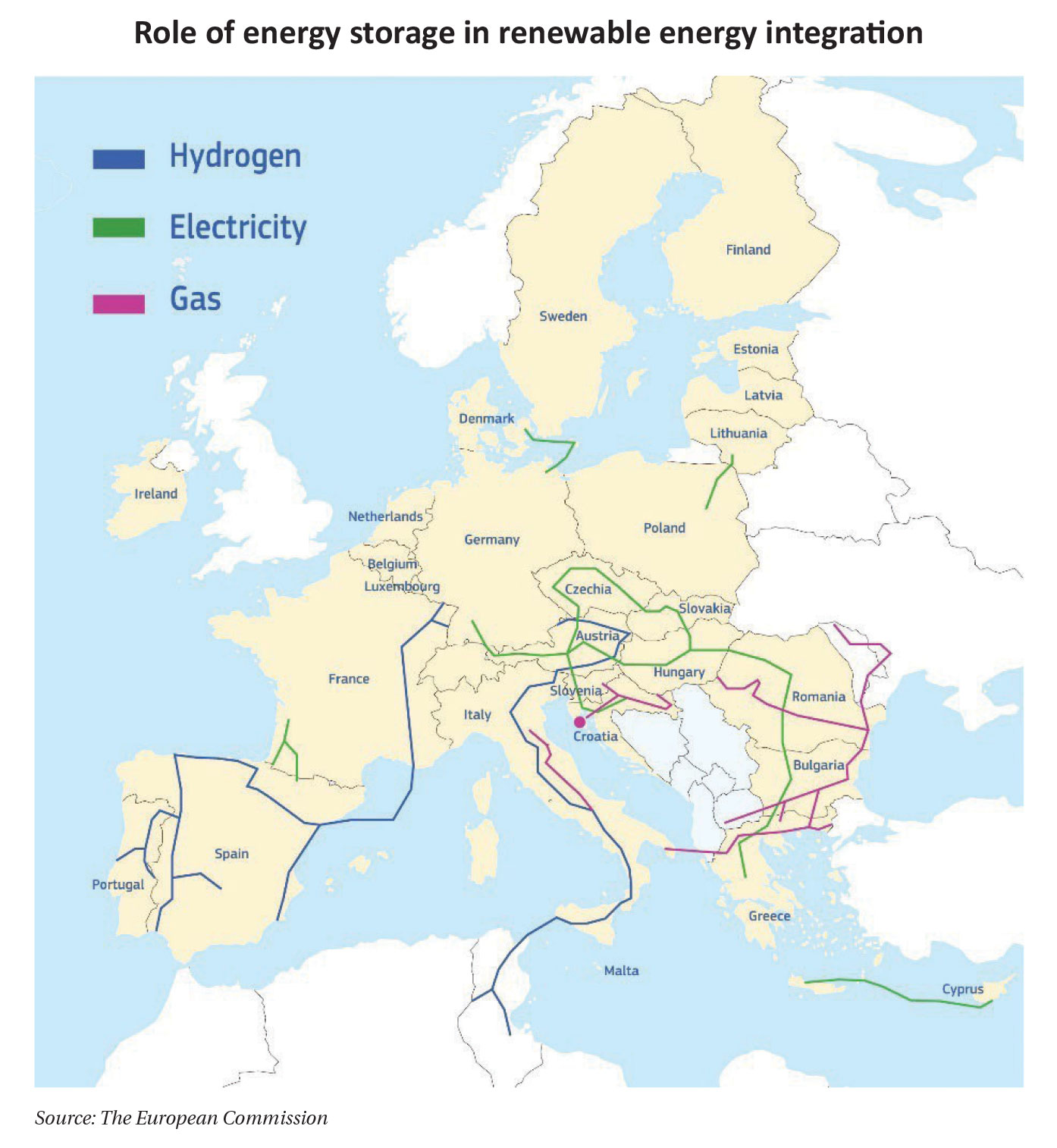
While the revised TEN-E framework provides the legal structure, the Energy Highways initiative introduced in the European Grids Package adds a layer of political prioritisation. Eight strategic corridors – spanning electricity interconnections, offshore hubs and hydrogen routes – have been identified as requiring immediate and sustained EU-level support.
These include the Pyrenean crossings (1 and 2) to better integrate the Iberian Peninsula; the Great Sea Interconnector to end Cyprus’s electricity isolation; the Harmony Link to strengthen power links with the Baltic countries; the Bornholm Energy Island to turn the Baltic Sea into an offshore interconnector hub; the south-eastern European electricity corridors to improve price stability and energy security in the region, including through storage; the TransBalkan Pipeline reverse flow to improve energy supplies in the Balkan region and neighbouring countries in the east; and two major hydrogen routes linking southern and western Europe to industrial centres in the north.
Many energy highways hold a PCI or PMI status in the second EU list of PCIs and PMIs, published on December 1, 2025. The list features 235 cross-border energy infrastructure projects such as the Celtic Interconnector, the Black Sea Interconnection Cable, and Estlink 3. Under the TEN-E framework, all PCIs/PMIs benefit from several advantages, such as priority status, streamlined permitting procedures, and eligibility to apply for financial assistance under the CEF.
For each energy highway, the EC has committed to enhanced coordination, possible appointment of European coordinators, targeted short-term actions and regular reporting to the European Council. This approach recognises that some infrastructure bottlenecks are as much political as technical and require sustained high-level engagement to be resolved.
Some projects are recognised as Important Projects of Common European Interest (IPCEIs), bringing additional benefits in terms of funding and coordination. Likewise, the Pyrenean crossings (1 and 2), the southwest hydrogen corridor, and the south-eastern Europe highway will be designated as pilots under the Competitiveness Coordination Tool, allowing them to benefit from the tool’s whole-of-government approach and specific capacity to address horizontal issues.
The way forward
The proposal will be submitted to the European Parliament and the Council under the ordinary legislative procedure, which will adopt positions following a scrutiny and modifications. This will be followed by trilogue negotiations (among the EC, Parliament, Council) before reaching a final agreement on the package’s directives (such as the TEN-E framework revision and the Permitting Acceleration Directive) and regulations, in turn, fast-tracking grid development for renewables integration and market efficiency.
The EC’s recent grids package, including legislative proposals and guiding documents, represents a decisive evolution in the EU’s energy policy. It acknowledges that the success of the energy transition depends less on announcing targets and more on delivering the physical, digital and institutional infrastructure that makes those targets achievable. By strengthening the EU-level steering of the electricity grids while preserving national involvement, broadening the concept of infrastructure, accelerating permitting, improving cost-sharing and embedding security considerations, the new framework seeks to transform Europe’s grids into strategic enablers.