
Rajasthan is consistently progressing in its clean energy efforts and supporting the nation’s sustainability goals. According to the Central Electricity Authority (CEA), as of January 2026, the total installed power capacity in the state was 61,075.02 MW, with thermal power contributing 14,727.35 MW and nuclear contributing 806.74 MW. According to data from the Ministry of New and Renewable Energy (MNRE), the state’s installed renewable energy capacity reached 43,798.06 MW as of January 2026. This installed renewable capacity comprises a diverse mix of 23.85 MW of small hydro, 207.52 MW of biopower, 412.5 MW of large hydro, 5,229.15 MW of wind power and 37,925.04 MW of solar power.
Rajasthan’s solar portfolio includes 33,064.77 MW of ground-mounted solar, 2,064 MW of rooftop solar installations (including those under the PM Surya Ghar: Muft Bijli Yojana), 1,980 MW under the hybrid solar component, and 816.27 MW off-grid/Pradhan Mantri Kisan Urja Suraksha evam Utthaan Mahabhiyaan (PM-KUSUM) Component B. The state’s biopower capacity is further divided into 134.15 MW of biomass power/bagasse cogeneration, 2 MW of non-bagasse biomass cogeneration, 59.6 MW of waste-to-energy (WtE) and 11.77 MW of off-grid WtE components.
Power Line takes a look at recent developments across renewable energy segments, renewable energy regulations and the future outlook for Rajasthan…
Solar surge
Rajasthan holds the largest installed solar power capacity in the country. Furthermore, it is among the only three states with an active presence across all four solar verticals: ground-mounted projects, rooftop solar, hybrid systems, and PM-KUSUM. Under the Rajasthan Solar Policy 2019, the state had set a target of achieving 30 GW of installed solar capacity by 2024-25, a milestone it has successfully surpassed.
The state has also seen strong uptake under the PM Surya Ghar scheme. According to the scheme’s website, Rajasthan has received a total of 271,840 applications. Of these, 133,546 installations have been completed, covering 137,502 households across the state. This translates into a conversion rate of 49 per cent. The cumulative installed capacity under the scheme in the state stands at 528.95 MW.
Simultaneously, the state has demonstrated mixed performance under the PM-KUSUM scheme. Under Component A, although 5,250 MW has been sanctioned, only 512.5 MW has been installed so far. Component B, which focuses on the installation of stand-alone solar pumps, has seen 144,752 pumps sanctioned, of which 121,940 had been installed as of February 2026. Under Component C (individual pump solarisation), 2,138 pumps were sanctioned, and all of them have already been installed. In contrast, under Component C (feeder-level solarisation), 400,000 pumps were sanctioned, while 137,499 pumps have been installed to date.
Rajasthan has also placed significant emphasis on the development of large-scale solar parks. According to a Rajya Sabha response dated December 9, 2025, several solar parks in the state have achieved full installation of their sanctioned capacities. These include the Bhadla-II Solar Park (680 MW), Bhadla-III Solar Park (1,000 MW), Bhadla-IV Solar Park (500 MW) and Fatehgarh Phase-1B Solar Park (421 MW). A few solar parks have recorded partial installations. The Phalodi-Pokaran Solar Park (750 MW sanctioned) has achieved 600 MW so far, while the Nokh Solar Park (925 MW sanctioned), Jaisalmer, has reached 847 MW, reflecting substantial progress. In contrast, several solar parks have been sanctioned but have not recorded any installations to date. These include the Pugal Solar Park Phase I (1,000 MW), Bikaner; Pugal Solar Park Phase II (1,000 MW), Bikaner; Pugal Solar Park Phase III (450 MW), Bikaner; RVUNL Solar Park (2,000 MW), Bikaner; and Bodana Solar Park (2,000 MW), Jaisalmer, where installations are yet to commence.
Rajasthan’s BESS and PSP ambitions
Rajasthan has been actively investing in both battery energy storage systems (BESSs) and pumped storage projects (PSPs). According to the CEA, the likely installed capacity of energy storage systems in Rajasthan is estimated at 11,323 MW by 2034-35. Furthermore, the state has a total pumped storage potential of 12,560 MW. Of this, around 6,160 MW is currently under survey and investigation or at the detailed project report preparation stage, as per the CEA estimates. Key projects at this stage include Shahpur (1,800 MW), Sirohi (1,200 MW), Brahmani (600 MW) and the Sukhpura off-stream PSP (2,560 MW). Overall, pumped storage development in Rajasthan remains at an early planning stage, with most projects yet to move beyond preparatory activities.
At the same time, Rajasthan has been expanding its footprint in the BESS segment through a combination of competitive tenders and regulatory interventions. In August 2025, Rajasthan Rajya Vidyut Utpadan Nigam Limited (RVUNL) floated a stand-alone BESS tender for 500 MW/2,000 MWh. This was followed in October 2025 by the declaration of results for RVUNL’s 1,000 MW/2,000 MWh stand-alone BESS auction, which saw strong market participation. The auction concluded with 11 successful bidders, and the lowest discovered tariff was Rs 177,500 per MWh per month. Project commissioning activity has also gained momentum. In January 2026, Juniper Green Energy Limited fully commissioned its 100 MWh merchant BESS in Bikaner through its subsidiary, Juniper Green Cosmic Private Limited. Of the total capacity, 60 MWh had already been commissioned in December 2025.
The state has also taken important steps on the regulatory front. In September 2025, the Rajasthan Electricity Regulatory Commission (RERC) proposed an amendment requiring all new renewable energy projects above 5 MW, excluding hydroelectric projects, to install energy storage systems. Under the proposal, developers would be required to deploy storage equivalent to at least 5 per cent of the project’s renewable capacity, with a minimum storage duration of two hours. This was followed in October 2025 by the issuance of draft regulations by RERC aimed at creating a comprehensive framework for the planning, procurement, deployment and utilisation of BESSs in Rajasthan.
 Harnessing CBG
The compressed biogas (CBG) sector in Rajasthan is still at a nascent stage, with limited commissioned capacity and most projects currently in the planning or construction phase. According to data from the GOBARdhan portal, a total of 53 CBG/bio-compressed natural gas (CNG) plants have been registered in Rajasthan so far. Of these, 33 projects are yet to commence construction, while 11 plants are currently under construction. Only nine plants have been commissioned. Recent project developments reflect gradual momentum in the sector. In January 2026, Organic Recycling Systems was awarded a contract by BNG Power and Energy for the development of a high-capacity CBG plant in Jaipur, Rajasthan. The plant will use Napier grass as its primary feedstock and is designed to produce 5 tonnes of CBG per day. In the same month, Biofics Private Limited signed an MoU for setting up a 3 tonne per day CBG plant in the state, which will utilise Napier grass and cow dung as feedstock.
State of the sector
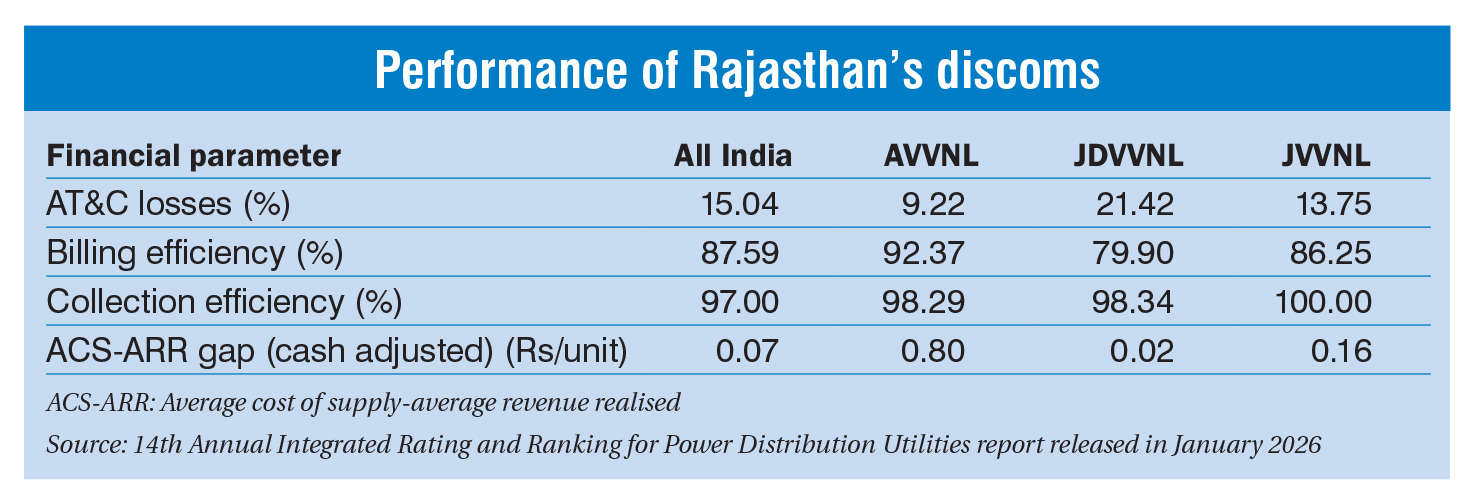
As the share of renewable energy in India’s power mix continues to rise, the operational and financial health of discoms has become increasingly critical, particularly given the variable and decentralised nature of renewable generation. In this context, Rajasthan’s discoms exhibited a mixed performance in FY2025 compared to the all-India average. As can be observed from the table, compared to the national average, Ajmer Vidyut Vitran Nigam Limited (AVVNL) performed better, with lower aggregate technical and commercial (ATaC) losses and stronger billing and collection efficiency. Jaipur Vidyut Vitran Nigam Limited (JVVNL) remained largely aligned with national trends and maintained high collection efficiency. In contrast, Jodhpur Vidyut Vitran Nigam Limited (JDVVNL) underperformed relative to both the national average and the other two discoms, with higher losses and weaker billing efficiency.
Furthermore, the roll-out of smart meters assumes critical importance in addressing revenue leakages and improving financial sustainability for discoms. Data from the National Smart Grid Mission shows that 14,900,527 smart meters have been sanctioned in Rajasthan, of which 2,991,251 have been installed so far, translating into an installation progress of about 20.07 per cent. This is broadly in line with the national average of around 24 per cent.
On the generation side, according to the CEA’s daily renewable generation report, the state recorded an average renewable energy generation of 709.98 MUs per day in January 2026. Of this, solar power accounted for 482.34 MUs per day, followed by wind power at 197.87 MUs per day, while other renewable sources, including biomass, bagasse and small hydro, contributed 29.76 MUs per day. Looking at the project pipeline, the CEA’s quarterly report on under-construction renewable energy projects released in September 2025 indicates that Rajasthan has more than 7 GW of solar park capacity under construction. Additionally, over 11 GW of renewable
energy capacity is currently under development in the state. Notably, this entire pipeline is solar-based, with no wind or hybrid projects under construction.
Regulatory updates
Rajasthan continued to refine its regulatory framework during 2025-26 to support higher renewable energy integration. In May 2025, RERC notified the RERC (Terms and Conditions for Green Energy Open Access) Regulations, 2025. Under these regulations, captive renewable energy projects, including behind-the-meter installations, were permitted to be sized up to 200 per cent of a consumer’s contract demand. If the capacity exceeds 100 per cent, a BESS storing at least 20 per cent of the energy generated beyond 100 per cent is mandatory. RERC also issued the third amendment to the Grid-Interactive Distributed Renewable Energy Regulations, 2025, in October 2025. The amendment formally enabled virtual net metering and group net metering across the state, allowing residential as well as commercial and industrial consumers to share solar power across multiple electricity connections. This addressed key space and ownership constraints that have historically limited rooftop solar adoption.
In January 2026, RERC issued the draft Rajasthan Electricity Regulatory Commission (Demand Flexibility/Demand Side Management) Regulations, 2026. The draft regulations were a response to the operational and cost challenges emerging from Rajasthan’s rapid solar capacity expansion. The draft regulations aim to address these challenges by shifting electricity consumption to low-cost, solar-rich periods and reducing peak demand through structured demand response and energy efficiency measures.
Challenges
Rajasthan has emerged as a front runner in India’s renewable energy transition. However, the state is also grappling with transmission constraints, which are increasingly affecting the timely evacuation of renewable power. According to the Institute for Energy Economics and Financial Analysis and JMK Research and Analytics, as of July 2025, around 22 GW of interstate transmission system-connected renewable energy projects were operational in the state. However, only about 64 per cent of this capacity had access to a dedicated associated transmission system (ATS). The remaining projects continued to operate without ATS and relied on temporary general network access, exposing them to frequent curtailment and operational uncertainty.
Evacuation challenges are further aggravated during peak solar hours due to real-time grid constraints. Key transmission corridors such as the Bhadla-Ajmer 765 kV line and the Bhadla-Bikaner 400 kV line remain heavily loaded. In high-wind zones, voltage dips and oscillations caused by reactive power add to grid instability.
In parallel, ecological restrictions linked to the conservation of the Great Indian Bustard (GIB) have added another layer of complexity. In April 2021, the Supreme Court mandated the undergrounding of overhead transmission lines in GIB habitats, effectively constraining the expansion of green energy corridors. This order was revised in March 2024 and further clarified through a judgement dated December 19, 2025. Under the revised framework, around 80 km of identified 33 kV lines in Rajasthan must be undergrounded immediately, while remaining lines in priority areas must be rerouted or insulated within two years. Additionally, nine transmission lines of 66 kV and above – many aligned with planned green energy corridor strengthening – must be shifted away from bustard habitats. All future power evacuation through the region will be channelled through a single dedicated corridor, up to 5 km wide, located south of the Desert National Park. These measures have significantly increased costs and are estimated to affect the transmission of a significant portion of renewable energy capacity in the state.
These challenges are compounded by an imbalanced renewable energy mix. Rajasthan has an estimated wind power potential of around 284 GW at a hub height of 150 metres, based on assessments by the National Institute of Wind Energy. Despite this vast potential, wind energy accounts for only about 5.2 GW of the state’s total renewable capacity. Overdependence on solar power could strain grid operations, making wind power, along with battery storage, critical for balancing generation and improving grid stability. A more balanced solar-wind mix is essential for ensuring stable and reliable renewable power integration in Rajasthan.
Outlook
For Rajasthan’s successful clean energy transition, transmission infrastructure must be strengthened in parallel with renewable capacity addition, especially given the scale of expansion being planned. This becomes even more critical because transmission planning and execution require long lead times. The gestation period for transmission projects is significantly longer than that of solar and wind plants, making advance planning essential to avoid future bottlenecks and stranded assets. Furthermore, a recent study by the Centre for Study of Science, Technology and Policy estimates that an investment of around Rs 21.18 billion will be required to upgrade Rajasthan’s transmission infrastructure to integrate about 119 GW of solar and wind capacity at voltage levels of 220 kV and above by FY2029-30. This requirement is over and above the investments already planned under state and central transmission proposals. Looking ahead, Rajasthan will need a comprehensive, state-level green power transmission road map to sustainably accommodate future renewable energy additions. Such a road map should go beyond conventional grid expansion and explicitly recognise the role of energy storage systems.
According to Rajasthan’s Integrated Clean Energy Policy, 2024, the state aims to achieve a target of 125 GW of renewables by 2029-30 (solar 90 GW, wind and hybrid 25 GW, and hydro, PSP and BESS 10 GW). However, the current installed renewable capacity stands at around 43 GW, implying that around 82 GW must be added within a short span of just three to four years. This would require a sharp acceleration in the pace of capacity addition. Even considering the existing project pipeline, meeting the 125 GW target appears challenging under current conditions, particularly given the persistent transmission and evacuation constraints in the state. Moreover, achieving this scale of expansion is unlikely to be possible through reliance on solar power alone. A diversified approach will be critical. This includes scaling up wind power deployment, promoting hybrid renewable projects, and accelerating the installation of energy storage systems to ensure grid stability and reliable integration of new capacity. Unless transmission expansion, energy storage planning and renewable capacity addition move in lockstep, Rajasthan’s clean energy ambitions could be constrained by grid limitations. A coordinated and forward-looking approach will determine whether the state can convert scale into system-level resilience.
Nidhi Dua


