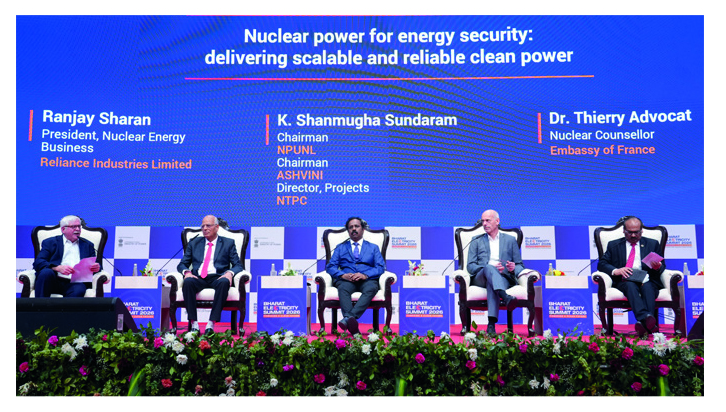
 The session on “Nuclear Power for Energy Security: Delivering scalable and reliable clean power” featured remarks by Ranjay Sharan, President, Nuclear Energy Business, Reliance Industries Limited; K. Shanmugha Sundaram, Chairman, NTPC Parmanu Urja Nigam Limited, and Vice-Chairman (ASHVINI), Director, Projects, NTPC; Dr Thierry Advocat, Nuclear Counsellor, Embassy of France; and Prateek Agarwal, ED, Corporate Planning and Corporate Communication, Nuclear Power Corporation of India Limited. The session was moderated by Chris Gadomski, Lead Analyst, Nuclear, BloombergNEF. The session focused on the development of nuclear energy projects, technological aspects, safety concerns, supply chain management and financing mechanisms in India as well as globally. Edited excerpts…
India’s growing confidence in its nuclear programme is reflected in increasingly ambitious capacity targets, meaningful policy reforms, and – perhaps most significantly – a genuine openness to private sector participation. For a sector that has historically been the exclusive domain of state-owned entities, this is a structural shift worth paying attention to. The perception around nuclear energy, is gradually improving. The government’s promises of energy security and climate benefits are significant in reshaping public and investor sentiment, even as safety concerns continue to linger among some stakeholders.
Recently, the SHANTI Act, 2025 has represented the most significant regulatory overhaul in India’s nuclear history – repealing both the Atomic Energy Act of 1962 and the Civil Liability for Nuclear Damage Act of 2010. This act permits private companies, joint ventures and approved entities to build, own and operate nuclear plants and reactors under licence. It also allows up to 49 per cent FDI and equity participation, opening the door to international capital and technology partnerships. The act strengthens institutional oversight by granting the Atomic Energy Regulatory Board statutory powers for licensing, inspections, enforcement and full lifecycle oversight. Hence, as India is targeting 100 GW of nuclear capacity expansion by 2047, this legislative foundation is an essential one.
One of the most substantive debates on global nuclear development today concerns the relative merits of large conventional reactors versus small modular reactors (SMRs). Large reactors carry inherent advantages – their scale drives down per-unit electricity generation costs over time. However, their megaproject nature is also their weakness. Cost overruns and construction delays have often impacted large nuclear projects. The bigger the project, the greater the chances of supply chain disruptions, regulatory shifts and financing risk.
On the contrary, SMRs offer a different value proposition: scalability, deployment flexibility, shorter deployment timelines, and – in many designs – the potential for alternative cooling technologies that reduce water stress. For a country such as India, where grid requirements vary across geographies and where energy demand is growing in ways that are difficult to predict with precision, SMRs offer an adaptability that large reactors simply cannot match. India currently stands on SMRs at an early stage. Regulatory readiness, design validation, supply chain development and private sector participation frameworks – all need to mature before SMRs can move from concept to commercial deployment in India.
With respect to India’s nuclear operational fleet, it is predominantly set up as Pressurised Heavy Water Reactors (PHWR). The PHWR supply chain is highly localised, supported by indigenous manufacturing under NPCIL and the Department of Atomic Energy. Looking ahead, NPCIL is targeting a significant capacity expansion by 2031-32, scaling further toward 2047 through a combination of PHWRs and light water reactors. The pipeline includes reactors already under construction, fleet-mode projects designed to leverage standardisation and serial manufacturing efficiencies, and planned additions that will carry India’s nuclear capacity to the levels demanded by its clean energy commitments.
With respect to international dimension of nuclear energy, France derives a large share of its electricity from nuclear power, making it one of the world’s largest producers and a net exporter within Europe. French start-ups are accelerating the development of advanced modular reactors – compact, factory-built systems designed for both industrial heat and electricity generation. As India opens its nuclear sector to private participation and international investment, collaborations with established nuclear nations such as France could meaningfully accelerate technology transfer, supply chain development and regulatory capacity building.