By Omkar Dhanke, Research Analyst; and Debajit Palit, Centre Head, Centre for Climate Change and Energy Transition, Chintan Research Foundation
India’s civil nuclear programme has long been anchored in strategic objectives, technological autonomy and clean energy ambitions. The early decades focused primarily on scientific capability and indigenous development. As India expands electricity access and accelerates industrialisation, digitalisation and electric mobility, demand for reliable baseload power to support Viksit Bharat is rising rapidly. Although India’s renewable energy capacity has tripled over the past decade, its variability leaves a gap that must be filled by clean, round-the-clock power sources to enable a transition away from fossil fuels.
Nuclear power remains a key source of such reliable, stable clean energy. Yet, despite its strategic relevance, nuclear power contributes only about 3 per cent to India’s total electricity mix. State monopoly, uncertain liability norms and limited financing channels, among others, have constrained its expansion. Following the announcement of the Nuclear Energy Mission in Union Budget 2025-26 to achieve 100 GW of nuclear capacity by 2047, it was recognised that the existing public sector-dominated framework may be insufficient to deliver a twelvefold capacity increase within two decades. The sector needs a legal framework that addresses risk, distributes responsibilities and attracts new investment while retaining government control over strategic activities.
The Sustainable Harnessing and Advancement of Nuclear Energy for Transforming India (SHANTI) Act, passed during the winter session of Parliament in December 2025, seeks to address the challenges that have constrained its growth and scale up India’s nuclear power capacity to achieve the net zero target by 2070.
A transformative step forward in modernising nuclear governance
The SHANTI Act replaces and consolidates parts of the existing statutory frameworks governing nuclear energy, such as the Atomic Energy Act, 1962, and the Civil Liability for Nuclear Damage Act, 2010. It establishes statutory authority for the Atomic Energy Regulatory Board (AERB), restructures responsibility for safety oversight, clarifies the liability regime for operators, expands the institutional framework for compensation adjudication and enables private-sector participation across the nuclear value chain.
While the government retains full authority over strategic and sensitive functions such as uranium and thorium mining, fuel enrichment, and management of spent fuel and nuclear waste, the SHANTI Act distinguishes between strategic segments and the commercial generation segment, allowing private participation in the latter. The intention appears to be retaining sovereign control where required while freeing up capital for reactor deployment and power generation.
Following the announcement of the Nuclear Energy Mission in the last budget speech, we at the Chintan Research Foundation (CRF) argued that India’s nuclear stagnation stemmed less from technological constraints and more from weaknesses in the legal and institutional framework. CRF has made the case that, without reforms to licensing, liability and risk allocation, nuclear power would remain financially unattractive. This article examines the key provisions of the SHANTI Act, which are largely aligned with the recommendations put forward by CRF through a workshop in May 2025 and a subsequent policy paper on the subject.
Private sector participation and investment flows: By allowing Indian private companies, alongside government entities and joint ventures among them, to build, own, operate and decommission nuclear plants, the act widens the pool of investible resources available to the sector. Public funding alone would have struggled to meet the ambitious target. Private investment can accelerate reactor deployment and increase capacity additions if tariff frameworks and risk-sharing mechanisms keep projects techno-commercially viable. The act seeks to create that space by delinking generation activities from strategic segments, which remain under direct state control. This is not a privatisation of nuclear sovereignty, but a recognition that the government can focus its resources on strategic fuel-cycle development while leveraging private investments for capacity expansion.
Sovereign control over the nuclear fuel cycle and strategic facilities: While allowing private participation is a significant change, the act retains firm state authority over the nuclear fuel cycle, including enrichment and spent fuel management. These functions connect directly to India’s three-stage nuclear programme, which remains central to long-term technological autonomy, especially given India’s limited uranium reserves and substantial thorium resources. Fuel cycle sovereignty ensures that the entry of private capital does not dilute strategic direction or non-proliferation commitments. This approach is consistent with international practice, where fuel cycles typically remain under strict state oversight.
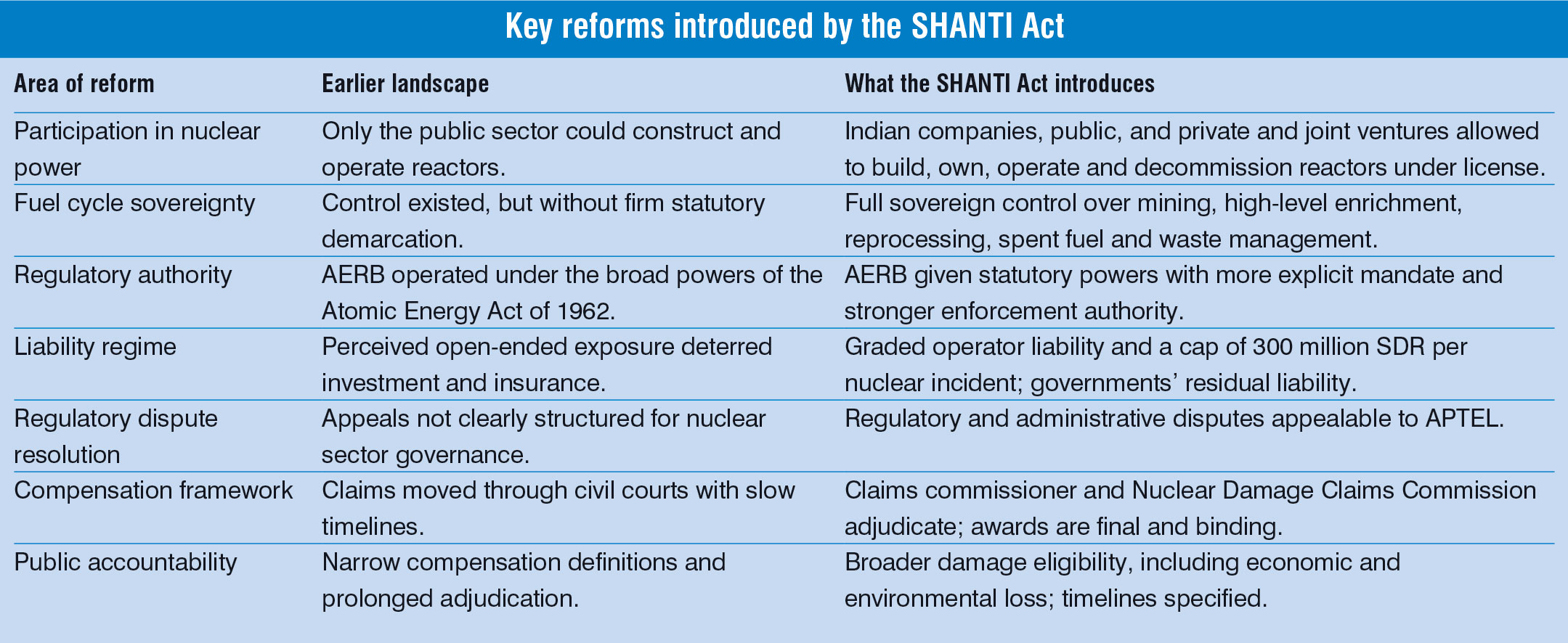 Liability structure and risk clarity: The financial risk associated with nuclear incidents has long been a major barrier to investment. The earlier regime was perceived as open-ended, deterring investors, insurers and suppliers. The SHANTI Act stabilises the liability framework through graded operator liability, and with a cap of 300 million special drawing rights (SDRs) per nuclear incident. The SDR is an international reserve asset created by the International Monetary Fund and, in 2025, averaged about Rs 111 per SDR. Operators must maintain insurance or financial security up to the capped level for each nuclear installation. Beyond this cap, the central government will cover compensation up to 300 million SDR, potentially through a Nuclear Liability Fund. Any compensation exceeding this limit will be met through the Convention on Supplementary Compensation for Nuclear Damage, to which India is a signatory. This framework thus brings predictability to risk-sharing, enabling insurers to price coverage more confidently. For suppliers, while contractual liabilities remain commercially negotiated, the clearer liability regime improves project bankability and reduces exposure to unlimited risk.
Regulatory enforcement, safety oversight and dispute resolution: The act strengthens regulatory structure by introducing a four-tier adjudication architecture. First, it provides statutory backing to the AERB, ensuring it has adequate powers to enforce safety standards, conduct inspections and initiate corrective measures. Alongside this, the Atomic Energy Redressal Advisory Council will serve as an expert review body for those disputing AERB decisions. The Appellate Tribunal for Electricity (APTEL), augmented with technical members specialising in nuclear energy and radiation safety, will be the third tier of appeals. The Supreme Court remains the final arbiter.
Compensation adjudication and institutional accountability: The act creates a structured pathway for compensation following a nuclear incident. Initially, the claims commissioner, designated by the central government, will adjudicate claims. Depending on the scale of damage, the government may establish a nuclear damage claims commission, which can form benches and possess powers equivalent to those of a civil court for the award of compensation. Compensation awards issued by the commission are final and binding. For affected persons, this design ensures faster finality; for operators and insurers, it provides certainty in estimating exposure. In addition, the definition of compensable damage is broad, covering not only loss of life and property but also economic losses and environmental restoration. This reflects an understanding long articulated in policy discussions that public acceptance of nuclear energy depends as much on credible compensation mechanisms as on assurances of safety.
The appellate structure for regulatory decisions is important because it separates regulatory oversight from compensation adjudication, avoiding overlap between safety enforcement and post-incident claims. Combinedly, these elements create a more structured, predictable environment for nuclear power development while tightening accountability and oversight to ensure safety and compliance.
The tasks at hand
The true significance of the SHANTI Act will lie in its implementation. The statute creates the framework, but investor confidence will depend on the clarity of subordinate policies, rules and regulations, particularly those governing licensing timelines, insurance mechanisms, tariff setting and the operationalisation of the Nuclear Liability Fund, with transparency in decision-making essential to avoid perceptions of arbitrariness.
Alongside this, human capacity to operate, manage and regulate the nuclear sector will need to scale up to complement the growth in reactor capacity. The government should launch public education campaigns linking nuclear power with national energy security and low-carbon growth. Expanding human capital will require public-private training initiatives and greater collaboration among organisations engaged in the nuclear sector, including IITs and NITs offering master’s programmes in nuclear engineering. In the initial phase, central government agencies should take the lead in developing human capital through institutionalised training programmes, with private players focusing on efficient project development while contributing to the creation of high-end skilled employment in the economy.
Tariff setting will need more clarity. The act enables private-sector participation, but investment decisions will hinge on predictable tariff frameworks set by independent regulators, and long-term power purchase agreements. Without this, even clearer liability norms may not be enough to attract sustained capital. Electricity tariffs are closely linked to financing structures that determine capital and operating costs. Given the capital-intensive nature of nuclear projects and long construction timelines, financing costs will be decisive in their competitiveness vis-à-vis other clean power sources.
Access to low-cost and patient capital will be essential. Including nuclear energy within green finance taxonomies would unlock concessional finance and lower the cost of capital. Additionally, reducing GST on nuclear equipment and components – bringing them in line with renewable energy technologies – would further reduce project costs.
Another important area is the issue of grid integration. Large reactors require robust transmission connectivity, and without timely evacuation infrastructure, capacity additions could face bottlenecks like those experienced by renewable energy projects. Coordinated planning among the central government agencies, regulators, states, developers and transmission companies will be essential to draw full advantage of the act’s provisions and drive the sector.
Furthermore, while the act allows private participation in generation, supply chains and manufacturing, these are not yet fully developed domestically to prevent import dependencies. Expanding local capability through partnerships, technology transfer mechanisms that comply with the liability regime, andstandardisation of design could strengthen Atmanirbhar Bharat and reduce project costs over time.
The SHANTI Act marks a turning point for India’s nuclear sector. Its importance lies not only in enabling new projects but in making nuclear energy a realistic contributor to India’s broader clean and sustainable energy goals. At the same time, its effectiveness will largely depend on regulatory clarity, tariff structures, grid readiness, institutional strengthening and regulatory capacity. If these elements advance together, the act has the potential to shift nuclear power into a meaningful pillar of India’s energy strategy, delivering reliable, low-carbon electricity at the scale required by a rapidly growing economy.
(The views expressed in this article are the personal views of the authors.)