
In India, about 40 per cent of the total electricity consumption is contributed by the industrial sector, with up to 69 per cent of energy consumption attributed to motors and motor-driven systems. Over 2 million motors are produced in India each year, but historically, 90-95 per cent of the motors sold and used are at the IE1 (standard efficiency) and sub-IE1 levels. The issue of multiple rewinding in the service life of motors further reduces their efficiency drastically, resulting in more energy consumption. Therefore, the annual energy saving potential just through motor replacement is estimated at more than 5 billion kWh, translating into savings of $500 million and an avoided power generation capacity of 600 MW.
Timeline of government initiatives
Energy Efficiency Services Limited (EESL) – a joint venture of NTPC Limited, Power Finance Corporation, REC Limited and Power Grid Corporation of India Limited – was set up in 2009 by the Ministry of Power (MoP) to facilitate the implementation of energy efficiency projects in the country.
The Perform, Achieve and Trade (PAT) scheme was launched in 2012 as a market-based regulatory instrument developed by the Bureau of Energy Efficiency (BEE) under the National Mission for Enhanced Energy Efficiency to reduce specific energy consumption in energy-intensive industries. In 2026, the PAT scheme is undergoing a major transition, with nine energy-intensive sectors (including steel and cement) moving to the new Carbon Credit Trading Scheme (FY 2026-27), while others remain under PAT. PAT Cycle-VIII (2023-26) continues, setting a total energy saving target of 0.3370 mtoe for 138 designated consumers across six key sectors.
In 2017, the Department of Industrial Policy & Promotion issued a quality control order requiring all imported and domestically manufactured motors to comply with the minimum IE2 efficiency class as per the revised IS:12615, with effect from January 1, 2018, which was an opportunity for users to advance to the readily available IE3 class of motors.
The Production Linked Incentive (PLI) Scheme for Automobile and Auto Component Industry (PLI-Auto) was approved in 2021, providing incentives for manufacturing advanced automotive technology components, including electric motors in India. Under the Phased Manufacturing Programme, launched in 2022, traction motors and battery packs are designated as essential components and are subject to stringent local manufacturing requirements to qualify for subsidies.
As of early 2026, India is accelerating electric vehicle adoption through the Electric Mobility Promotion Scheme 2024 and related PLI schemes, following the conclusion of FAME II in March 2024. These initiatives focus on promoting domestic manufacturing of motors, controllers and battery packs with mandatory local value addition.
The 2026 India Energy Conservation Building Code (ECBC) continues to mandate high-efficiency, premium-class motors (IE3 or higher) for all new commercial buildings with a load of 100 kW/120 kVA or more, targeting significant energy savings (25–50 per cent+). The code emphasises electronically commutated (EC) fans, variable speed drives (VSDs) and energy-efficient motors (EEMs) to meet stringent performance standards, aligning with net-zero building goals.
 Key aspects of motors under the ECBC 2017/2026 Guidelines
The ECBC is periodically updated by the BEE, with stricter voluntary levels (Super ECBC) preparing the market for future, tighter and mandatory regulations in 2026. The key mandates for motors are:
- Minimum energy performance standards for electrical equipment, with strong emphasis on IE3 (premium efficiency) and increasing adoption of IE4/IE5 motors for heating, ventilation and air-conditioning (HVAC) and pumping systems
- Use of high-efficiency motors across mechanical equipment, including air handling units, fans, pumps and cooling towers
- Promotion of EC fans in HVAC systems, offering higher efficiency compared to traditional AC motors, achieving IE5 standards
- Mandatory use of VSDs in many applications to adjust speed based on load, thereby reducing power consumption
- A three-tier compliance structure: ECBC (base), ECBC+ (35 per cent savings) and Super ECBC (50 per cent or greater savings).
National Motor Replacement Program
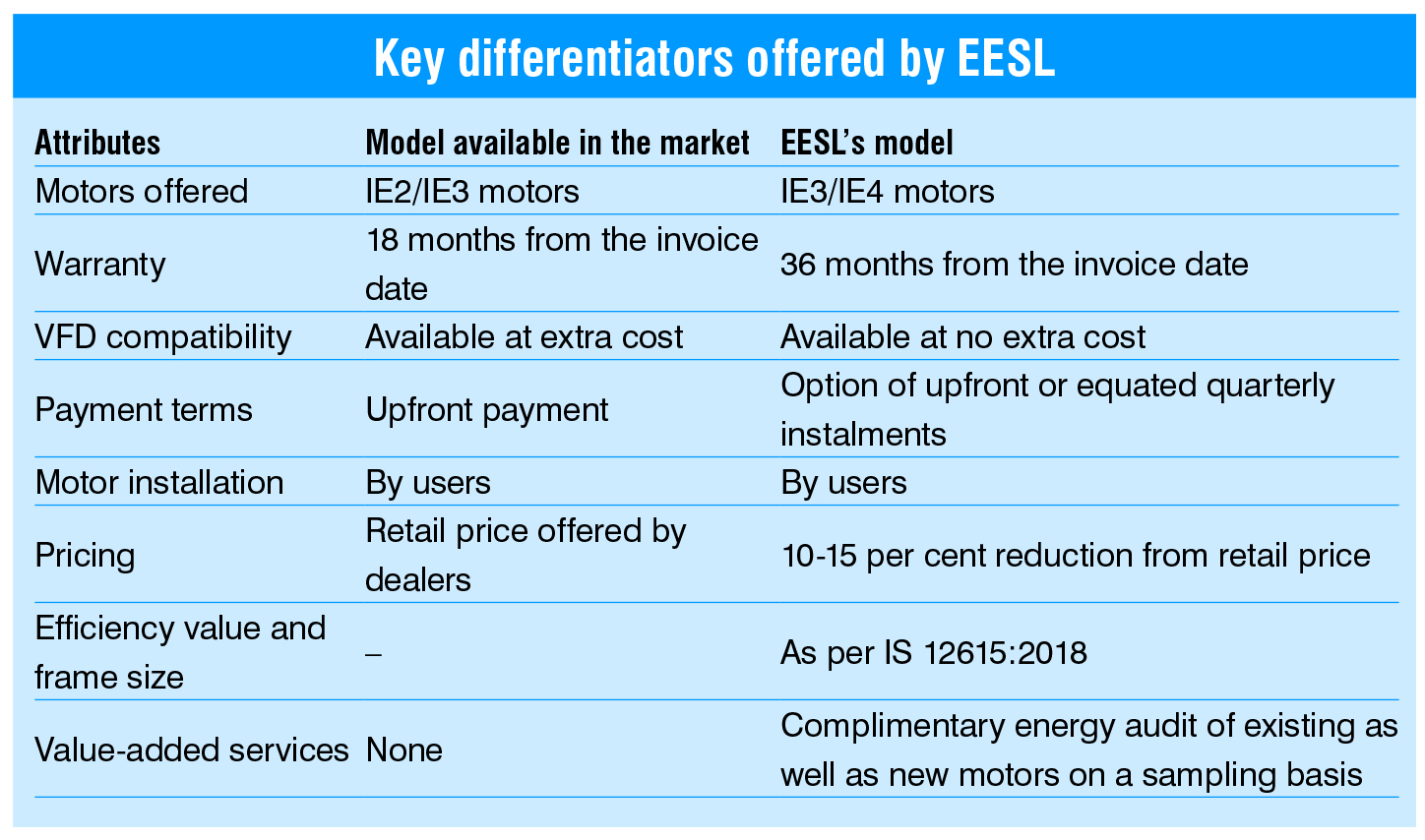
The National Motor Replacement Program (NMRP) is a first-of-its-kind, nationwide initiative aimed at promoting energy efficiency in the industrial sector. The programme, led by EESL, United for Efficiency and the International Copper Association India, among other implementation partners, focuses on replacing inefficient motors with premium-efficiency IE3 motors.
One of the key objectives of the NMRP is to save up to 5 billion kWh annually, equivalent to an estimated $500 million in energy costs. Under the programme, IE3 and IE4 motors, ranging from 1 HP to 100 HP, are being offered to Indian industries, both micro, small and medium-sized enterprise (MSME) and non-MSME sectors.
The programme aims to address several systemic barriers to the adoption of EEMs, including the lack of awareness among companies and consumers about the benefits and technological options available for EEMs, and financial challenges due to high upfront costs with limited market availability. For this, the NMRP employs a combination of strategies such as:
- Pooling the demand for EEMs, which helps lower costs and encourages manufacturers to produce higher volumes of high-efficiency motors.
- Undertaking outreach activities to educate and inform stakeholders about the benefits of high-efficiency motors and energy conservation.
- Facilitating financing options for industries to help them cover the upfront costs of motor replacement and make informed decisions.
The NMRP focuses on the commercial and industrial sectors, particularly manufacturing and processing industries; commercial facilities such as shopping malls, hospitals and office buildings; and water and wastewater treatment plants. For these sectors, increased motor efficiency helps reduce both emissions and costs while creating new operational efficiencies, such as allowing companies to place large-volume single orders for EEMs through the programme.
The increased demand for IE3 motors will create new opportunities for manufacturers, suppliers and workers in the sector, fostering the growth of a skilled labour force that can manufacture, install and maintain these advanced machines.
In its first few years itself (2017-18 onwards), the NMRP supported the replacement of approximately 5,000 inefficient motors, saving 9,150 MWh and $902,112 annually and reducing 8,050 tonnes of carbon emissions per year. Through the NMRP, an alliance between the Institute for Sustainable Communities and EESL has already saved $7.3 million worth of energy. The programme is targeting an annual energy-saving potential of approximately $62 million as it continues to replace inefficient motors.
 Business models under the NMRP
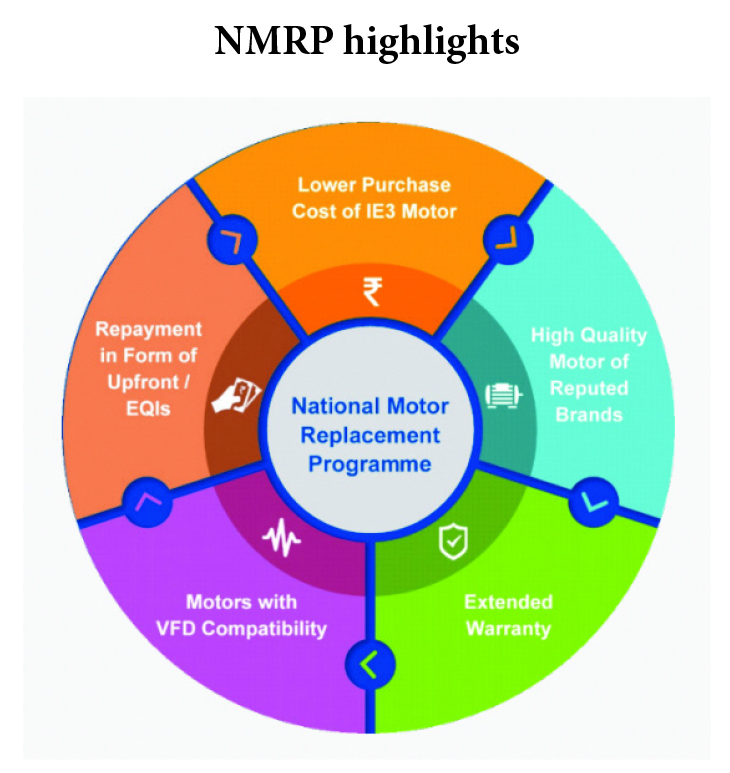
Upfront mode: EESL facilitates the direct supply of EEMs at discovered prices, with project monitoring and extended warranty support. Customers make a one-time payment.
Annuity mode (energy service company or ESCO model): EESL supplies motors and finances the initial investment, recovering the cost through equated quarterly instalments over three years. This removes the upfront financial burden on industries and enables immediate energy savings.
Motor rewinder certification system
In India, the industrial sector heavily relies on electric motors, with more than 2 million motors produced domestically each year. However, motor rewinding, a common practice in case of motor failure, can result in significant efficiency losses of up to 5 per cent, thereby increasing energy consumption, greenhouse gas emissions and costs. Instead, for example, using the right size of magnet wire in electric motors could lead to annual energy savings of 2.38 TWh.
Recognising the need for standardised rewinding processes and improved motor repair practices, ICA India and the Confederation of Indian Industry (CII) developed the motor rewinder certification system (MRCS), supported by state-designated agencies under the BEE.
MRCS involves a comprehensive evaluation of motor repair centres in India, including those in the open market, in-house repair workshops in large industries, and energy management centres focused on SMEs. An onsite inspection by independent assessors and representatives from CII is carried out to validate data, assess rewinder competence and ensure compliance with requirements. Overall, MRCS aims to enhance the skills of rewinding professionals, promote the adoption of best practices, and guide motor repair centres toward becoming nationally and globally recognised entities.
Anita Khuller


