With rising global electricity consumption, particularly in urban areas, utilities are expanding and upgrading their power transmission and distribution networks. Moreover, aging infrastructure in many countries calls for a large‑scale replacement of old, loss‑prone units with modern, higher capacity transformers. In India, the ambitious target of 500 GW of renewable energy by 2030, coupled with rising thermal capacity, requires a robust and reliable grid, fuelling significant growth in the transformer market. A look at the key trends, demand drivers and outlook for the transformer industry…
Overview
Transformers are an intrinsic part of the power system. They support efficient generation, transmission, distribution and end-use electrification. The pace of substation capacity addition at the 220 kV level and above has increased significantly. As per the Central Electricity Authority (CEA), India added an impressive 113,013 MVA 2025-26, achieving 90 per cent of its 126,007 MVA target. As of March 2026, AC transformation capacity (220-765 kV) stood at around 1,417 GVA, reflecting a compound annual growth rate (CAGR) of around 7 per cent from 2018-19. Concurrently, high voltage direct current (HVDC) transformation capacity (±320 kV to ±800 kV) reached 33,500 MVA, at a CAGR of 5.85 per cent over the same period. Within the HVDC segment, the ±800 kV level dominates with a share of around 53.7 per cent, followed by ± 500 kV (40.2 per cent) and ± 320 kV (5.9 per cent).
Key trends
Grid expansion for renewable energy integration
In the dynamic landscape of energy production and consumption, renewable energy integration has become essential for sustainable development. The efficient operation of power transmission has become increasingly important as several economies worldwide are planning to increase the amount of renewable energy in their fuel mix in order to achieve net-zero objectives.
The target to integrate 500 GW of renewable energy, including 280 GW of solar and 140 GW of wind by 2030, indicates the need for robust electricity transmission infrastructure. As of March 2026, about 157.80 GW of renewable energy capacity was under construction, this included 67.28 GW of solar, 6.5 GW of wind and 60.04 GW of hybrid projects. Another 48.72 GW of renewable energy capacity, comprising 35.44 GW of solar and 11.48 GW of hybrid power, is scheduled for completion by 2029-30. In this regard, the expansion of the electricity grid and the establishment of new substations are expected to drive substantial demand for transformers in the coming years.
Green energy corridors
The Ministry of New and Renewable Energy (MNRE)-backed Green Energy Corridor (GEC) scheme has been executed in 10 renewable energy-rich states to expedite renewable energy integration. As of March 2026, the GEC intra-state transmission scheme has integrated 26 GW of renewable capacity, as against the planned 44 GW.
The total substation capacity targeted under GEC Phase-II is 24,488 MVA. Further, the proposed GEC Phase-III scheme is likely to integrate 134.7 GW of clean energy capacity, 25.2 GW of pumped storage projects and 44.8 GWh of battery energy storage systems (BESS) in the intra-state transmission network. This would entail about 229 GVA of aggregate substation capacity. Moreover, the Union Budget 2026-27 has allocated Rs 5.99 billion for GECs.
In February 2026, Adani Energy Solutions Limited (AESL) secured long-term financing from Japan’s MUFG Bank Limited and the Sumitomo Mitsui Banking Corporation (SMBC) for the development of a HVDC corridor connecting Bhadla, Rajasthan, to Fatehpur, Uttar Pradesh. The project will facilitate the evacuation of 6,000 MW of renewable energy. Such flagship energy transmission programmes are likely to propel the development of new substations, which could benefit the transformer market in the coming years.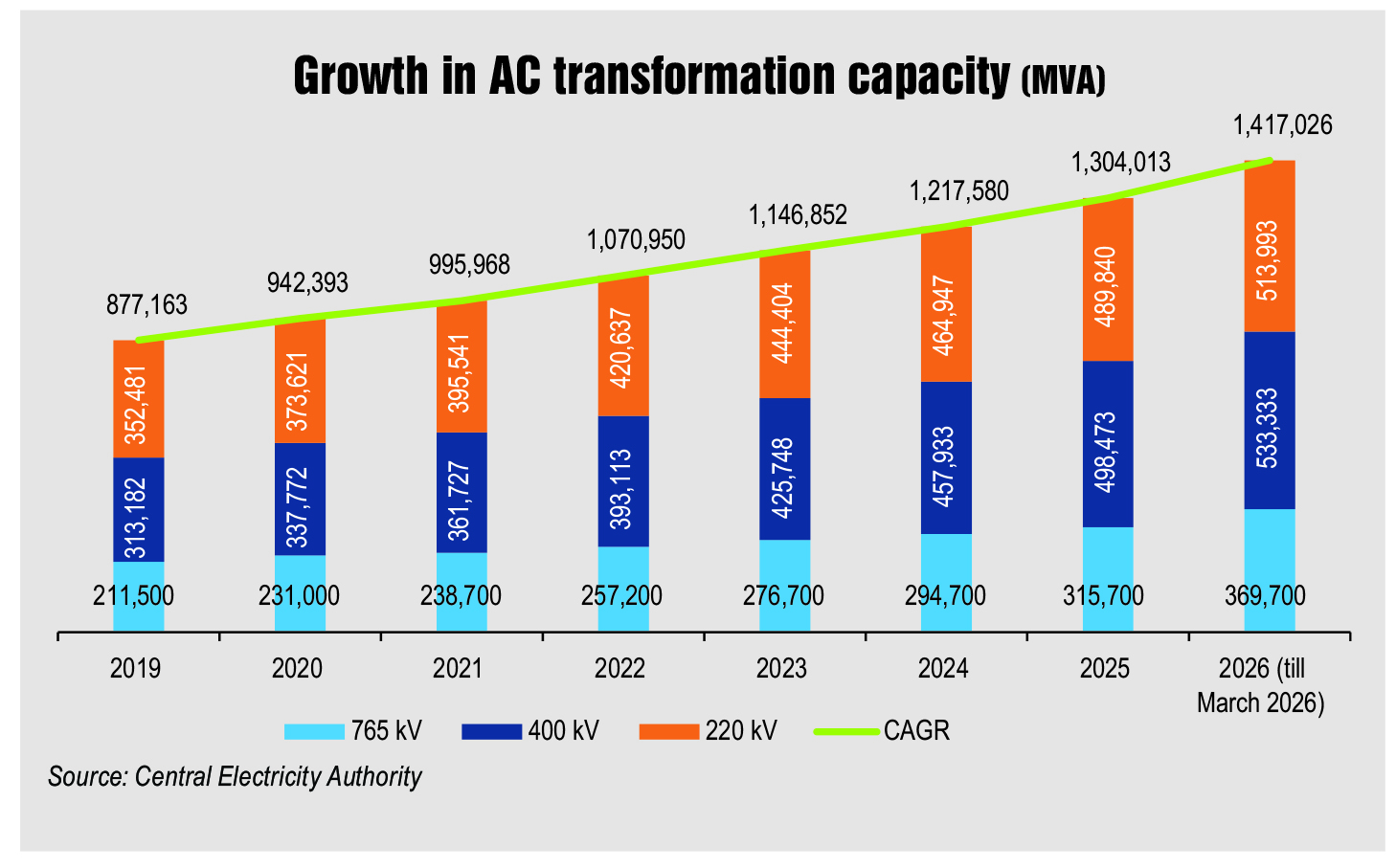
Distribution capex
Launched in 2021 to improve the quality and reliability of power supply to end-consumers, the Revamped Distribution Sector Scheme (RDSS) aims to achieve a financially sustainable and operationally efficient distribution sector. The scheme has a total budgetary outlay of Rs 3.03 trillion along with an estimated gross budgetary support of Rs 976.31 billion. Hence, the works associated with distribution strengthening are likely to drive demand for distribution transformers.
Further, as per the Ministry of Power (MoP), the distribution segment has witnessed the installation of about 696,302 distribution transformers, the addition of 2,927 new substations and the augmentation of 3,965 existing substations between 2014 to 2026 (as on March 2026). The installation of transformers is anticipated to gain momentum on account of strengthening of the distribution network planned by the power department/utilities of various states under the RDSS. For instance, in March 2026, the Noida power department reported the construction of nine 33/11 kV substations. In addition, the capacity enhancement of 10 existing substations is planned, wherein 12 additional transformers of 10 MVA each will be deployed.
Nuclear and thermal drive
The addition of new nuclear generation capacity is expected to significantly augment the transmission network and substation capacities. The Nuclear Energy Mission’s ambitious target of adding 100 GW of nuclear capacity by 2047 and recently declared measures such as the exemption of customs duty on the import of goods needed for nuclear power projects till 2035 in the Union Budget 2026-27 are expected to strengthen nuclear energy generation.
The MoP has projected thermal generation capacity to reach 307 GW by 2034-35. This will require an additional 97 GW of thermal capacity in the coming years. The thermal capacity requirement has been fulfilled through various initiatives till date. For instance, between April 2023 and January 2026, a total of 18.16 GW of thermal capacity had been commissioned. As of March 2026, about 38.74 GW of thermal capacity was under construction (including 4.84 GW of stressed thermal power projects), followed by 22.92 GW of awarded thermal capacity and 24.02 GW of thermal capacity under planning.
Hence, the upcoming nuclear and thermal generation capacities are expected to drive the expansion of electricity transmission infrastructure and deployment of associated equipment such as transformers.
Addition of emerging assets
Electric vehicle (EV) charging stations are expected to reshape power consumption growth in India, driving the modernisation of the electricity distribution and transmission network, especially in urban and corridor-connected establishments. As per the Institute for Transportation and Development Policy, between 2021-22 and 2024-25, public EV charging stations in India grew by 70 per cent. As EV adoption accelerates towards the 30 per cent penetration goal for 2030, the resulting need for electricity transmission and distribution network upgrades is expected to benefit the transformer market as well.
Data centres
Data centre capacity in India grew from over 375 MW in 2020 to over 1,500 MW in 2025. The majority of data centre establishments are located in urban areas such as Bengaluru, Hyderabad, Jamnagar, Mumbai, Navi Mumbai and Noida. As per the MoP, power demand from data centres is anticipated to hover around 13.56 GW by 2031-32. In recent years, a couple of utilities in the power industry have adopted investment and operational strategies to support data centres. For instance, in February 2026, the Adani Group announced an investment of about Rs 9 trillion for the development of a renewable energy-based AdaniConnex hyperscale AI-ready data centre by 2035.
Similarly, in November 2025, NTPC Green Energy Limited (NGEL) signed an MoU with Ctrls Datacentres to supply about 2,000 MW of renewable energy. Likewise, in October 2025, Karnataka’s Department of Energy highlighted its plans to upgrade power transmission lines from 400 kV to 765 kV to facilitate high electricity loads to cater to the power appetite of data centres. The expansion of transmission infrastructure will require transformers to ensure adequate and reliable electricity supply for data centres.
Railway capex
Rail infrastructure has been critical to economic growth and logistics efficiency. Significant investment in the sector is likely to ease freight movement, curtail logistics costs and decongest high-density corridors. The allocation of Rs 2.93 trillion in the Union Budget 2026-27 for Indian Railways marks a significant development for the rail infrastructure sector. In addition, the development of proposed high-speed rail corridors is anticipated to drive the demand for transformers required for rail infrastructure.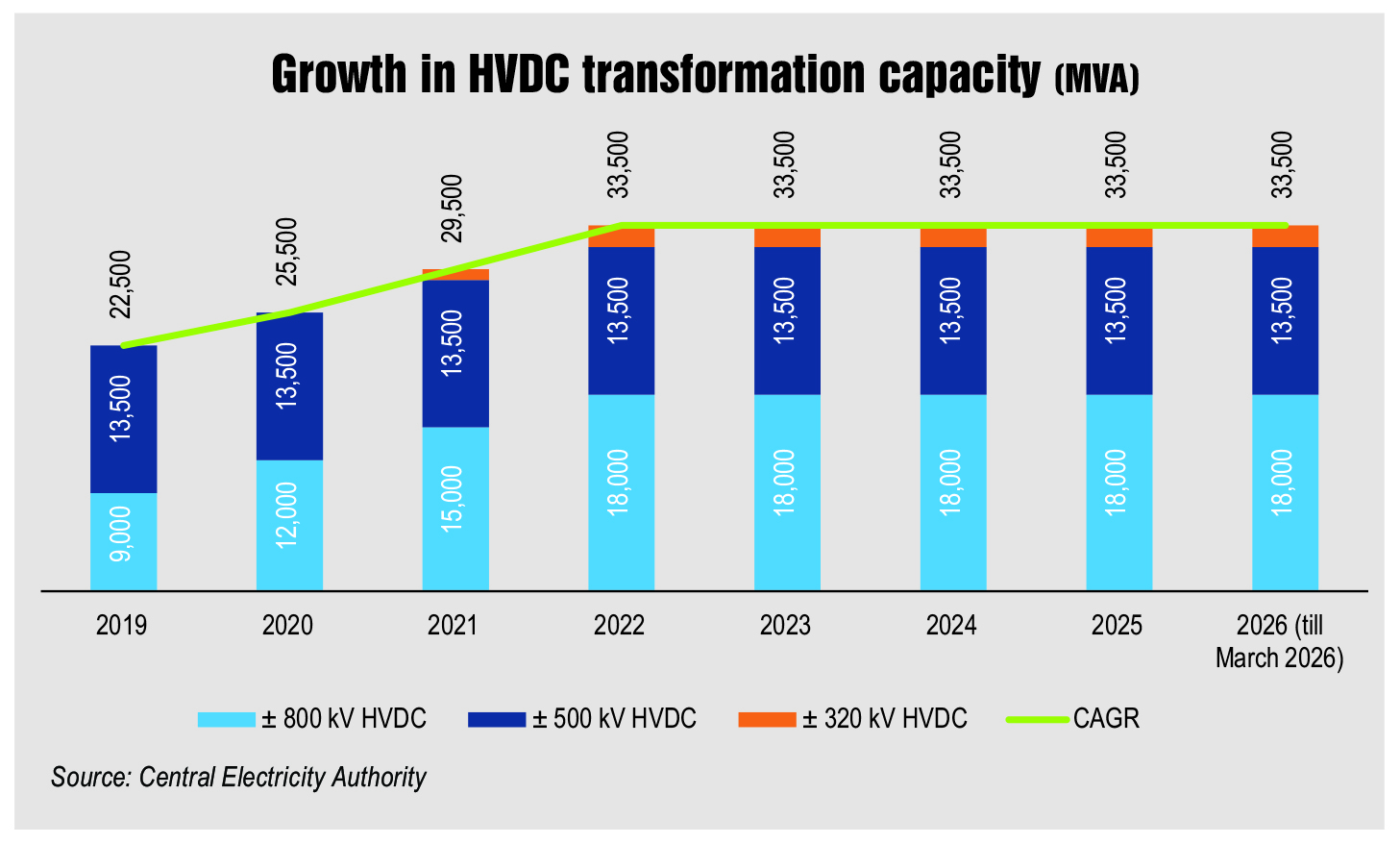
Technology trends
Transformers have evolved as an active and communicative equipment in recent years. The integration of sensors in new-age transformers has enabled real-time conditioning monitoring of multiple parameters such as gas formation, moisture, oil temperature, partial discharge and load conditions. This capability has facilitated predictive maintenance, helping reduce unexpected transformer failures, decrease downtime, enhance lifespan, optimise performance and lower maintenance costs.
Indian firms are gradually adopting eco-friendly transformers to meet their environmental, social and governance (ESG) goals, comply with energy efficiency mandates, and support renewable energy growth. Eco-friendly transformers utilise biodegradable ester oils, amorphous metal cores, or dry-type technologies to reduce environmental impact. Conversely, traditional transformers use mineral oil for cooling and insulation, which presents spillover issues and can adversely affect the environment. Eco-friendly alternatives, such as biodegradable oil and dry insulating techniques, minimise environmental impact and contamination risk.
Power distribution equipment, such as solid-state transformers (SSTs), has emerged as one of the most promising technologies for grid modernisation to meet the power demands of modern, dynamic loads. SSTs, which use semiconductions, are more efficient than conventional transformers, especially under variable load conditions. In September 2025, the Indian Institute of Science and Delta Electronics India jointly made cascaded H-bridge multiport DC converters to cater to megawatt-scale power demand driven by fast EV charging stations. Furthermore, SST technology promises to reduce the need for large, heavy line-frequency transformers.
Meanwhile, mobile transformers are gaining traction for their ability to provide temporary power transformation during emergencies, maintenance and temporary capacity boosts at substations and construction sites. Factors such as flexible power requirements, economic advantages over permanent installations, aging infrastructure and the need for rapid restoration to critical load centres are expected to expected to drive demand for mobile transformers in the coming years.
Future outlook and challenges
Rapid urbanisation and industrialisation in India, driven by a growing population and robust economic growth, have significantly increased power demand in recent years. This trend is further intensified by the growing use of cooling systems due to long summers and heightened pre- and post-harvest operations in the agricultural sector.
As per a recent CEA report, titled “National Generation Adequacy Plan (2026-27 to 2035-36)”, projected peak electricity demand and electrical energy requirement are expected to reach 459 GW and 3,365 BUs. Besides, the growth of industries such as steel, cement, petrochemicals and manufacturing is expected to drive the demand for both distribution transformers and power transformers for industrial clusters.
As per the Transmission Plan for Integration of over 900 GW Non-Fossil Fuel Capacity by 2035-36, India is likely to witness a much larger, cleaner and more grid-intensive power system, where the installed capacity may reach about 1,121 GW, including about 960 GW from non-fossil fuel sources. Further, increasing electrification, economic activity and new loads, such as green hydrogen and data centres, are likely to push the system towards a much higher demand base by 2035-36.
The transmission plan estimates that the total associated network required for additional wind and solar integration during 2026-27 to 2035-36 involves about 137,500 ckt km of lines and 827,600 MVA of substation capacity, at an estimated cost of Rs 7,933 billion. Considering the transmission infrastructure requirement, it is expected that the role of transmission equipment, including transformers, is poised for significant growth in the near future.
However, the transformer industry faces technology and supply chain issues. For instance, key raw materials, such as grain-oriented electrical steel, copper, aluminium and other insulating materials, are vulnerable to global market price fluctuations. This could directly raise the cost of transformer manufacturing. Further, the risk of unplanned failures and disruptions is increased by the fact that a significant part of the transmission and distribution network is integrated with ageing transformers.
Addressing this with retrofitting, refurbishment and phased replacement of these assets requires huge financial investment, especially when combined with the need for renewable energy integration and rising electricity demand. These factors can often hinder the growth of the transformer market. Therefore, the transformer industry’s future depends on technological investment, innovation, supply chain resilience, enhanced domestic manufacturing capacity and raw-material security.
Mohnish Makwana