

 By R.G. Gupta, Former Chairman, Rajasthan discoms, and Arjun Singh, Former Managing Director, Jaipur Discom
The power sector is one of the most socio-politically sensitive sectors, functioning not only as a lifeline for citizens but also as a key driver of industrial and agricultural development. Within this ecosystem, the transmission system — both interstate and intrastate — plays a pivotal role by transporting power procured by state discoms from generators located within and outside the state to interface points, from where electricity is delivered to consumers across various categories. Intrastate transmission loss is the difference in energy received at the state’s periphery from the generators outside and inside the state, captive/ third-party generation injected, and the energy dispatched to state discoms and direct to consumers.
Importance of intrastate transmission in Rajasthan
Intrastate transmission systems handle a large quantum of power sourced from diverse generating stations. Their efficiency and reliability have a direct bearing on the financial health of discoms and the quality of supply to end consumers. Unlike the distribution system, transmission losses are purely technical in nature, with no pilferage involved.
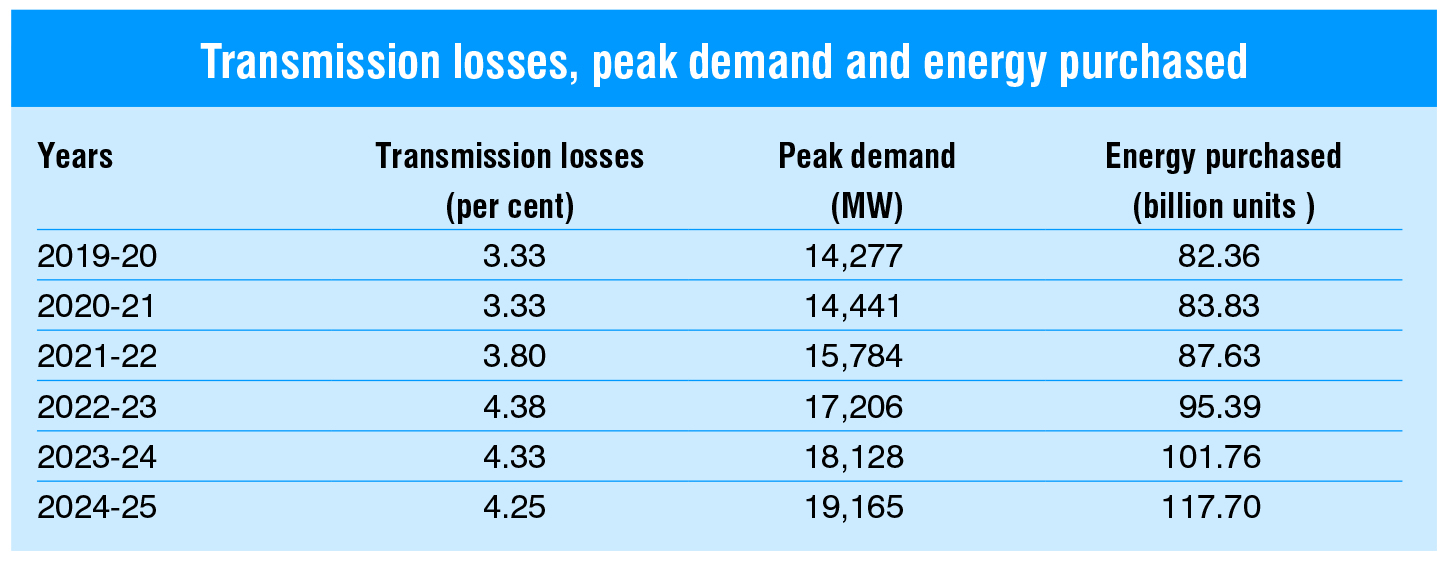
In recent years, Rajasthan has witnessed a steady increase in peak demand and energy procurement along with a surge in transmission losses from 3.3 per cent to 4.38 per cent (that is, a surge of 31.5 per cent), as shown in table below.
Transmission losses have increased from 3.33 per cent to 4.25-4.38 per cent, significantly higher than the Northern Region grid average of 3.34 per cent. Each incremental 0.1 per cent increase in transmission loss translates to an additional burden of approximately Rs 500 million at the current level of energy handling, directly impacting discom power purchase costs.
Future demand and network expansion challenges
According to various studies, Rajasthan’s peak demand and annual energy requirement are expected to reach approximately 30,000 MW and 180 billion units respectively by 2031-32. To cater to this demand, the existing 220 kV and 132 kV transmission network would need to be expanded by nearly two-thirds of its present capacity, in addition to strengthening the 765 kV and 400 kV backbone.
Such large-scale expansion will require the construction of several thousand circuit-kilometres (ckt. km) of new transmission lines, leading to:
- Congestion in substation approach and exit corridors
- Severe right-of-way (RoW) challenges, especially in agricultural areas
- Longer execution timelines and higher capital costs
If the current planning philosophy continues, transmission losses are likely to increase further, exacerbating financial stress on discoms.
Need for a paradigm shift: Adoption of 220/33 kV system
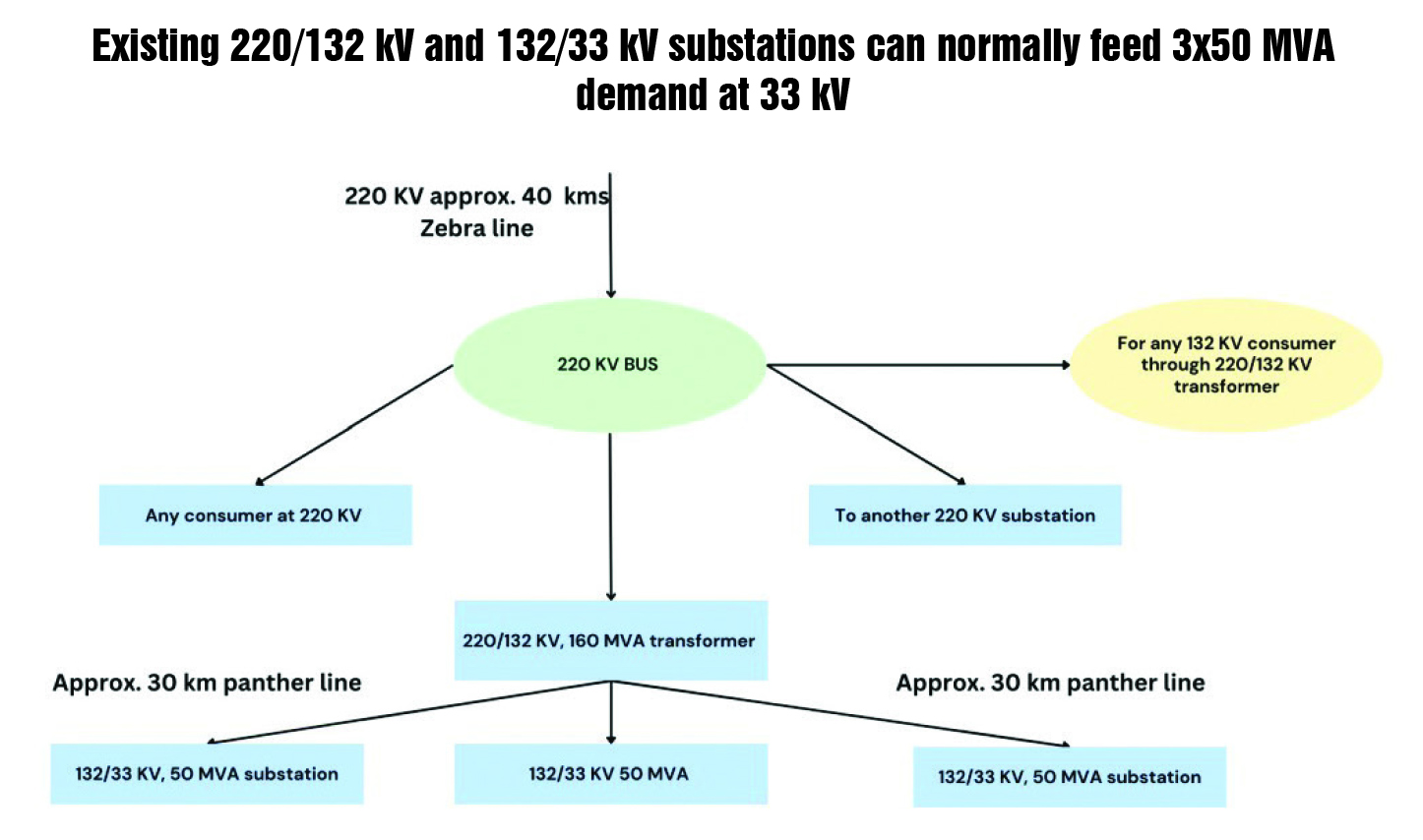
To arrest and reverse the rising trend of transmission losses, it is imperative to enhance the primary transmission voltage from 132 kV to 220 kV and adopt a 220/33 kV transmission system in place of the ageing 132/33 kV system for future expansion.
Comparative studies of the existing 220/132 kV + 132/33 kV arrangement and the proposed 220/33 kV system indicate that the latter offers significant technical and economic advantages.
Key benefits of the 220/33 kV transmission system
- Capital cost reduction: An overall reduction in capital expenditure of approximately 10 per cent, owing to elimination of the intermediate voltage level and fewer substations and lines.
- Substantial reduction in transmission losses: Estimated reduction of losses by around 40 per cent, enabling Rajasthan to return to its earlier loss levels and potentially perform better than the Northern Region average.
- Lower operating and maintenance costs: Fewer assets and simplified network architecture result in reduced O&M expenditure.
- Reduced line length and faster execution: Lower ckt km required to deliver the same quantum of power, leading to:
- Faster project completion: Reduced manpower and material requirements
- Fewer towers/poles in agricultural land, easing RoW challenges
- Improved reliability: 220 kV lines are inherently more reliable and less prone to outages compared to 132 kV lines, enhancing supply security to discoms.
Loss reduction through augmentation of existing network
In parallel with system restructuring, losses in the existing network can be reduced through the following measures:
Conductor bundling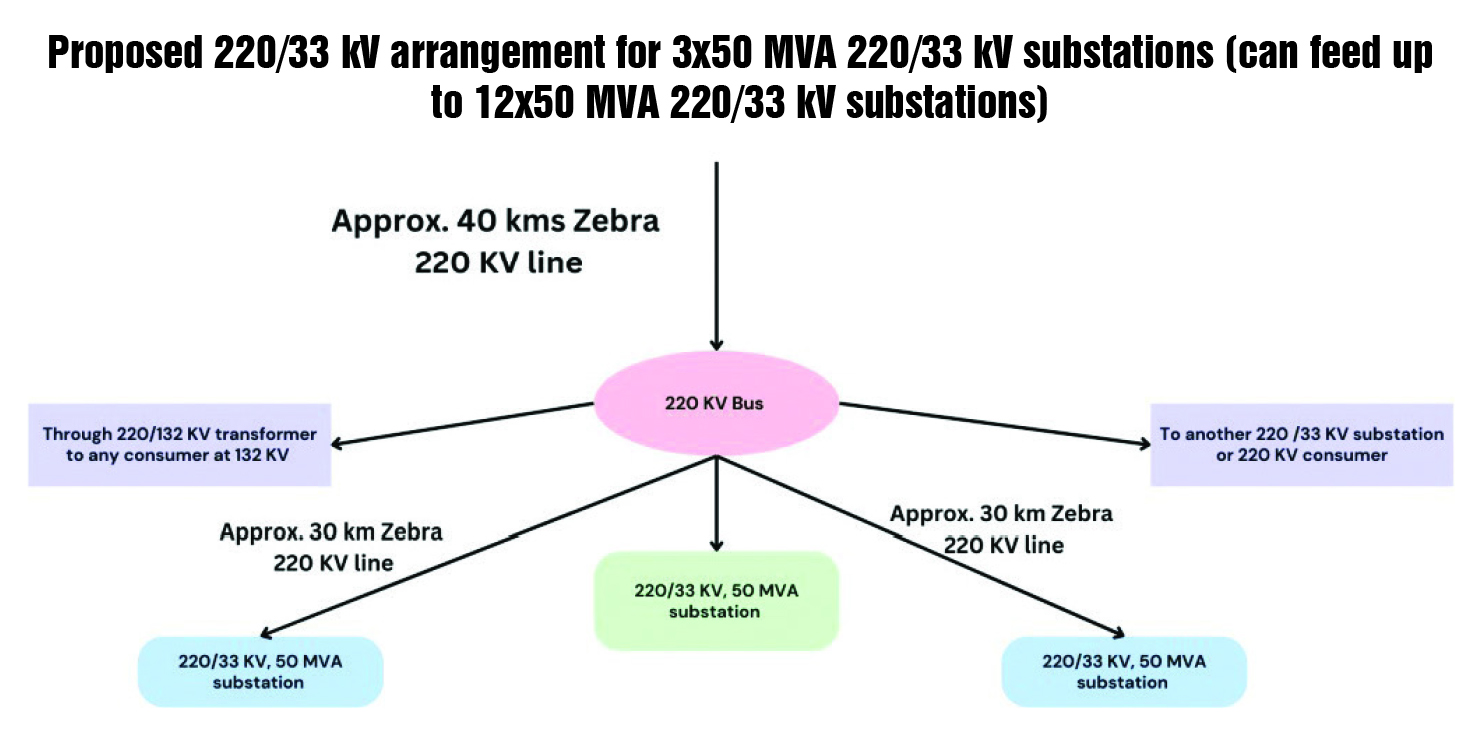
- Twin Panther conductors for 132 kV lines
- Twin Zebra conductors for 220 kV lines: Achievable through tower retrofitting, mid-span narrow-base structures, or monopoles.
- Enhancement of 400 kV line capacity: Adoption of triple Moose conductors (equilateral triangle configuration) by modifying existing towers or introducing mid-span supports.
- Reactive power management: Installation of adequate MVAR capacity close to load centres, the benefits of which will propagate upstream up to the generating stations.
- Improvement in power factor: Discoms should be mandated to maintain a minimum power factor of 0.9, reducing reactive power flow and associated losses.
- Selective use of HTLS conductors: High-temperature low-sag (HTLS) conductors offer higher thermal ratings (for example, ampacity) and are suitable for critically congested sections. However, they should not be adopted for wholesale replacement without a detailed cost–benefit analysis, as they may not always be economically justified.
Conclusion
With demand projected to double over the next decade, Rajasthan’s transmission planning must move beyond incremental expansion and adopt a strategic voltage upgradation approach. The adoption of a 220/33 kV transmission system, coupled with targeted augmentation of existing assets and robust reactive power management, offers a sustainable pathway to reduce losses, optimise costs, mitigate RoW issues, and enhance overall system reliability.
(The views expressed in the article are authors’ personal views. The figures/data are approximate but enough to substantiate the suggestions/views)