
Hydropower renovation and modernisation (R&M) is crucial for India’s power sector, especially with the changing role of hydro in the power mix. Even though 12,723.50 MW of hydroelectric capacity was under construction as of January 31, 2026, the system still needs faster options to recover peaking capability, improve plant availability and strengthen balancing support for a grid with an increasing share of renewable energy. In this context, R&M, uprating and life extension are increasingly being treated as a practical route to low-gestation capacity recovery and operational flexibility. The technical case for such interventions is well established. Hydropower plants usually have a normative operating life of about 30-35 years, after which ageing equipment, obsolete control systems, lower efficiency and higher instances of forced outages begin to affect performance. Hydro R&M as well as life extension and refurbishment programmes can add another 15-25 years of useful life to the hydropower plant, while uprating through improved runners, upgraded windings, modern excitation and governor systems, and auxiliary system upgrades that can also restore or enhance the output.
Progress and pipeline
As per the Central Electricity Authority’s (CEA’s) quarterly progress report of February 2026, hydro RMU&LE schemes aggregating 4.78 GW are scheduled for completion during 2022-27. The CEA guidelines draw a clear distinction between R&M, restoration and life extension with uprating and emphasises that the scope has to be finalised through residual life assessment, performance review and techno-economic evaluation, rather than by simply replacing old equipment on a like-for-like basis.
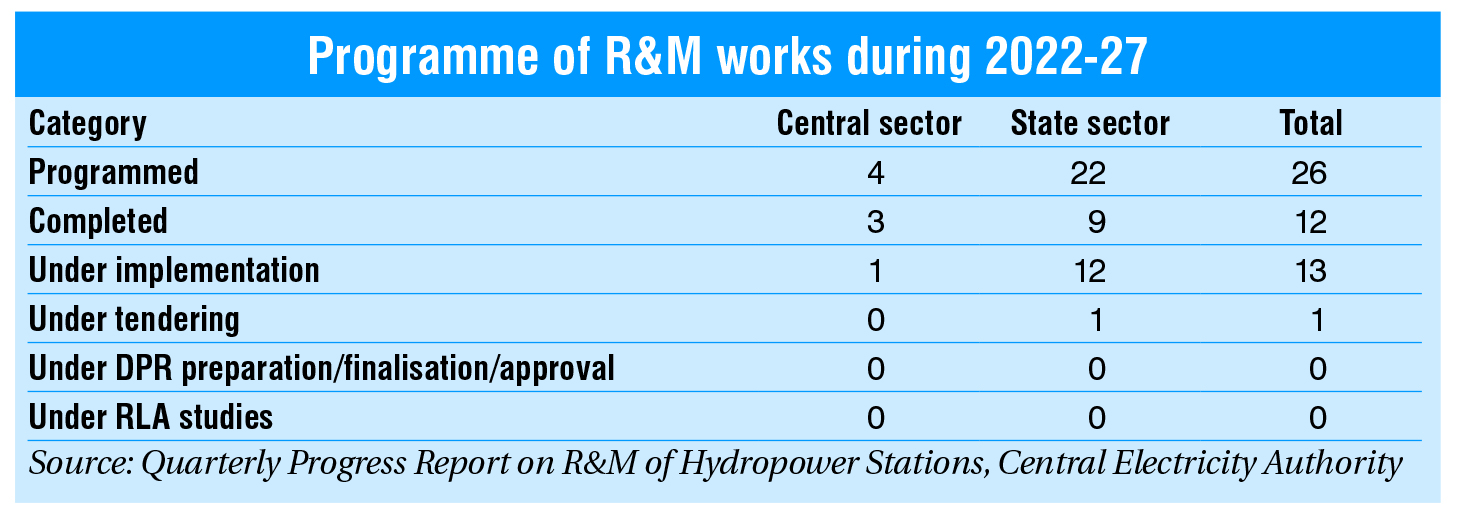
For the period 2022-27, R&M, uprating and life extension works at 26 hydroelectric plants, with an aggregate installed capacity of 4.78 GW are programmed for completion. Of these, 11 plants, with a combined capacity of 2.37 GW, are expected to benefit through life extension alone. Overall, the revised installed capacity, after completion of RMU and LE works across these 26 projects, would rise to 4,910.05 MW. Of the 26 schemes, 12 schemes with an aggregate installed capacity of about 2,546.8 MW had been completed till December 2025, resulting in life extension benefits for projects aggregating 1,347 MW and uprating of 90 MW.
For the period 2027-32, R&M, uprating and life extension works at 59 hydroelectric plants, with an aggregate installed capacity of 10.08 GW, are programmed for completion. Among these, 43 plants, with a combined capacity of 6.98 GW, are expected to benefit through life extension. Following completion of these planned works, the revised aggregate installed capacity of these 59 projects would increase to 10.23 GW.
 Technology priorities
As per CEA guidelines for R&M of hydropower stations, the framework calls for residual life assessment of ageing units, diagnostic testing of stators, rotors, shafts, runners, bearings, transformers and civil structures, and hot and cold walk-down surveys before finalising the detailed project report. On the equipment side, the modernisation now typically includes static excitation systems, microprocessor-based governors, numerical relays, digital voltage regulators, supervisory control and data acquisition, optical fibre-based signal transmission, online vibration monitoring and improved automation. On the generator front, one of the most feasible options is shifting from older Class B insulation systems to Class F insulation, which can support higher output, while also contributing to life extension. On the turbine side, runner redesign, profile optimisation, guide vane replacement and better hydraulic matching are increasingly central to capacity recovery and efficiency improvement.
For India, however, the most distinctive technical challenge remains silt. The CEA guidelines pay special attention to run-of-river stations in the Himalayan and sub-Himalayan belt, where quartz-rich silt causes severe erosion of runners, guide vanes, seals, coolers, strainers and pumps. The recommended toolkit includes high-velocity fuel coatings on underwater parts, cupro-nickel cooler tubes, cyclone separators in cooling water systems, modified runner profiles suited to silt-laden flows, modular replacement of vulnerable components and better silt monitoring. These are not peripheral measures. In many Himalayan stations, they are central to keeping machine downtime within manageable limits. The economics are also favourable when the intervention is well scoped. The CEA guideline recommends payback periods of two to three years for R&M and four to six years for life extension schemes. That benchmark helps explain why utilities continue to pursue such projects despite complicated shutdown planning and procurement challenges. In a system where clean peaking capacity is at a premium, recovering output from existing hydro assets can remain economically attractive even though the intervention is technically demanding.
Recent project-related developments
Following is a year-wise and state-wise review of the original and anticipated completion schedule of R&M schemes at hydropower stations during 2022–27. In 2022–23, a total of 1,469.8 MW across seven schemes was completed, namely the Bhabha Power House (120 MW) in Himachal Pradesh; Tiloth (90 MW) in Uttarakhand; Rihand (300 MW) in Uttar Pradesh; Munirabad (28 MW) and Linganamakki (55 MW) in Karnataka; and Nagarjuna Sagar Phase II (815.6 MW) and the Nagarjuna Sagar Left Canal Power House (61.2 MW) in Telangana. In 2023–24, 831 MW across three schemes was completed, comprising Bhakra Left Bank (540 MW) in Himachal Pradesh, Dhalipur (51 MW) in Uttarakhand, and Gerusoppa (240 MW) in Karnataka.
In 2024–25, R&M of 200 MW was completed under a single scheme – the Kopili Power Station (200 MW) in Assam, which was originally scheduled for completion in 2023-24. During 2025-26, out of 221 MW across four schemes, 46 MW has been completed so far with the commissioning of the Khandong Power Station (46 MW) in Assam, while the remaining 175 MW was expected to be completed within the year – Obra (99 MW) in Uttar Pradesh, Moyar (36 MW) in Tamil Nadu and Panchet Unit 1 (40 MW) in Jharkhand.
Looking ahead, a substantial capacity of 2,062.75 MW across 11 schemes is scheduled for completion in 2026–27. The projects are Dhakrani (33.75 MW) in Uttarakhand; Pochampad Stage I (27 MW) in Telangana Sharavathy Generating Station (1,035 MW), Kadra (150 MW), Kodasalli (120 MW), Supa (100 MW) and Shivasamudram (42 MW) in Karnataka; Balimela (360 MW) in Odisha; Umiam Stage III (60 MW) in Meghalaya; Kuttiyadi (75 MW) in Kerala; and Kodayar Stage I (60 MW) in Tamil Nadu.
Challenges and the way forward
Despite the momentum, the sector, at the core, continues to face the same bottlenecks that have slowed hydro R&M for years. Detailed project reports are not always backed by sufficiently rigorous residual life assessment. Shutdown planning remains difficult where utilities cannot easily absorb generation loss. Reverse engineering is often required because of ageing equipment and unavailable original spares. In many cases, the challenge is not only electro-mechanical. Civil structures, hydro-mechanical systems, transformers, auxiliaries, drainage and dewatering systems, and even cooling arrangements have to be assessed together. If these interfaces are not addressed properly, cost overruns and delays become almost inevitable.
The CEA’s hydro R&M guideline, therefore, places strong emphasis on institutional arrangements as much as on technology. It recommends dedicated R&M cells within utilities, high-powered task forces for faster decisions, better prioritisation of shorter-gestation works, and closer alignment of R&M execution with planned annual or capital maintenance shutdowns. It also suggests turnkey execution where appropriate, especially for specialised life-extension jobs where performance guarantees matter. These recommendations remain highly relevant in 2026 because hydro R&M is no longer a routine maintenance function. It has become a multidisciplinary project exercise involving diagnostics, engineering, procurement, civil review, regulatory approval and tight outage management.
Conclusion
Hydro R&M in India is clearly moving into a more mature phase. The broad rationale has not changed. Ageing hydro assets still offer one of the fastest and most cost-effective routes for restoring clean peaking capacity and improving system reliability. What has changed is the execution model. The sector is now seeing more project-specific interventions, more emphasis on diagnostics and residual life assessment, and a clearer focus on digitalisation, hydraulic optimisation and silt-resilient design.
With the rise in renewable integration, balancing requirements are becoming more demanding and the strategic value of hydro R&M is likely to increase further. In that sense, R&M is no longer a peripheral issue in hydropower. It is increasingly becoming central to how India preserves and upgrades the value of its existing hydro fleet.