In line with its energy transition goals, India aims to set up 500 GW of non-fossil-based electricity generation installed capacity by 2030. To support this target, the Central Electricity Authority (CEA) released a comprehensive transmission plan in March 2026 for the integration of over 900 GW of non-fossil fuel capacity by 2035-36.
Given that renewable energy projects, particularly solar and wind, have significantly shorter gestation periods than transmission infrastructure, advance transmission planning is essential. Further, renewable energy integration requires the development of robust interstate transmission systems (ISTS) to connect resource-rich regions with load centres. In this context, the CEA has now expanded its planning horizon, outlining a transmission framework for integrating over 900 GW of non-fossil capacity by 2035–36.
Expanding renewable energy base
The plan identifies key renewable energy zones across Rajasthan, Tamil Nadu, Madhya Pradesh, Ladakh, Assam, Gujarat, Andhra Pradesh, Karnataka, Telangana and Maharashtra, and aligns transmission development accordingly. It also includes provisions for evacuating 10 GW of offshore wind capacity – 5 GW each from Gujarat and Tamil Nadu.
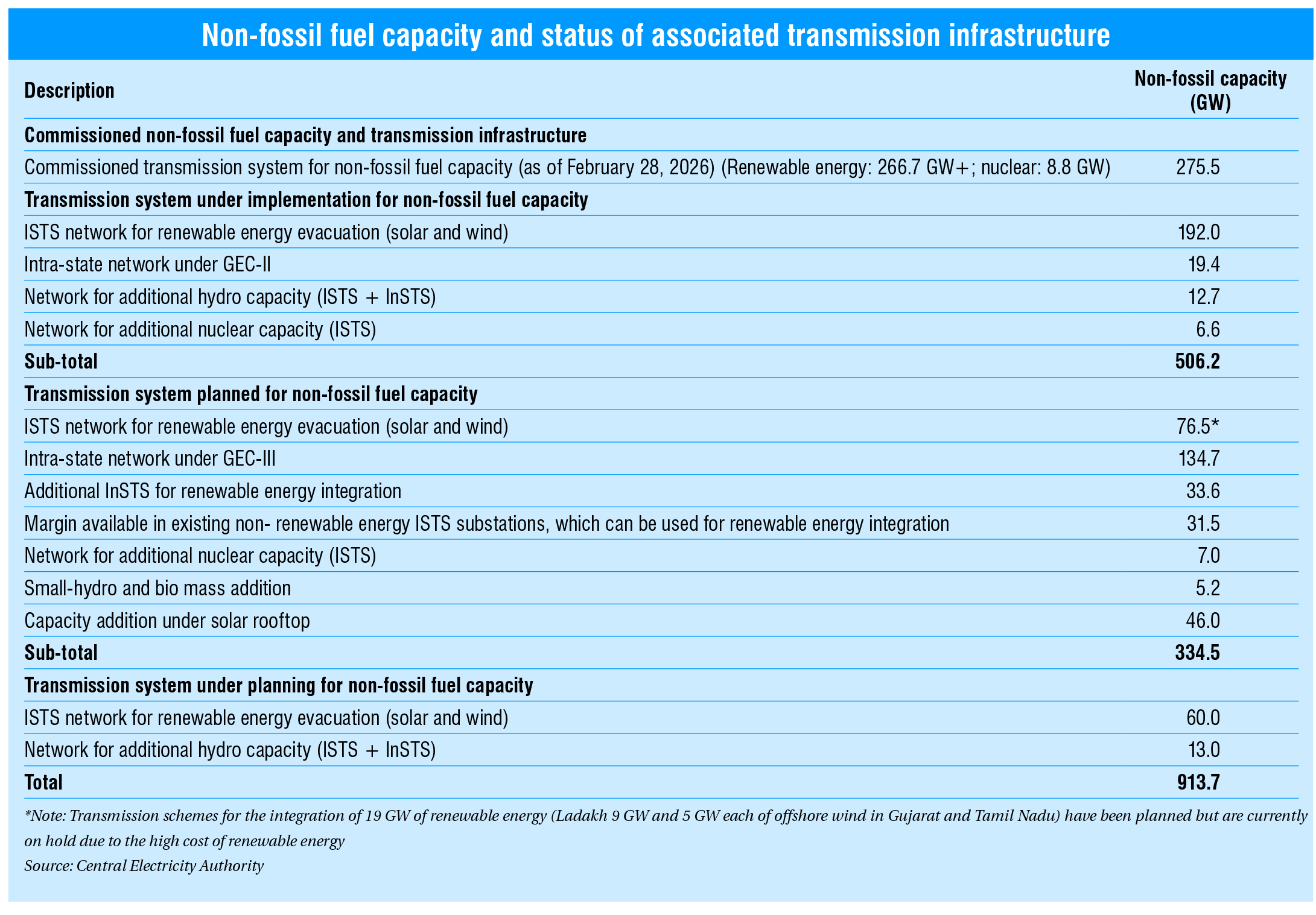
As of March 2026, India’s installed non-fossil fuel-based capacity stood at 283 GW, accounting for over 53 per cent of total installed capacity. Distributed renewable capacity has also seen strong growth, with rooftop solar installations increasing from 11.87 GW in March 2024 to 24.87 GW by February 2026.
 Demand growth and capacity outlook
Electricity demand in the country has witnessed steady growth over the past five years and is expected to rise further, driven by economic expansion, increasing electrification and higher consumption across sectors. Further, the emergence of new load segments such as green hydrogen and data centres is expected to add to demand growth. As per projections, peak electricity demand is likely to reach about 459 GW, while total energy requirement is estimated at 3,365 BUs by 2035–36.
To meet this demand in a reliable and sustainable manner, generation planning studies indicate that the country’s installed capacity may increase to around 1,121 GW by 2035–36, of which about 786 GW is expected to come from non-fossil sources. A significant share of this capacity addition will be driven by renewable energy, with solar and wind capacity projected to reach a combined 664 GW (solar: 509 GW; wind: 155 GW). This translates into an annual capacity addition of around 40–45 GW from these sources. However, transmission planning has been carried out for over 900 GW of non-fossil capacity, with implementation to be aligned with the actual pace of renewable energy development.
For effective integration of the planned renewable capacity, it is critical that capacity addition progresses broadly in line with the year-wise trajectory envisaged in planning studies. This ensures that transmission infrastructure and grid support systems are developed in tandem with generation capacity. Any significant deviation could result in operational challenges such as transmission congestion and renewable energy curtailment. Aligning capacity addition with the planned trajectory is therefore essential for ensuring efficient power evacuation and reliable grid operation.
A robust ISTS will play a critical role in connecting resource-rich regions with load centres and enabling efficient power evacuation.
Regulatory support
Regulatory developments are supporting improved utilisation of transmission infrastructure. The Central Electricity Regulatory Commission’s Third Amendment Regulations, 2025, introduced the concepts of solar and non-solar hours. While solar projects are aligned with solar hours, wind and energy storage systems are permitted round-the-clock access. The framework aims to ensure the optimal utilisation of transmission capacity while promoting the development of hybrid renewable energy projects.
Notably, a margin of about 176 GW is available during non-solar hours at existing and under-construction renewable energy pooling substations, of which connectivity applications for around 105 GW have already been received. These margins can be utilised for integrating wind capacity and battery energy storage systems (BESS).
Further, resource adequacy studies by the CEA highlight the need for long-duration energy storage to support higher renewable penetration beyond 2030. Pumped storage projects (PSPs) are expected to play a key role, given their ability to provide both storage and grid-balancing services. In addition, the CEA’s roadmap for achieving 100 GW of PSP capacity by 2034–35 outlines the development trajectory along with associated transmission requirements.
Renewable energy integration
At the intra-state level, transmission strengthening is being undertaken through schemes such as the Green Energy Corridor II (GEC-II), which is expected to facilitate the integration of about 20 GW of renewable energy capacity. Further, the proposed Green Energy Corridor III (GEC-III) scheme is expected to support the evacuation of an additional 134.7 GW of renewable energy capacity and 25.2 GW of pumped storage capacity. This would involve the development of over 51,126 ckt km of transmission lines and substations with a capacity of about 228,903 MVA, along with support for 44.8 GWh of BESS capacity.
In addition, about 33.3 GW of renewable energy capacity is planned for integration into intra-state networks in Rajasthan (10 GW), Gujarat (15 GW) and Karnataka (8.3 GW).
For hydroelectric projects expected by 2035–36, the country has an installed capacity of 51,415 MW (as of March 2026), with transmission systems planned for evacuating 12.7 GW of additional capacity and another 13 GW currently under planning. Meanwhile, for nuclear projects expected by 2035–36 under the ISTS, the country has an installed capacity of 8.78 GW (as of March 2026), with transmission systems planned for evacuating an additional 7 GW.
Emerging technologies
The transmission plan also considers advanced technologies to support large-scale renewable energy integration. These include 1,150 kV AC corridors and 800 kV HVDC links for evacuating power from high renewable potential regions, offshore wind zones and emerging green hydrogen hubs, while strengthening interregional connectivity.
Conclusion
The transmission plan for integrating over 900 GW of non-fossil capacity by 2035–36 will serve as a critical enabler of India’s energy transition. The associated transmission schemes are at various stages of implementation, ranging from commissioned assets to projects under construction and bidding, and will be taken up in line with renewable capacity additions.
Given the relatively shorter gestation period of renewable projects, the timely development of transmission infrastructure remains critical to ensure seamless power evacuation and avoid system constraints.
Overall, the transmission network planned under ISTS and intra-state states for integrating additional wind and solar capacity during 2026-27 to 2035–36 is estimated to 1,37,500 ckt km and 8,27,600 MVA respectively at an estimated cost of Rs 7,933 billion. This underscores the scale of infrastructure development required to support the next phase of India’s clean energy transition.