Currently, India relies on long-term power purchase agreements (PPAs) for procuring generation capacity. Under this system, generators enter into long-term contracts with discoms and recover fixed costs based on the declared availability of their plants. The buying discoms hold scheduling rights over the contracted capacity and pay energy charges separately based on actual power supplied. While this framework helps ensure the availability of capacity, it does not necessarily guarantee that sufficient capacity will be available during periods of system stress. This is because the existing contracting structure is largely based on long-term bilateral contracting and does not always ensure that capacity is available where and when the grid needs it the most.
To address these concerns, the Central Electricity Regulatory Commission has released a staff paper proposing the introduction of capacity markets in India to ensure adequate capacity availability during periods of system stress.
Rationale behind capacity markets
A capacity market is an additional market created alongside the existing energy market, where capacity is procured and remunerated separately from the actual supply of electricity. While the energy market handles short-term electricity despatch, the capacity market is meant to ensure that sufficient generation resources remain available in the system over the long term. Such markets are generally introduced when energy-only markets do not provide adequate incentives for investment in new capacity, generators are unable to recover fixed costs due to limited despatch, ancillary service (AS) markets remain underdeveloped, or increasing renewable energy generation creates greater uncertainty in the system.
Three proposals for capacity markets in India
The paper proposes three options for introducing capacity markets in India. Under these options, electricity despatch is linked more closely to market-based price discovery rather than direct scheduling rights held by buyers.
Capacity market for resource adequacy obligation
Under India’s resource adequacy (RA) framework, discoms are required to procure generation capacity to meet demand. At present, this is done through long-term PPAs based on fixed capacity and energy charges. Generators recover fixed costs based on plant availability, while energy charges are paid based on power scheduled by the discom. Scheduling and despatch rights remain with the buying discom and electricity does not flow through the market. The paper proposes three alternative approaches.
The first option proposes a pure capacity market where discoms procure only capacity availability. In this scenario, generators would bid only for capacity charges discovered through auctions based on the Net-CONE principle, that is, the cost of capacity adjusted for expected energy market revenues. While generators would receive payments for keeping capacity available, actual electricity supply would go through the day-ahead market (DAM) and real-time market (RTM). The paper proposes that buyers may be allowed to bid above the market price cap to ensure access to electricity equivalent to their contracted capacity and prevent free-riding problems.
The second option is closer to the existing PPA framework. Discoms would continue procuring capacity based on fixed and variable charges, and retain scheduling rights, but despatch would happen through the market. The discom and generator would then settle the price difference outside the market.
The third option proposes a centralised mechanism where a central agency would procure capacity through market-based auctions for discoms facing RA shortfalls. Once the auction is completed, discoms with capacity shortfalls would pay the proportionate capacity charge discovered in the auction to the agency. In turn, contracts would be signed between the agency and generators, while electricity despatch would go through the DAM and RTM.
Under all options, generators would be required to bid as price takers during peak periods, failing which penalties of 1.5 times the discovered capacity charge could apply.
Reserve capacity market
During solar hours, thermal power plants often operate at minimum technical levels because of low net demand, leaving limited reserve capacity in the system and creating risks for grid security. In order to address this, the paper proposes a reserve capacity market to ensure backup capacity remains available during periods of system stress.
Under the proposal, the National Load Despatch Centre (NLDC) would allocate reserve requirements under the grid code, identify state-wise reserve shortfalls, and centrally procure secondary and tertiary reserves in advance through annual auctions with one-year contracts. Price discovery would again be based on the Net-CONE principle, that is, the cost of new capacity adjusted for expected revenues from the energy and ancillary services markets, plus 10 per cent. Reserve capacity payments would ultimately be recovered from reserve-deficient states.
Importantly, these payments are meant only for keeping reserve capacity available and do not necessarily imply actual despatch. Once selected, the NLDC would have the first right of scheduling and despatch. If reserves are despatched, generators would receive both the capacity and energy payments. If they remain available but are not despatched, they would receive a holding charge in addition to the capacity payment. If reserves are not requisitioned, generators could still sell electricity in the market while receiving the capacity payment. Failure to participate in the AS market when required would attract penalties at 1.5 times the discovered capacity charge plus the AS price.
This proposal is intended as an interim mechanism until adequate reserves become available and procurement shifts closer to real time.
Secondary short-term capacity market
The third proposal relates to a secondary short-term capacity market for existing contracted capacities. At present, short-term markets are energy-only in nature. While they facilitate electricity trading, they do not guarantee capacity availability. As a result, there can be periods when electricity demand exceeds supply and prices reach the ceiling, even though some generation capacity remains locked under bilateral contracts and unavailable to the market. To address this concern, the paper proposes a secondary market where existing contracted capacity can be traded in the short term. Auctions could be conducted every three months for contracts lasting up to three months. Sellers could include discoms with surplus contracted capacity, generators and traders, while buyers could include discoms facing capacity shortages.
Bidding could be based only on capacity charges, while actual electricity despatch would continue through the DAM. Alternatively, bidding could include both capacity and energy charges. In this case, buyers would get the first right to schedule power from the contracted capacity until the DAM window opens, after which generators could sell any remaining electricity in the market. However, buyers would still pay the discovered capacity charge because the capacity was reserved for them.
 Concerns and the way forward
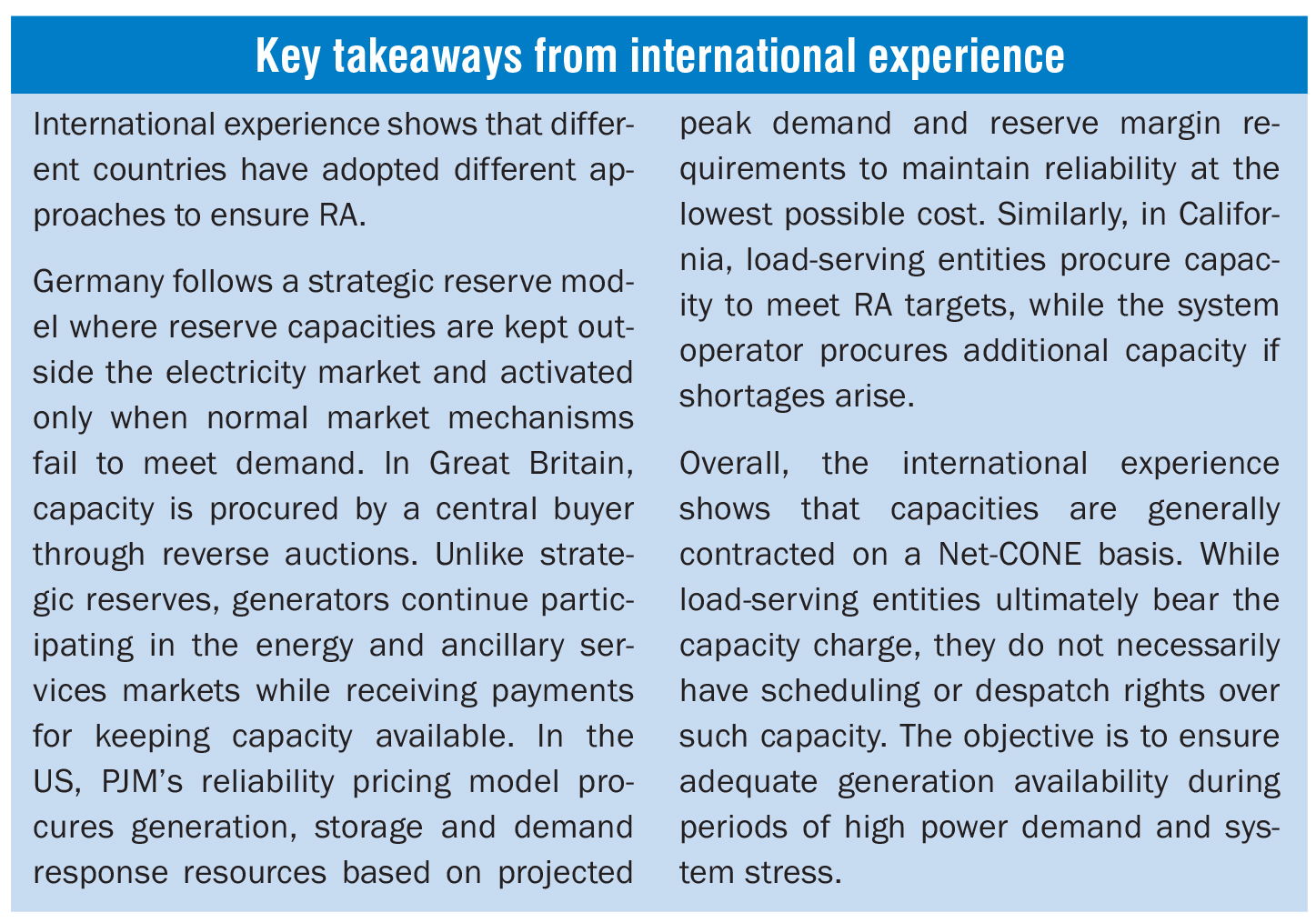
While capacity markets are intended to improve RA and grid reliability, they also raise concerns. One worry is whether partial recovery of fixed costs through capacity payments would provide sufficient comfort to investors and financial institutions. Another concern relates to the possibility of double payment, as buyers might end up paying both capacity charges through the capacity market and electricity prices through the energy market.
However, international experience suggests that these concerns can be mitigated through a robust energy market and strict no-load-shedding requirements. These together can provide adequate assurance regarding recovery of investment costs. Additionally, capacity markets can help keep energy prices under control by ensuring sufficient generation availability. In the absence of adequate capacity, energy prices can rise sharply, which can potentially result in higher overall costs for buyers than under a system with separate capacity remuneration.
Going forward, renewable energy projects may also participate in capacity markets by pairing generation with energy storage systems to provide firm power. The framework could encourage generators to maintain spare capacity and create opportunities for storage systems – deployed by renewable energy developers and transmission licensees – to participate in reserve markets. Over time, this could support a more technology-agnostic, flexible and resilient power system.