 By Piyush Pandya, Senior Vice President and Head of Engineering and Operational Excellence, IndiGrid
With a rapidly evolving power sector in India, utilities are facing growing pressure to ensure reliable power supply across large and complex asset bases. IndiGrid manages a significant portfolio of assets. Between operational plus pipeline assets, IndiGrid’s portfolio includes 18 substations with a combined capacity of over 32,000 MVA, around 1.5 GWp of solar capacity and 2.5 GWh of battery energy storage systems. Its transmission network comprises multiple extra-high voltage lines operating at 400 kV and 765 kV, covering nearly 9,700 ckt km across the country.
Given the scale of operations, the number of towers, the length of conductors and the geographical spread of assets are significant, making monitoring and maintenance complex. To manage such an extensive network, the use of artificial intelligence (AI) becomes important, alongside human effort. AI-based asset maintenance helps handle large data sets, improves visibility across the network, enhances defect detection and reduces operational risks.
Need for AI-based asset maintenance
Transmission line towers are typically inspected through conventional manual methods such as ground-based visual checks and tower-top patrolling. However, the scale of operations and the geographical spread of assets make this approach time-consuming and require a large workforce to be deployed regularly on field.
As per industry practise, ground patrolling alone generally accounts for nearly 50-60 per cent of the total effort and limits human productivity due to a significant portion of time spent on travel. Another 15-20 per cent is used for infrared (IR) scanning, which has limited effectiveness. As a result, only about 20 per cent of the effort is spent on actual defect rectification and other productive activities. Moreover, observing transmission components from the ground does not always allow accurate identification of all issues, leading to limited detection ability, delayed identification and inconsistent reporting.
To address these limitations, human effort needs to be complemented with more advanced technologies.
AI use cases at IndiGrid
To address the challenges associated with manual patrolling, there is a need to revisit conventional model, and IndiGrid is studying a new operating model. This model is expected to free up nearly 30 per cent of the technicians’ time, while improving productivity, defect detection and overall safety.
Drone patrolling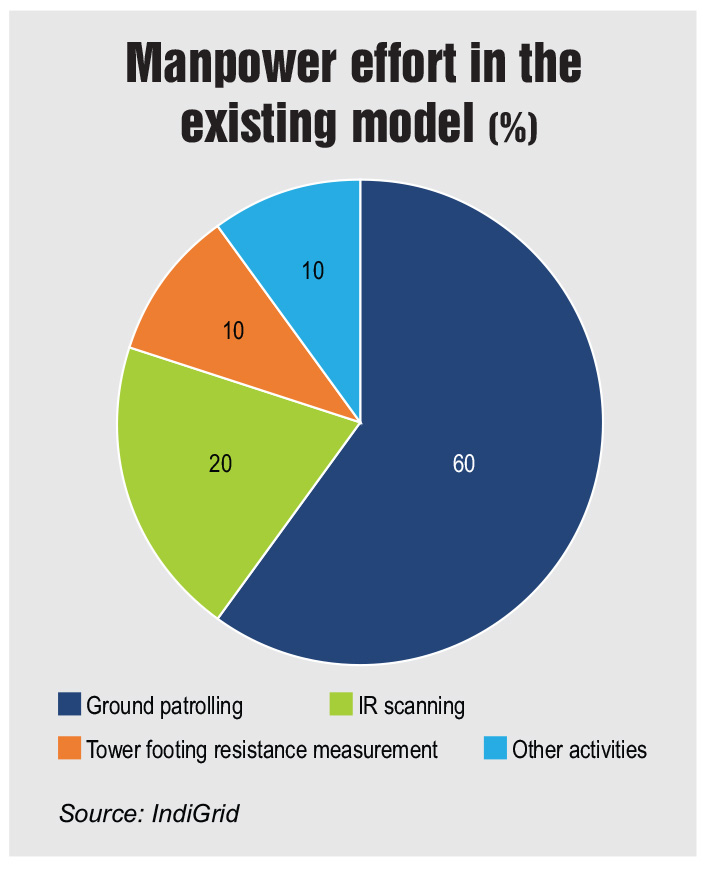
As part of this approach, IndiGrid has adopted drone-based patrolling for transmission line inspections.
Drones are increasingly used across the power value chain for a range of inspection, monitoring and data-gathering applications. They are used for the inspection of transmission lines, towers and substations by capturing high resolution visual and thermal images. This helps identify issues such as cracked insulators, loose fittings, corrosion and line sag. Similarly, they enable detailed checks of equipment such as transformers and circuit breakers. A key application of drone technology is vegetation management, especially along transmission corridors passing through forests and agricultural areas. Equipped with light detection and ranging (LiDAR) or multispectral sensors, they help identify vegetation growth near power lines, enabling targeted trimming and reducing the risk of faults or fire hazards. Drone-based photogrammetry and LiDAR can also be used to create high-resolution maps and 3D models of assets. This supports engineering, asset management and planning by providing accurate data on transmission routes, conductor clearances and substation layouts. In addition, drones support surveillance and security by monitoring large and remote assets such as solar plants and transmission corridors, helping detect theft, vandalism and other unauthorised activities.
IndiGrid is using drones to capture images of transmission line components, which are then analysed to identify defects and anomalies. Initial deployments were carried out on transmission assets under three assets of IndiGrid – Bhopal Dhule Transmission Company Limited (BDTCL), East-North Interconnection Company Limited (ENICL) and Jabalpur Transmission Company Limited (JTCL). The inspections identified around 4,000 defects in assets under BDTCL, 22,000 under ENICL and over 5,000 under JTCL.
While drone-based inspections have improved coverage and detection, they also generate a substantial volume of image data. Analysing these images manually is not practical, making it necessary to adopt AI-based models that can automatically identify defects and enable faster corrective action.
Image analytics with AI platform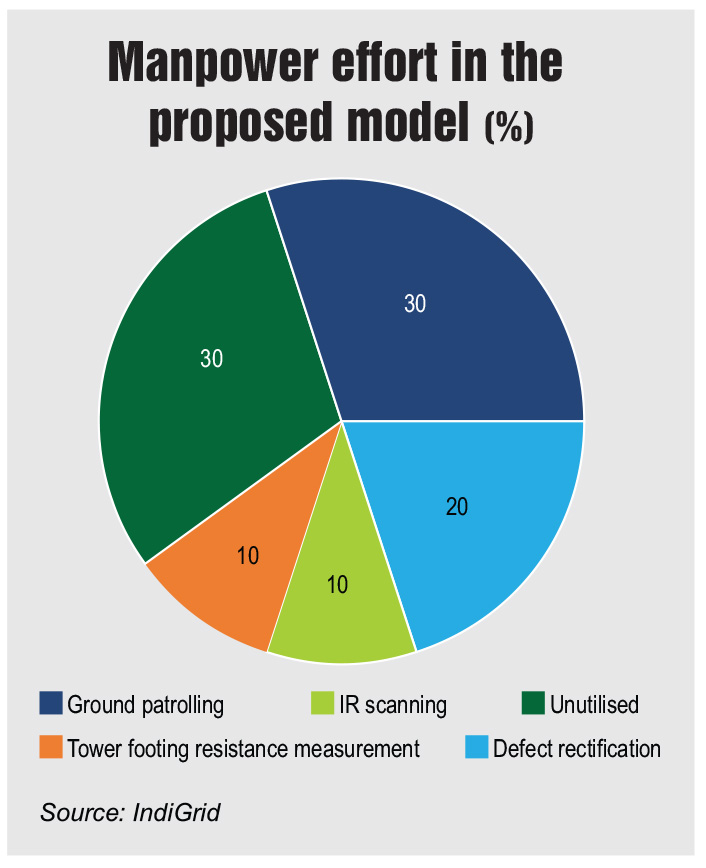
To address this, AI-based image analytics has been developed for automated defect detection. This has been implemented through a collaborative approach involving three stakeholders: IndiGrid for domain expertise in transmission line inspection and maintenance, a technology partner for AI model development, and a drone agency for data capture.
At the initial stage, small pilot use cases were undertaken to identify defects in components such as bundle spacers and foundation chimneys. The results showed that AI could reliably detect anomalies with a reasonable level of accuracy, establishing confidence in the approach and its scalability. Building on this, AI models were developed to detect 16 types of defects across transmission line components. A key part of the development process was image annotation, where each image was labelled to identify components and classify defects. More than 0.1 million images from the asset portfolio were used, with over 1 million annotations created to train the model. The system was refined through three iterations of model tuning and after about a year of development, it was found to be stable and ready for deployment.
The use of AI-based analytics has enabled the detection of defects that are difficult to identify through manual inspection. These include issues such as improperly fixed grading rings, which can lead to unequal voltage distribution and potential insulator failure. It has also enabled the detection of loose jumper bolts and nuts that may cause line tripping or system breakdown in high voltage transmission lines. The model is currently operating at an accuracy of around 75 per cent, with further improvement expected as more data becomes available and the training data set expands.
CCTV technology
In addition to drone and AI-based analytics, IndiGrid has implemented closed-circuit television (CCTV)-based monitoring to strengthen surveillance and enable centralised operations. The company operates a central control room (CCR) in Noida, from where assets across its network are monitored and controlled with the support of supervisory control and data acquisition and CCTV systems. The long-term plan is to move towards unmanned substations. To support this, the surveillance infrastructure has been enhanced through a combination of thermal cameras, pan-tilt-zoom cameras and conventional analogue CCTV systems. These systems enable continuous monitoring of both security and operational activities, with real-time visibility at the control room.
The set-up is supported by digital video servers, video management software and video analytics tools. Digital video servers combine the capabilities of digital and network video recorders, supporting both analogue and internet protocol (IP) cameras and enabling video transmission over IP networks. Video management software provides centralised access to live and recorded feeds across multiple locations, along with features such as event and alarm management, scheduling and automated notifications. Further, video analytics enables automated monitoring by detecting anomalies and security events, reducing the need for manual intervention. This system is used not only for substations but also across solar plants, construction sites and storage facilities to monitor personnel movement and material handling.
Drone thermography for solar assets
For solar assets, drone-based thermography is widely used for inspection and maintenance. Solar plants consist of a large number of modules spread over extensive areas, making drones equipped with thermal cameras well suited for rapid inspection and fault identification. This approach enables the detection of common issues such as overheating panels, bypass diode failures and dirt or vegetation affecting performance. Like the rest of its asset portfolio, IndiGrid monitors its solar assets from the CCR in Noida.
Conclusion
Overall, these use cases show how technologies such as drones, AI-based analytics and advanced surveillance systems are being applied to improve asset maintenance and operations. They have helped enhance inspection efficiency, improve defect detection and enable better monitoring across a large and geographically dispersed asset base.
While multiple technology options are available, their adoption needs to be aligned with operational priorities and resource availability. Therefore, a focused approach is required to identify the most relevant use cases and deploy solutions that deliver measurable improvements in productivity and safety.