With the growing integration of renewable energy into the grid, hydropower is expected to play a major role in addressing the intermittency and balancing requirements. As India strives to achieve the 500 GW non-fossil capacity target by 2030, hydropower will be a key component in providing firm, despatchable and balancing power that helps the grid absorb large volumes of variable renewables. Power Line takes a look at the key trends and outlook for the hydropower sector in India…
Segment size and growth
As of June 2026, the hydropower capacity in India stood at 52,065 MW, with a share of 9.49 per cent in the overall energy mix. This includes about 7,425 MW of pumped storage projects (PSPs). In FY 2025-26, the hydropower capacity reached 51,415 MW with an addition of 3,687 MW from the previous fiscal year. With respect to generation, in FY 2026-27 (till June 2026), hydropower generation stood at 36.87 BUs. In FY 2025-26, 167 BUs was generated, recording an increase of 12.5 per cent from the previous year. Further, small hydropower (SHP) capacity in June 2026 reached 5,182 MW, highlighting a share of 0.94 per cent in the energy mix. With respect to hydro pumped storage projects (PSPs), as of June 2026, about 7,425.6 MW of PSP capacity was under operation, while about 15,870 MW was under the construction stage.
The key projects commissioned during 2025-26 include NHPC’s Subansiri Lower Units 1-3 (3×250 MW); Greenko Energies’ Pinnapuram HPS Unit 5 (240 MW); JSW Energy Limited’s Kutehr hydroelectric project Units 1-3 (3×80 MW); Greenko’s Pinnapuram Units 7-8 (2×120 MW); THDC’s Tehri PSP Unit 2 (250 MW); THDC’s Tehri PSP Unit 1 (250 MW); Greenko’s Pinnapuram HPS Units 1-5 (5×240 MW); and NHPC’s Parbati-II HPS Unit 4 (200 MW). In FY 2026-27 (till June), projects such as THDC’s Tehri PSP Unit 4 (250 MW), NHPC’s Subansiri Lower Unit 4 (250 MW), JSW’s Tidong-I Unit 1 (50 MW), and JSW’s Tidong-1 Units 2-3 (2×50 MW) were commissioned.
Regulatory and policy developments
The draft National Electricity Policy 2026 prioritises the optimal use of hydropower potential through sophisticated site assessments, expedited approval procedures, appropriate funding, and tariff structures and incentive systems to improve project viability. Therefore, it is imperative to accelerate the development of storage-based hydroelectric projects to ensure energy security, support irrigation and mitigate flood risks. The draft policy suggests appropriate financing mechanisms to encourage such projects and strengthen India’s water and energy security, which should drive the hydropower market in the coming years.
In April 2026, the government approved the Small Hydro Power (SHP) Development Scheme to support SHP projects from FY 2026-27 through FY 2030-31. With a total outlay of Rs 25.84 billion, the scheme aims to build SHP projects of 1,500 MW across states in the coming years. The north-eastern states and other hilly regions with significant small hydro potential are anticipated to derive benefit from the scheme. Financial assistance of Rs 36 million per MW or 30 per cent of the project cost, whichever is lower, with a ceiling of Rs 300 million per project, is being provided for the development of small hydro projects in the north-eastern states and those in international border districts. For other locations, financial assistance of Rs 24 million per MW or 20 per cent of the project cost, whichever is lower, with a ceiling of Rs 200 million per project, is being offered. The SHP Development Scheme is likely to attract Rs 150 billion in investments over the coming years. The scheme supports the preparation of detailed project reports (DPRs) for at least 200 small hydro projects and allocates about Rs 300 million to establish a future project pipeline. The SHP Development Scheme is an important policy intervention that could drive the hydropower industry and help in attaining India’s clean energy goals.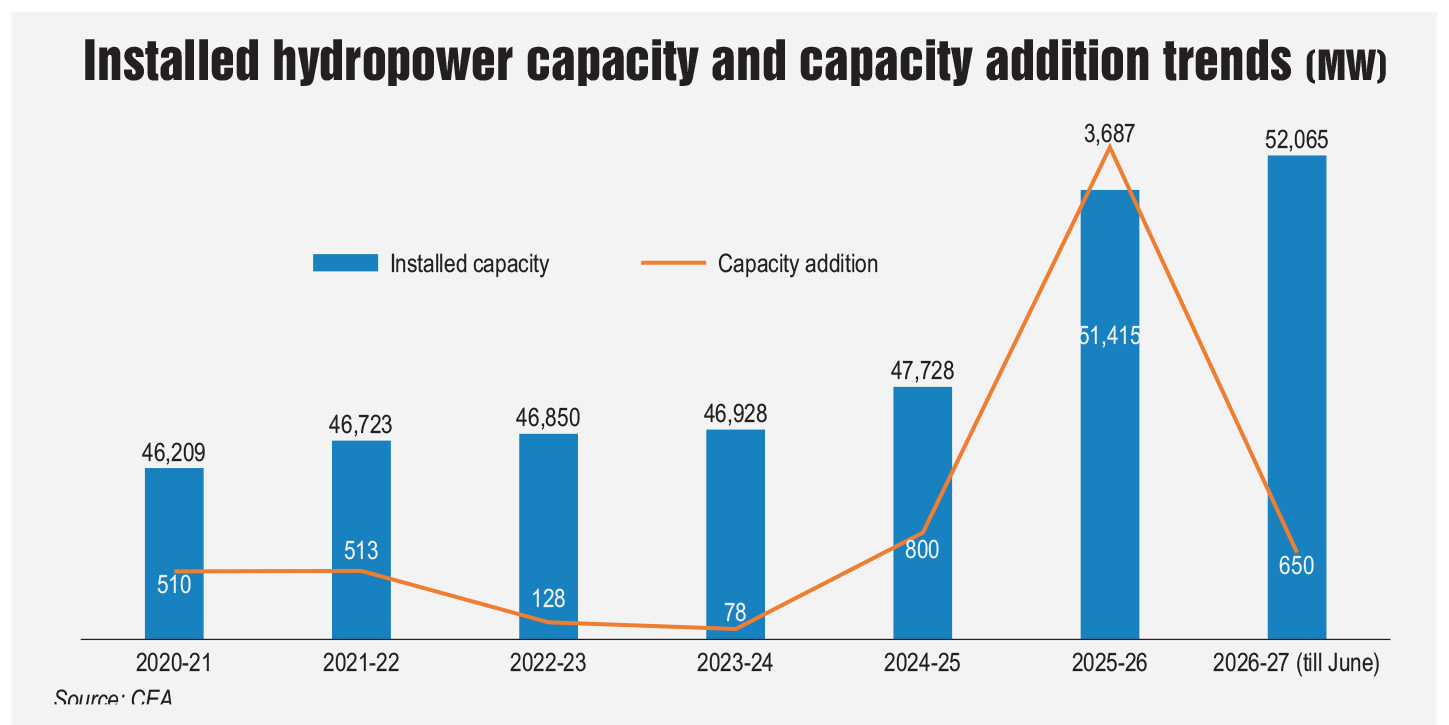
In October 2025, the Central Electricity Authority (CEA) released a Rs 6.42 trillion master plan for the evacuation of about 76 GW of hydropower (65 GW of hydro and 11 GW of pumped storage capacity) from the Brahmaputra basin. The plan aims to strengthen transmission infrastructure across the north-eastern region to support large-scale hydropower development. The framework comprises a two-phase implementation process: Phase I runs until 2035, requiring an investment of about Rs 1.91 trillion (30 per cent), while Phase II starts after 2035 with an estimated cost of Rs 4.51 trillion (70 per cent), out of the total investment of about Rs 6.42 trillion. Of the 64,945 MW of hydropower capacity expected to be commissioned, only about 6 per cent (4,045 MW) will be connected through the intra-state transmission system in states such as Arunachal Pradesh, Assam, Manipur, Meghalaya, Mizoram, Nagaland, Sikkim and West Bengal, while the remaining 94 per cent will be integrated with the interstate transmission system (ISTS). For pumped storage capacity of 11,130 MW, nearly 74 per cent (8,210 MW) will be pooled into the ISTS network and the remaining 26 per cent (2,920 MW) into Assam’s intra-state grid. These measures are expected to drive the growth of India’s hydropower sector.
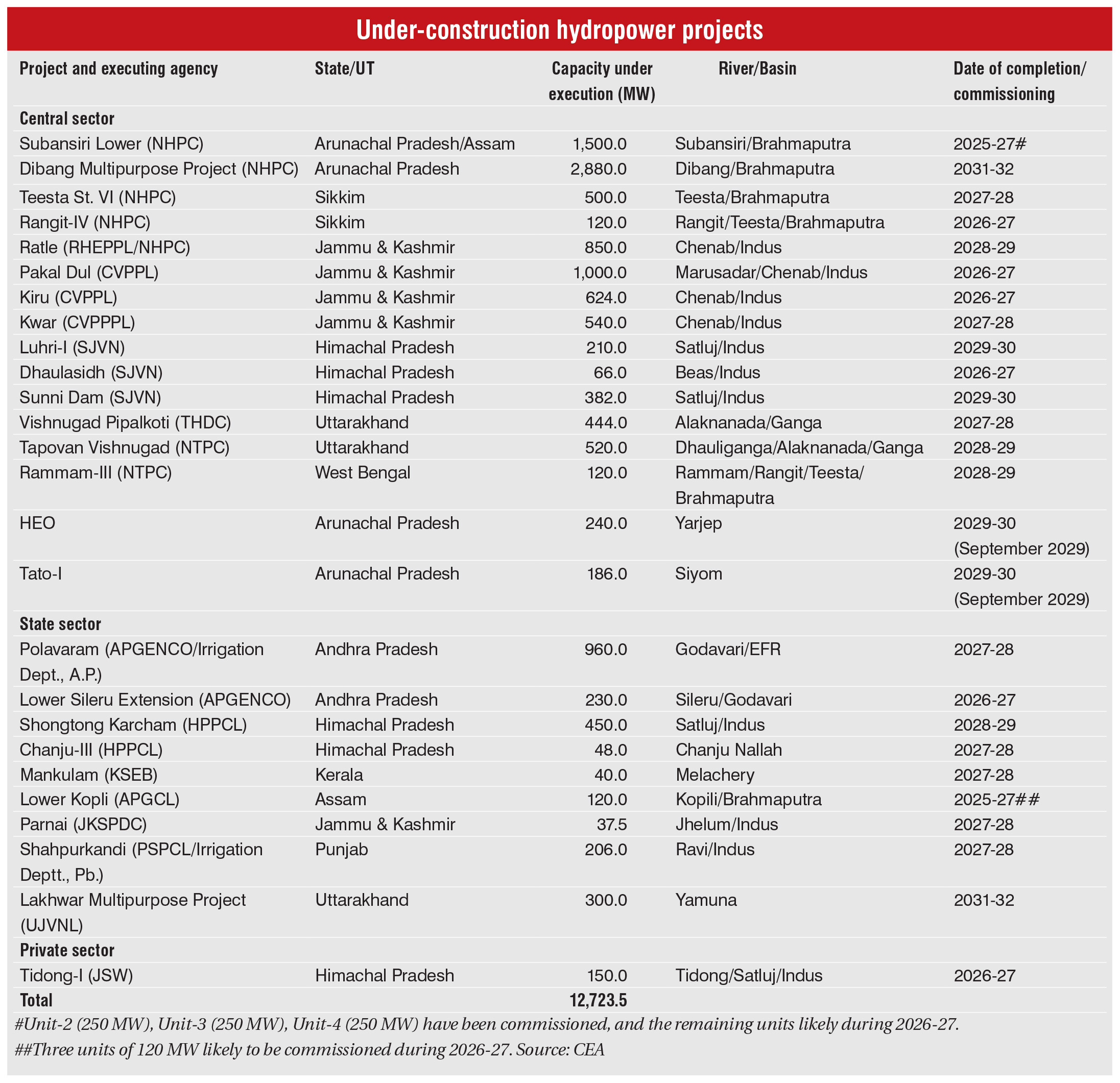
As per the Generation Resource Adequacy Report (2026-27 to 2035-36), hydropower installed capacity is projected to reach 78 GW by 2035-36. Likewise, PSP installed capacity is expected to reach 94 GW by 2035-36. Further, as reported in the generation resource adequacy report in March 2026, hydropower projects of about 12,723.5 MW were under the construction stage, while about 19,386 MW of hydropower projects were under various planning stages.
The roadmap to 100 GW of hydro PSP by 2035-36 envisages the installation of 100 GW of PSP capacity by 2035-36. The roadmap gives emphasis on a capital investment of nearly Rs. 5.8 trillion for the development of upcoming PSPs, considering major civil works, electro-mechanical equipment and supporting infrastructure. The roadmap recommends policy support such as faster statutory clearances, standardised tariffs, priority transmission connectivity, and viability support to improve bankability. It also highlights the need for public-private partnerships, market-based storage procurement and possible budgetary support for enabling infrastructure.
Recent developments
The hydropower segment in India has witnessed multiple developments in areas of new project development, key contracts, project pipeline and expansion plans. In April 2026, the government approved two hydropower projects in Arunachal Pradesh to support clean energy integration and regional energy infrastructure. The Cabinet Committee on Economic Affairs gave a green nod to the Kamala hydroelectric project (1,720 MW) and the Kalai-II hydroelectric project (1,200 MW), which is likely to be set up through a joint venture between public sector utilities and the state government. Reportedly, investments of Rs 260 billion and Rs 141 billion for the construction of the Kamala and Kalai-II projects, respectively, have been approved by the government.
Under the government’s hydropower expansion plan, state-owned entity NHPC Limited aims to achieve a 13 GW hydropower portfolio by FY 2026-27 through the phase-wise commissioning of active and pipeline hydropower projects. NHPC’s 2,000 MW Subansiri Lower hydroelectric project, which recently operationalised four of its units, is expected to commission its remaining units by December 2026. Other NHPC projects scheduled to be commissioned in FY 2026-27 include the 120 MW Rangit-IV in Sikkim, the 1,000 MW Pakal Dul, and the 624 MW Kiru in Jammu & Kashmir. Meanwhile, supported by a planned capex of about Rs 150 billion for FY 2026-27, the state-owned entity plans to start development of about six new hydropower projects with a cumulative capacity of 10 GW in FY 2026. In March 2026, the Bhakra Beas Management Board (BBMB) awarded a contract to Andritz for the design, manufacture and supply of critical hydropower generator components for Unit 4 of the Bhakra Left Bank powerhouse.
 Challenges and the way forward
Hydropower technology – whether in the form of large hydro, PSP or small hydro – offers flexibility to the electricity grid through its unique ability to rapidly adjust power generation and respond to changing demand patterns. The development of hydropower projects is contingent upon reliable hydrological, geological and environmental studies, as well as unforeseen incidents during construction. Hence, the time and cost required for these projects are relatively higher. Hydropower project development in remote locations multiplies costs because developers are entrusted with the responsibility to build roads, bridges, transmission links and communication systems, and provide logistics support before plant development can even progress. In addition, hindrances to project development due to natural calamities, such as flash floods, landslides and cloudbursts, create repeated construction roadblocks, and can damage completed works, equipment and access routes. Social acceptance of hydropower projects also remains a major concern as compensation disputes, rehabilitation issues, local resistance and expectations around jobs and benefits can delay projects for years.
In order to mitigate these issues, greater emphasis must be placed on proactive engagement with the concerned authorities. Regarding land acquisition, inclusive stakeholder consultation, prompt and adequate payment of compensation and enhanced awareness among landowners about the benefits of hydropower projects can reduce challenges. Moreover, a data-driven approach can be undertaken by project developers to improve project screening, risk detection and operational planning to enable better selection of geographical sites and robust construction management. As renewable energy integration accelerates, the electricity grid will require more balancing, storage and ramping resources. Hydropower is one of the clean technology options available at a utility scale, and its biggest advantage is its ability to shift electricity generation from low-demand to high-demand periods, support round-the-clock despatch and reduce renewable energy curtailment. Hence, hydropower can play a vital role in catering to India’s energy needs in the coming years.
Mohnish Makwana