Over the years, Power Line has published articles focusing on poor compliance with and weak enforcement of renewable power obligations (RPOs) and the renewable energy certificate (REC) mechanism. Earlier, the central concern was whether RPOs had succeeded in creating a robust demand for renewable energy. Today, the debate has shifted considerably. RPOs now serve as the principal regulatory mechanism for ensuring that obligated entities such as discoms, large captive power producers and open access consumers procure a minimum share of electricity from renewable sources. Hence, rather than questioning the relevance of RPOs, the focus now is increasingly on improving compliance under a more comprehensive and centrally monitored regulatory framework.
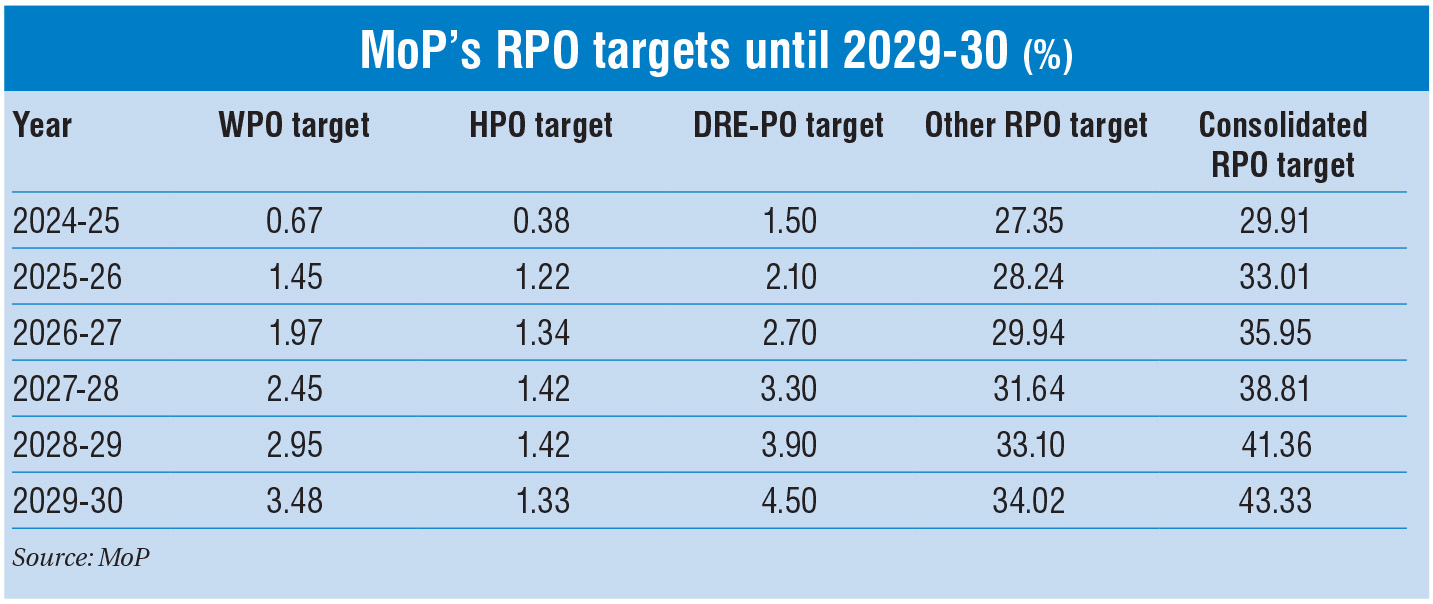
This transition is also reflected in the increasing sophistication of the RPO framework itself. What began as simply a renewable procurement requirement gradually evolved into a differentiated compliance structure in 2023, comprising wind purchase obligations (WPO), hydro purchase obligations (HPO), distributed renewable energy purchase obligations (DRE-PO) and other RPOs, each with separate compliance requirements. Simultaneously, procurement targets are growing each year. The consolidated RPO target set by the Ministry of Power (MoP) stood at 29.91 per cent in 2024-25, and is scheduled to increase to 43.33 per cent by 2029-30, representing an increase of nearly 45 per cent in the next five years.
The conversation has therefore shifted from how stringent RPO targets should be to whether obligated entities are complying with them consistently, and whether regulators have the necessary tools to monitor and enforce compliance. Against this backdrop, this article examines the evolution of India’s RPO framework, regulatory developments over the years, compliance gaps observed, implementation challenges, and the road ahead…
 From policy ambition to regulatory enforcement
RPOs were first introduced under the Electricity Act, 2003 as a demand-side instrument to support an emerging renewable energy market. Following this, the Electricity (Amendment) Rules, 2022 fundamentally altered the compliance framework by giving the Forum of Regulators (FoR) the task of monitoring compliance with RPO targets by discoms as well as captive and open access consumers, and submitting an annual report. The FoR developed a standardised reporting format for collecting RPO compliance data from obligated entities through their respective state electricity regulatory commissions (SERCs) and joint electricity regulatory commissions (JERCs). The reporting framework required quarterly submission of compliance data against both the MoP-specified RPO trajectory and the targets notified by individual SERCs, thereby introducing a uniform methodology for data collection across states for the first time.
Subsequently, the MoP notified long-term RPO and energy storage obligation trajectories extending up to 2029-30. For 2024-25, the prescribed obligations comprised 0.67 per cent WPOs, 0.38 per cent HPOs, 1.50 per cent DRE-POs and 27.35 per cent other RPOs, resulting in a consolidated obligation of 29.91 per cent. For the north-eastern and hill states, the DRE-PO and other RPO targets stood at 0.75 per cent and 28.1 per cent respectively, with the rest being the same. Unlike earlier RPO structures, these category-wise targets require obligated entities to diversify renewable procurement across multiple technologies rather than relying predominantly on solar generation.
Furthermore, orders were issued by the Appellate Tribunal for Electricity in April and May 2025 instructing SERCs to provide complete annual compliance data, after earlier submissions were found to be incomplete. Consequently, the “Report on Status of RPO Compliance” for 2024-25 was prepared. Responses were received from 29 SERCs and JERCs, with only the Manipur SERC not providing information.
Compliance gap persists
The reporting quality continues to vary considerably. Several large states, including Bihar, Gujarat, Haryana, Himachal Pradesh, Nagaland, Punjab, Tripura, Uttar Pradesh and West Bengal, did not furnish compliance data against the MoP-prescribed RPO trajectory, reporting only against their respective SERC regulations. This distinction is significant, because several SERCs continue to specify consolidated renewable procurement percentages, whereas the national trajectory requires compliance separately across wind, hydro, DRE and other renewable categories. Moreover, they still operate under earlier regulatory frameworks with lower overall obligations than the 29.91 per cent target notified by the MoP for 2024-25. For instance, the overall targets notified by the SERCs of West Bengal, Uttar Pradesh, Telangana and Tripura still remain significantly below the national ones. Additionally, some discoms across Telangana, Meghalaya and Odisha appear compliant when assessed against state regulations, but fall short of the MoP targets.
As a result, high aggregate compliance figures do not necessarily imply that all category-wise obligations prescribed under the MoP’s targets have been met. Hydro-rich states, such as Uttarakhand, Himachal Pradesh, Arunachal Pradesh and Mizoram, comfortably exceeded the overall renewable procurement levels as per the MoP target. This suggests that in certain hydro-rich states, compliance is partly influenced by the inherent advantage of an established renewable generation base, particularly from legacy hydropower projects. In contrast, several industrial and thermal power-dependent states, particularly Uttar Pradesh, Bihar, West Bengal, Tripura and Chhattisgarh, continued to report significant compliance deficits. Notably, the Kerala State Electricity Board emerged as the only utility in the country to fully comply with the MoP’s 2024-25 RPO targets across all four categories.
DRE has emerged as perhaps the weakest category in terms of compliance. Even utilities that achieved the overall RPO target or complied with the WPO or HPO frequently fell short of the 1.5 per cent DRE requirement. The compliance status of captive generating plants and open access consumers remains another significant regulatory concern. Karnataka, Sikkim, Tripura, West Bengal, Jammu & Kashmir and the JERCs for Goa and the union territories did not submit compliance data for open access consumers and/or captive users, while Bihar, Himachal Pradesh and Odisha provided only partial information for these categories. For states that did submit the data, entities continue to record poor compliance with the category-specific WPO, HPO and DRE-PO targets, while reporting itself remains inconsistent. Furthermore, in most cases, obligated entities comfortably exceeded the other RPO requirement through procurement from utility-scale solar and other renewable projects, yet failed to satisfy separate WPO, HPO or DRE-PO targets. Overall, renewable procurement may appear adequate, but category-wise compliance remains incomplete.
What lies ahead for India’s RPO framework?
While renewable procurement has increased substantially over the past decade, the focus is skewed towards solar power. Solar capacity additions have accelerated significantly, supported by declining tariffs, large-scale competitive bidding and improved project execution. As a result, procurement under the other RPO category has generally become easier for obligated entities. Wind procurement, however, did not expand at a similar pace. Similarly, HPOs remain dependent on existing legacy hydro projects more than the commissioning of newer ones, which usually involve long construction timelines.
The role of captive users and open access consumers has also become increasingly important. Traditionally, RPOs have focused primarily on discoms, because they accounted for the overwhelming majority of electricity procurement. However, industrial consumers have steadily increased renewable procurement through captive generation and open access arrangements, particularly after the introduction of the Green Open Access Rules in 2022.
The evolving REC market also deserves attention. When Renewable Watch examined the RPO framework in 2021, RECs were often viewed as the principal mechanism for addressing procurement shortfalls. Now, their role has become more complementary than central. Revised REC regulations in 2026, along with greater trading volumes and more liquidity, have improved the market. Although REC trading continues to provide compliance flexibility, the increasing emphasis on actual renewable procurement, together with category-specific obligations, has gradually reduced dependence on certificates as the primary means of meeting RPO requirements.
The policy priorities are becoming increasingly clear. One, SERCs will need to remain fully aligned with the MoP-notified trajectories to eliminate inconsistencies between consolidated and category-wise obligations. Two, reporting practices across SERCs also need to become more uniform to enable meaningful nationwide comparisons. Three, greater attention must be given to monitoring of captive generating plants and open access consumers, whose contribution to renewable procurement needs to grow. Finally, enforcement mechanisms, including timely compliance verification and regulatory action in cases of persistent default, will determine whether RPOs retain their effectiveness as India’s primary renewable procurement instrument.
Going forward, the effectiveness of the RPO policy will depend less on announcing increasingly ambitious targets and more on ensuring that existing obligations are implemented consistently across all obligated entities. The credibility of the RPO framework will ultimately be measured not by the percentages notified each year, but by the extent to which RPOs are uniformly monitored, transparently reported and effectively enforced.
Karan Sharma