The role of thermal energy generation has been critical for maintaining grid stability and reliability, particularly during times of intermittent or diminished energy generation. The technological superiority of thermal generation in providing firm, continuous and large-scale electricity compared to intermittent renewable energy sources has positioned thermal power plants (TPPs) as flexible energy generation resources in India.
While thermal energy generation comes with challenges related to high carbon emissions, intensive water utilisation, high operational cost and fossil fuel requirement, a greater emphasis on technological upgrades, and co-firing or fuel blending in TPPs has gained momentum in recent years.
Power Line takes a look at the key trends in India’s thermal generation sector…
Segment growth and performance
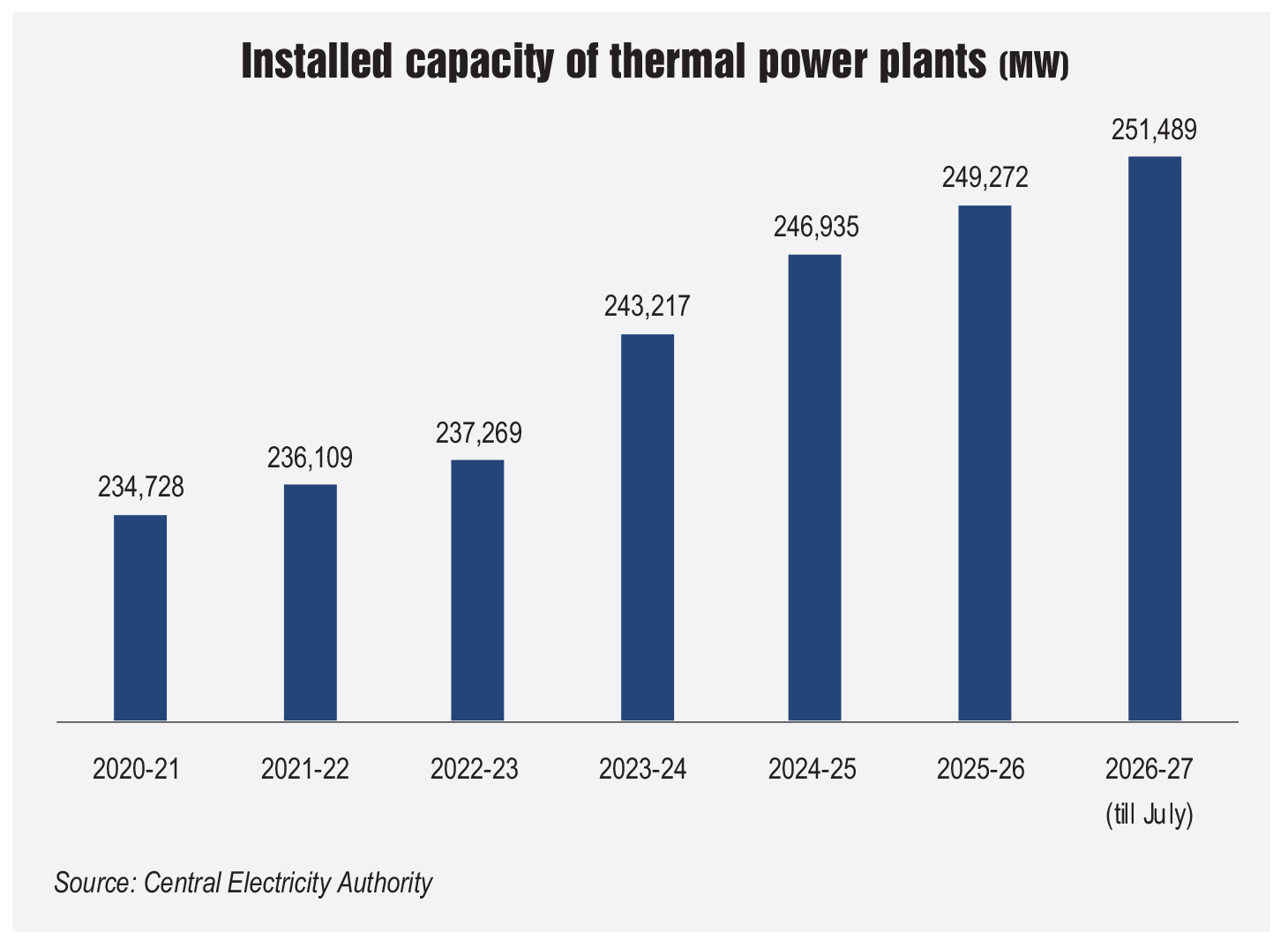
As of July 2026, India’s installed thermal power capacity stood at 251.48 GW, accounting for approximately 45 per cent in the overall energy mix. In the total thermal generation capacity, the coal generation fleet accounted for 224.15 GW (40.60 per cent) while lignite-fired generation capacity was 6.62 GW (1.19 per cent). Likewise, gas generation capacity was 20.13 GW (3.64 per cent) and diesel capacity was 589 MW (0.10 per cent).
Factors such as strong policy and regulatory push to increase renewable generation capacity, environmental concerns over the utilisation of conventional power plants, limited financing of coal and gas power plant projects have slowed thermal generation capacity addition in recent years. As per the Central Electricity Authority (CEA), in 2025-26, thermal generation capacity addition stood at 9.4 GW, against the target of 12.8 GW.
The under-construction capacity of TPPs, in June 2026, stood at 42,700 MW, with 19,300 MW in central, 9,800 MW in state and 13,600 MW in private sectors. The recently announced coal-based projects include the 1,600 MW Lara Stage-III expansion project, the 1,320 MW Koradi Thermal Power Project (Units 11 and 12), the 600 MW Thoothukudi TPP, the 800 MW Talcher Thermal Power Station Expansion Project (Stage IV) and the 1,600 MW Ropar TPP.
Coal-based capacity (including lignite) continues to be the major contributor to electricity generation in India with a share of over 70 per cent (with a generation of 1,281 BUs) in the all-India electricity generation in 2025-26, thus being the primary source to meet the base load electricity requirements.
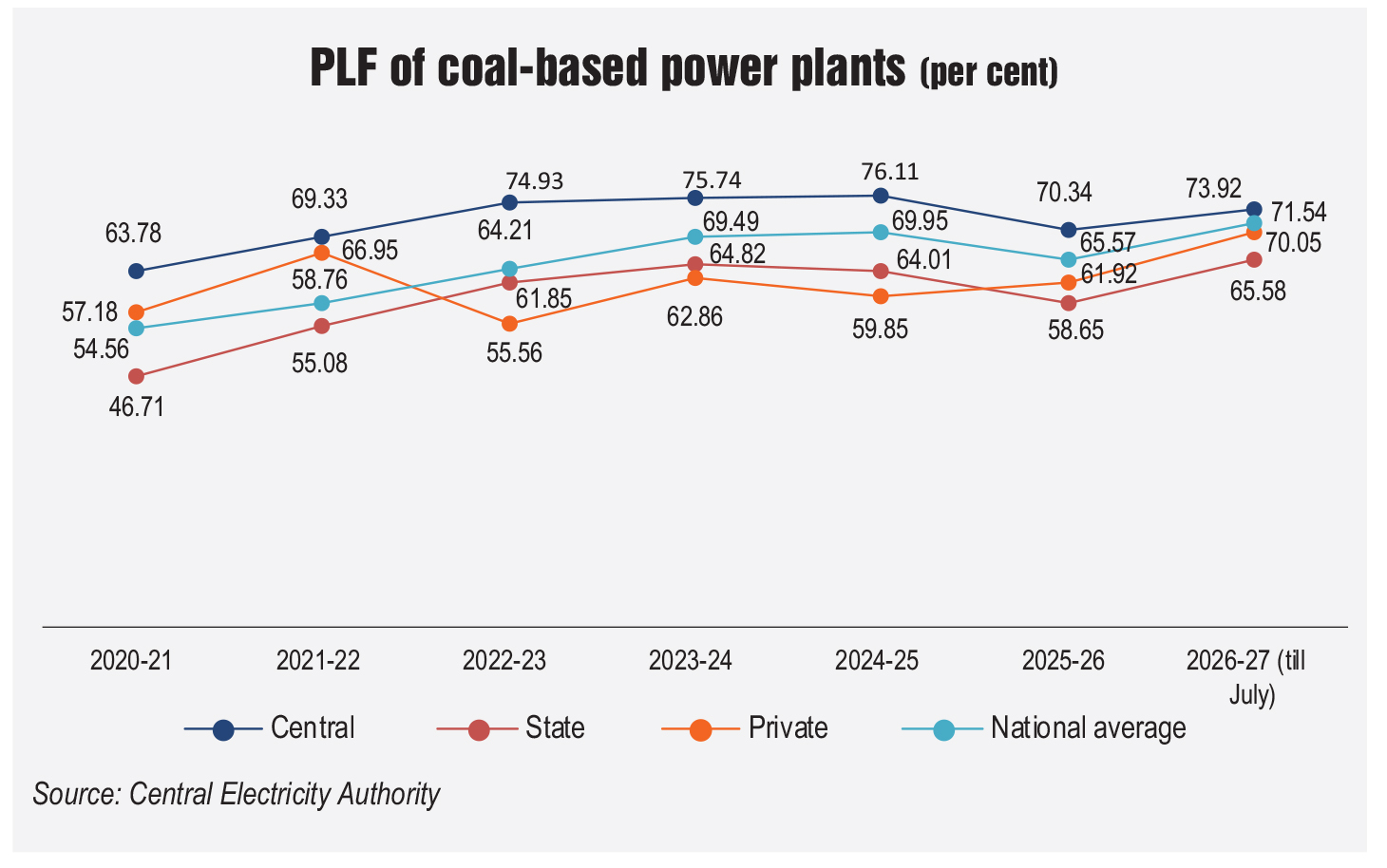
Further, the plant load factor (PLF) of thermal generating stations declined in recent years. The PLF decreased from 70.15 per cent in 2024-25 to 65.18 per cent in 2025-26, primarily due to lower electricity demand and rapid growth in renewable energy generation.
 Recent developments
In order to ensure adequate despatchable electricity during the peak-demand and monsoon period when power demand peaks and energy generation from some other sources becomes uncertain, thermal power stations are often deployed as dependable alternatives to cater to electricity demand. In June 2026, as per section 11 under the Electricity Act 2003, the Ministry of Power (MoP) extended the direction to Tata Power’s Mundra TPP in Gujarat to operate at its maximum capacity till September 30, 2026 to ensure adequate electricity supply amidst rising electricity demand during summer season. Earlier, the directions to operate and maintain the thermal generation unit were applicable till June 30, 2026.
Likewise, in April 2026, the MoP adjourned the planned maintenance of coal-based capacity of 10,000 MW for the upcoming three months, in order to ensure uninterrupted power supply amidst constraints such as shortage of gas at gas-fired stations. The higher fuel costs induced due to the West Asia crisis affected gas-based power generation in India. Considering the scenario, the government deferred the maintenance of 10 GW of coal-based capacity, while allowing only 5 GW of capacity for scheduled maintenance. The ministry also highlighted the addition of 22 GW of capacity (both conventional and non-conventional capacity) to ramp up power generation.
As environmental concerns take centre stage with the utilisation of TPPs, the utilisation of fly ash as well as bottom ash has become paramount. In this regard, in February 2026, the MoP issued revised guidelines for the disposal of current and legacy ash generated by coal and lignite-based TPPs, in line with the Ministry of Environment, Forest and Climate Change and subsequent amendments. The revised guidelines require TPPs to declare the quantity of issuable ash before initiating the ash disposal process. It also emphasised provisions on how TPPs must allocate, sell, transport and dispose of current and legacy ash so as to achieve 100 per cent ash utilisation with limited burden on electricity consumers.
Likewise, in November 2025, the MoP notified a comprehensive policy for co-firing of biomass pellets in coal-based TPPs, with an annual obligation for eligible coal-based TPPs with specific requirements varying by pellet type. It emphasised that all coal-based plants (TPPs) operated by generation utilities in the NCR shall, starting from the fiscal year 2025-26, incorporate (on an annual basis) a 5 per cent blend (by weight) of biomass pellets and an additional 2 per cent blend (by weight) either from biomass pellets and/or torrefied charcoal derived from municipal solid waste (MSW), in conjunction with coal. The biomass pellets can be in the form of non-torrefied or semi-torrefied (volatile matter in the range of >22-40 per cent) or torrefied. As on July 2026, a total of 75 TPPs have incorporated cumulative 6.57 million metric tonnes of biomass co-firing in India. This has translated into 8,303 MUs of power generation and 7.95 million metric tonnes of carbon dioxide savings.
With regard to flexible operation of coal power plants, in February 2026, the CEA issued a draft report of the committee constituted to examine wear and tear, operations and maintenance (O&M) and plant lifespan implications arising from flexible and two-shift operations in coal-based TPPs. The draft report notes that no significant damage has been observed that can be attributed directly to low-load operation (at 55 per cent minimum technical load (MTL) and conservative ramp rates). The principal sources of accelerated wear and tear are attributed to improper start-up/shutdown procedures, human and procedural errors, poor combustion management, etc. Therefore, the draft report emphasises measures for achieving 40 per cent MTL, in consultation with OEMs/main plant (BTG) manufacturers/BTG designers; improving operational discipline and training plant operators to manage cycling efficiently, rather than associating damage solely with flexible operation. The draft report highlights key recommendations for conducting pilot studies for two-shift operations on smaller size old units of less or equal to 210 MW with a lifespan of more than 35 years to assess component-specific damage, retrofit costs, O&M requirements, etc.
The rising domestic coal production and improvement in domestic coal linkages in recent months have lowered coal imports. For instance, coal imports by power plants declined by over 25 per cent, from 4.67 million tonnes in April 2025 to 3.51 million tonnes in April 2026. Further, coal imports for power plants supposed to be run on imported coal fell by over 27 per cent, from 3.97 million tonnes to 2.88 million tonnes. This is expected to lower the operational cost of coal-based generating stations. Further, the renovation and modernisation of TPPs has emerged as a strategic measure to enhance heat rate, curtail emissions, comply environmental norms, extend plant life and enable flexible operation. In August 2026, the CEA highlighted 223 potential thermal power stations with plant life of older than 20 years for renovation and modernisation/life extension (R&M/LE) works.
Power purchase agreements
Several recent thermal power purchase agreements (PPAs), particularly for new ultra-supercritical coal plants and long-term capacity procurement, highlight the requirement of firm capacity.
In July 2026, Adani Power signed a 25-year long-term power supply agreement (PSA) with MSEDCL to supply 1,600 MW from its forthcoming ultra-supercritical thermal power projects. Likewise, in February 2026, Adani Power’s subsidiary, Moxie Power Generation Limited received an LoA from Tamil Nadu Power Distribution Corporation Limited to supply 558 MW of power for a period of five years. In January 2026, JSW Thermal Energy Two Limited signed a PPA with West Bengal State Electricity Distribution Company Limited for a 1,600 MW greenfield coal-based super/ultra-super critical thermal power project. Further, in January 2026, MP Power Management Company Limited signed a PSA for 3,200 MW of capacity with three developers and an additional 800 MW capacity is available under the greenshoe option. Under the agreements, 1,600 MW has been allocated to Torrent Power Limited, 800 MW to Adani Power Limited and 800 MW to Hindustan Thermal Projects Limited.
 Boiler-turbine-generator awards
Considering the gradual thermal capacity expansion and renovation and modernisation, the BTG segment has witnessed the emergence of new contracts. In July 2026, NTPC Limited awarded a main plant package contract, including BTG, to L&T CarbonLite Solutions for two 800 MW of ultra-supercritical generation units. In March 2026, NTPC Limited awarded a main plant package contract, including BTG, to Bharat Heavy Electricals Limited for 3×800 MW of Telangana stage-II supercritical thermal power project. Likewise, in March 2026, Thermax Babcock and Wilcox Energy Solutions bagged a boiler package supply order for 800 MW of ultra-supercritical thermal power project in central India.
 Future outlook
As per the MoP, the thermal power generation capacity requirement is assessed at 307 GW by 2034-35, which is expected to be offset by additional 97 GW of coal and lignite based thermal capacity. Further, as on January 2026, contracts of about 22.9 GW of thermal capacity were awarded and due for construction, while 24 GW of thermal capacity was under different stages of planning.
Thermal generation, particularly the coal segment, is witnessing decarbonisation measures such as integration of existing coal plants through supercritical and ultra-supercritical technology, upgrades in efficiency and integration of emission-control systems, renovation and modernisation, felxibilisation through minimum-load operation, faster ramping and more frequent cycling.
Finally, the curtailment of carbon emissions would require a standardised approach with the integration of electrostatic preciptators and flue gas desulphurisation systems, improvement in coal quality and strict enforcement of carbon emission standards and their compliance. Despite increase in renewable energy capacity addition, coal is likely to remain the mainstay of India’s energy mix to meet rising electricity demand.
Mohnish Makwana