 Thermal power plants (TPPs) are responsible for large volumes of emissions, making the reduction of pollutants such as SOx, NOx and particulate matter a top priority for power plant operators. Overall compliance with the emission standards notified by the Ministry of Environment, Forest and Climate Change (MoEFCC) in December 2015 has been modest so far. India currently has coal and lignite-based plants with a total capacity of 213,666 MW, yet only 24 units, totalling 10,600 MW, have been equipped with flue gas desulfurisation (FGD) systems. Despite Indian coal having a relatively low sulphur content of 0.3-0.5 per cent, TPP developers are compelled to import coal due to rising power demand and domestic shortages. Imported coal may have a sulphur content of up to 3.5 per cent, contributing to additional CO2 emissions. This is a result of implementing FGD and using high-sulphur coal, adding to the CO2 released during coal combustion in TPPs.
While several technology solutions are available to help TPPs meet the prescribed norms, FGD is one of the most commonly used methods for SOx control. Notably, the majority of de-SOx systems, at various stages of installation across NTPC Limited’s power plants, are wet limestone-based FGDs. Apart from limestone, seawater and ammonia can be used as reagents in wet FGDs. Another de-SOx solution is dry absorbent injection (DSI), mostly suitable for small-sized TPPs.
In September 2022, the MoEFCC extended the deadlines for TPPs to implement SOx reduction equipment by two years, pushing the new compliance deadlines to December 2026 based on the location of the TPP. Category A (within 10 km of Delhi-NCR and cities with over 1 million population) has an extended deadline of December 31, 2024. Category B (within 10 km of critically polluted areas or non-attainment cities) has a new deadline of December 31, 2025, and Category C has until December 31, 2026. TPPs set to retire by December 31, 2027, are exempt from SO2 emission norms upon submission of an undertaking to the Central Pollution Control Board and Central Electricity Authority (CEA). Those retiring by December 31, 2022 (Category A) and December 31, 2025 (Category B and C) are exempt from norms for parameters other than SO2 emissions. Non-compliant TPPs face environmental penalties of Re 0.20 per unit (0-180 days), Re 0.30 per unit (181-365 days) and Re 0.40 per unit (366 days and beyond).
Progress update: FGDs installed and recently awarded contracts 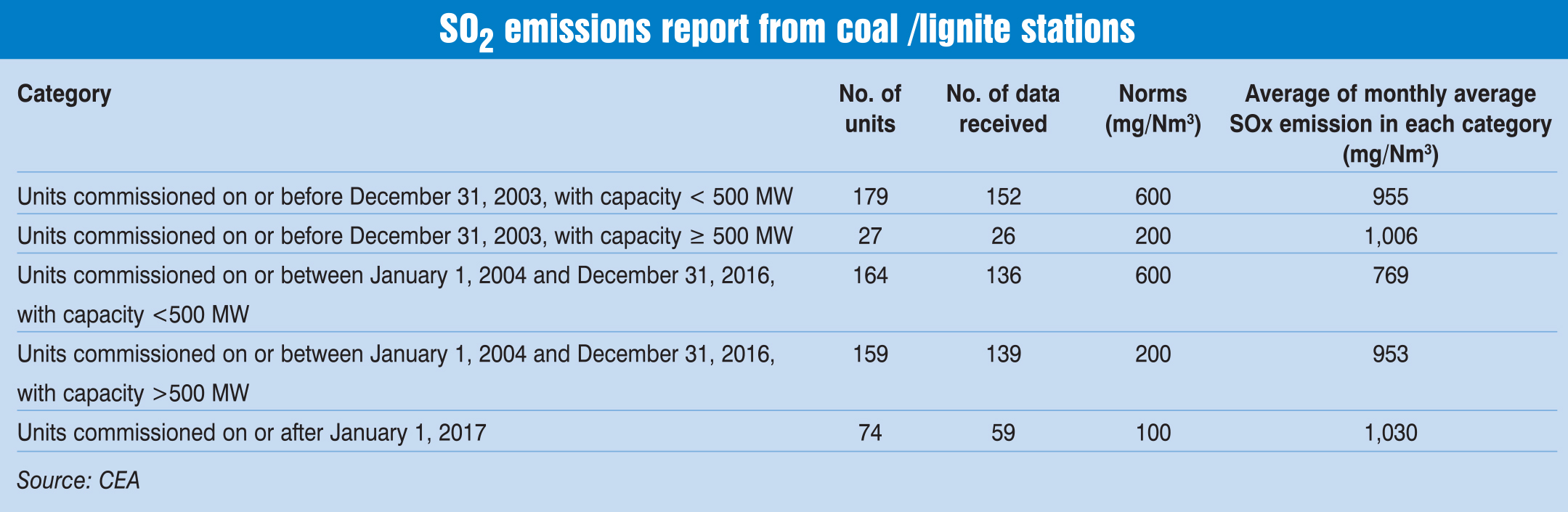
FGD systems have been planned for 600 units aggregating 211.52 GW in capacity. According to CEA data, as of October 2023, FGDs have been commissioned and are operational for 24 units with a total capacity of 10,600 MW. Meanwhile, bids have been awarded for 227 units, aggregating 102,960 MW in capacity. Sector-wise, bids have been awarded for 133 units in the central sector, 48 in the state sector and 46 in the private sector. Additionally, a notice inviting tender has been issued for 25,895 MW of capacity spanning 89 units.
NTPC has been a frontrunner in installing FGD systems at its power plants. So far, it has awarded FGD for 63,600 MW of capacity, implemented FGD in 2,990 MW, and the remaining 1,454 MW to be awarded soon. Following the implementation of FGD, NTPC plants have seen a 70 per cent reduction in average SO2 emissions.
Recent orders for FGD include Larsen and Toubro Limited (L&T) securing an engineering, procurement and construction (EPC) order from West Bengal Power Development Corporation Limited for the installation of wet FGD systems at the Sagardighi TPP in West Bengal. The key project highlights include three FGD absorbers serving four thermal power units (2×300 MW, 2×500 MW), along with balance of plant systems for five units. With this order, L&T is set to install FGD projects for TPPs with a total capacity of over 19 GW. In addition, Bridge and Roof Company (India) Limited has secured two EPC contracts worth Rs 15.90 billion from Chhattisgarh State Power Generation Company for the installation of FGD systems at two TPPs. The projects are at the 1×500 MW Korba TPP and the 2×500 MW Marwa TPP, with completion scheduled within 30 months of the contract signing date. Furthermore, GE Power India Limited has secured a significant contract worth Rs 4.40 billion from Gujarat State Electricity Corporation Limited. The scope of the contract encompasses the design, engineering, manufacturing, supply, packing and forwarding, installation, commissioning and performance guarantee testing of an FGD system.
De-SOx options
- Wet FGD: Wet FGD is one of the most popular and well-suited de-SOx technologies for Indian coal-based power plants. Depending on the type of reagent utilised, an FGD system can be categorised as seawater-based, ammonia-based or limestone-based. Notably, limestone-based wet FGD systems can eliminate 90-99 per cent of SOx. These systems exhibit great versatility, being suitable for units of all sizes, and are preferred for their cost-effective operation, as well as for generating a marketable by-product, gypsum. On the other hand, ammonia-based FGD systems are not widely favoured due to the significantly higher cost and hazardous nature of the reagent (ammonia). The first FGD system was installed at NTPC’s 500 MW Vindhyachal Stage V project in 2018, and was based on wet limestone technology.
FGD systems that rely on seawater as a reagent are well-suited for coastal power plants and can effectively eliminate up to 99 per cent of SOx. Seawater-based FGD systems offer advantages such as low capital cost, low capex and opex, easy seawater availability and treatment, absence of reagent, byproduct and effluent discharge, and a lesser tariff impact. Tata Power’s Mundra TPP has planned to install a seawater-based FGD system.
- Dry/Semi-dry FGD: Dry FGD systems are a more cost-effective choice for smaller power plants. In comparison to wet scrubbers, these systems consume approximately 60 per cent less water. Dry and semi-dry FGD technologies also exhibit a removal efficiency ranging from 70-98 per cent. These systems have lower capex but their opex is relatively higher compared to other FGD technologies. GE Power has completed the reliability run and full load operations, spanning 14 days, for India’s first semi-dry FGD systems project. This project, undertaken for Hindalco Industries Limited (1x150MW), is for their Aditya Aluminium Plant in Lapanga, located in Sambalpur, Odisha.
- DSI systems: Another post-combustion de-SOx technology alternative is DSI technology, well-suited for smaller units within the 60-250 MW range. The reagent cost associated with this technology is relatively higher compared to wet limestone and ammonia-based FGD. DSI achieves a SOx removal efficiency of 50-60 per cent. While traditional wet limestone FGD systems typically require over two years for installation, DSI can be operational in just 12-14 months. NTPC is implementing FGD through DSI technology in its older and smaller units. The erection work for the DSI system is at an advanced stage for two units of Tanda Stage I (4×110 MW).
Issues and challenges
The Indian FGD market is evolving, with limited vendor options causing extended lead times for equipment manufacturing due to high demand. Reliance on imports, particularly from neighbouring countries, is constrained by restrictions. Domestic manufacturing falls short for critical components such as agitators and gypsum dewatering systems. Recent procurement restrictions from neighbouring countries have impacted costs and timelines. Changes in procurement policies and stringent prequalification criteria have also led to increased price offers from domestic suppliers, disrupting project timelines and costs. Moreover, FGD orders often involve the integration of FGD components into existing brownfield projects. Retrofitting these components presents challenges related to conceptualisation and design, often encountering reengineering issues.
The substantial demand-supply gap in FGD equipment has led to a notable increase in raw material and component prices, with steel, cement, nickel, aluminium and copper experiencing significant surges. This impacts costs for tanks, ducts, pipe racks and related structures. The Covid-19 pandemic has further disrupted planning, order placement, the equipment supply chain and the installation of FGD systems, causing financial distress for subcontractors and vendors.
The way forward
In order to reduce SOx emissions, coal-based power plants must deploy FGD systems, which will necessitate an approximate investment of Rs 6 million-Rs 8 million per MW. The additional capex for FGD, coupled with higher operation and maintenance costs and increased auxiliary consumption, is expected to raise the levellised cost of electricity generation by an estimated Re 0.17 to Re 0.20 per unit. Additionally, power generating facilities will need to undergo two to three-month shutdowns for the installation of FGD systems.
Overall, the primary focus for thermal power generation companies in India is to comply with the recently introduced emission standards. In order to align with the SOx regulations, developers are increasingly adopting FGD systems. Consequently, it becomes imperative to extend the schedule for FGD system installations, initiate a gradual action plan for the immediate deployment of FGD units in TPPs located in heavily polluted areas, and commence a staged manufacturing initiative for FGD equipment.
Akanksha Chandrakar