
 As the focus on renewable energy intensifies, hydropower is emerging as a key energy source owing to its ability to provide reliable and flexible power. The hydropower segment is poised for significant growth, supported by recent policy initiatives and ongoing project developments. According to estimates by the Central Electricity Authority (CEA), India has a significant hydroelectric potential of 145,320 MW, but only 32 per cent has been harnessed so far. To promote the sector, several policy measures have been implemented recently, including the waiver of interstate transmission system (ISTS) charges for hydroelectric plants (HEPs) and the issuance of guidelines for pumped storage plants (PSPs) to simplify clearance processes.
Notably, while PSPs are a mature technology and have been around for generations, there has been a surge in demand for these projects in the past two years, as India moves towards integrating 500 GW of clean energy into its grid by 2030. PSPs, with long-duration storage capabilities, are expected to play a critical role in sustainably integrating intermittent renewables into the grid and maintaining grid stability. They have become an important part of the clean energy landscape in India, particularly with the increasing demand for round-the-clock renewables by both utilities, and commercial and industrial consumers.
Size and growth of the hydropower segment
Large hydro
The installed large hydropower capacity (above 25 MW) in the country stood at 46,928 MW as of May 2024. The share of hydropower in the country’s total installed capacity is 10.6 per cent. The CEA estimates the hydroelectric potential at 145,320 MW, of which only 32 per cent has been tapped. During the past five years (2019-20 to 2023-24), only 1,229 MW of hydropower capacity was added. In 2023-24, 78 MW of capacity was commissioned – SJVN Limited’s Naitwar Mori Units 1 and 2 (2×30 MW) and uprating of BBMB’s Bhakra Left HEP Unit 1 from 108 MW to 126 MW.
Based on the CEA’s generation data, erratic rainfall led to a decline in hydropower electricity generation during 2023-24, which stood at only 134.05 BUs, 17.76 per cent lower than the 162.99 BUs in the previous year. Its share in the total power generation dipped to 9 per cent in 2023-24 from 11 per cent in the previous fiscal. However, during 2024-25 (till May 2024), the power generated from HEPs stood at 20,704 MUs, an increase of 2.56 per cent from the 20,187 MUs during the corresponding period in the previous year. Falling reservoir levels in India are raising concerns about hydropower generation this summer. Reduced water availability could lead to decreased electricity production, impacting power supply and potentially increasing reliance on coal and other non-renewable energy sources. The situation underscores the need for efficient water management and diversified energy strategies to mitigate the effects of climate variability on power generation.
Small hydro
India has a significant small-hydro power (SHP) potential (25 MW and below) of about 19,749 MW, but less than 20 per cent of this capacity has been utilised, primarily due to challenges in remote site locations and associated costs of transmission infrastructure. The total installed SHP capacity stood at 5,005.25 MW as of May 2024. The total generation from SHP plants in 2023-24 was 9,485.04 MUs, 15 per cent lower than the 11,170.61 MUs recorded in the previous fiscal. During 2024-25 (till May 2024), the total generation from SHP plants was 1,328 MUs, 1.1 per cent higher than the 1,314 MUs recorded during the same period in the previous fiscal.
PSPs
PSPs will have a vital role to play in future green grids, providing the required storage and balancing services to keep the clean energy supply stable and reliable. India had about 4,745.6 MW of pumped storage capacity in operation as of May 2024, installed in various locations across the country including Telangana (Nagarjuna Sagar PSP and Srisailam LBPH PSP), Maharashtra (Bhira PSP and Ghatgar PSP), Tamil Nadu (Kadamparai PSP), West Bengal (Purulia PSP) and Gujarat (Kadana PSP and Sardar Sarovar PSP). However, only six plants with an installed capacity of 3,305.6 MW are working in pumped mode. The remaining 1,440 MW of capacity across two sites in Gujarat is currently not operating in the pumped mode due to delays in the construction of the tail reservoir and vibration-related issues in the system. Further, around 61,060 MW of pumped storage capacity is under various stages of investigation and construction.
 Policy initiatives
In April 2023, the Ministry of Power (MoP) notified guidelines for PSPs, considering their significant role in stabilising the grid and meeting the peaking power demand. The guidelines include recommendations for the PSP market, PSP policies and safe PSP development. Key aspects covered are the monetisation of ancillary PSP services to meet critical electricity market requirements; reimbursement of 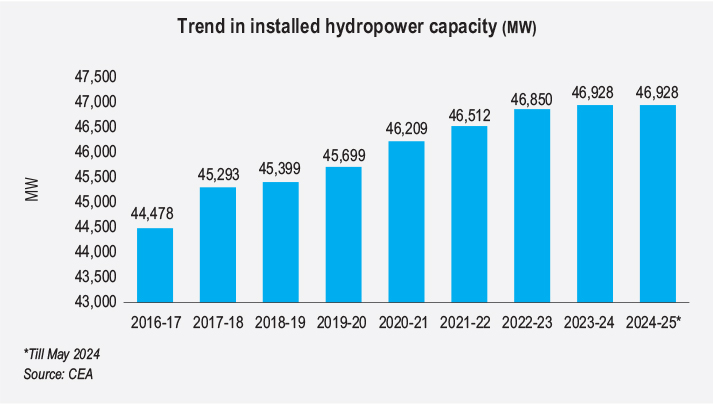 the state GST, or exemption of fees on land acquisition for off-river PSPs; removal of an upfront premium for project allocation; and identification and safe development of exhausted mines for prospective PSP sites.
In a key development, in May 2023, the waiver of ISTS charges was extended to PSPs for which construction work was awarded up to June 30, 2025, subject to certain conditions. Subsequently, the partial waiver of ISTS charges, in steps of 25 per cent from July 1, 2025 to July 1, 2028, was extended for PSPs where construction work was awarded up to June 30, 2028.
In March 2023, the CEA published revised Guidelines for the Formulation and Concurrence of Detailed Project Reports (DPRs) for PSPs. Under these revised guidelines, the timeline for the concurrence of DPRs for specific PSPs has been reduced from 90 days to 50 days. These specific PSPs include those awarded under Section 63 of the Electricity Act, 2003, which involves tariff determination through a bidding process, PSPs that are part of integrated renewable energy projects incorporating other renewable energy sources such as wind and solar energy, and PSPs being developed as captive or merchant plants. In addition, the timeline for the concurrence of DPRs for other types of PSPs has been reduced from 125 days to 90 days.
In March 2023, the CEA published revised guidelines for the formulation and concurrence of DPRs for PSPs. These guidelines reduce the timeline for the concurrence of DPRs from 90 days to 50 days for PSPs awarded under Section 63 of the Electricity Act, 2003 (tariff determined by bidding), PSPs that are part of integrated renewable energy projects including wind and solar energy, and PSPs being developed as captive or merchant plants.
Earlier, in September 2023, the central government constituted a standing technical committee to assess issues arising from geological surprises in HEPs and examine any additional time or cost involved. The committee will prepare biannual reports for the MoP, with flexibility to include additional members for specific projects when necessary.
Project updates
In June 2024, the Adani Group has signed an MoU with Druk Green Power Corporation for a 570 MW HEP in Chukha province. The move aligns with Bhutan’s infrastructure development vision. Adani also held discussions for collaboration on HEPs and other transformative projects, including green energy management
In April 2024, REC Limited signed an agreement with Chenab Valley Power Project Private Limited (CVPPPL), under which REC will provide CVPPPL with a financial assistance of Rs 18.69 billion as term loan for the greenfield 4×156 MW Kiru HEP in Kishtwar district of Jammu & Kashmir.
In March 2024, the central government inaugurated the 2,880 MW Dibang multipurpose hydropower project of NHPC Limited in the Lower Dibang Valley district of Arunachal Pradesh. To be built at a cost of over Rs 318.75 billion, the Dibang project will be the highest dam structure in the country. The project will generate 11,223 MUs of hydropower every year, which will be fed into the northern grid. With a construction period of 108 months, the project is scheduled to be commissioned in February 2032. Meanwhile, in June 2023, NHPC Limited achieved a major milestone in the Subansiri Lower HEP, reaching the dam’s top elevation of level 210 metres in all blocks.
To expedite project development, over 5 GW of projects in the Northeast were handed over to SJVN Limited in July 2023. These are the Etalin HEP (3,097 MW), the Attunli HEP (680 MW), the Emini HEP (500 MW), the Amulin HEP (420 MW) and the Mihumdon HEP (400 MW). The development of these projects will involve an investment of over Rs 500 billion.
Meanwhile, the pumped storage segment pipeline is growing. Important MoUs have been signed in the past year to set up PSPs. These include an MoU signed between NHPC and Gujarat Power Corporation Limited for a substantial investment in the proposed 750 MW Kuppa pumped hydro storage project; an MoU between the Uttarakhand government and JSW Energy to establish two PSPs with a combined capacity of 1,500 MW in Almora over the next six years; an MoU between Tata Power and the Maharashtra government for two 2,800 MW of PSPs; and an MoU between NHPC Limited and Andhra Pradesh Power Generation Corporation Limited for two PSPs.
Regarding cross-border HEPs, in June 2023, SJVN Limited signed a project development agreement for the 669 MW Lower Arun HEP to be located in the Sankhuwasabha and Bhojpur districts of Nepal. The project will be constructed in five years at a cost of Rs 57.92 billion with a levellised tariff of Rs 4.99 per unit. In addition, SJVN is executing the 900 MW Arun-3 HEP, which is at an advanced stage of construction, and the 490 MW Arun-4 HEP. In June 2023, NHPC Limited and Nepal’s Vidhyut Utpadan Company Limited signed an MoU for the development of the 480 MW Phukot Karnali HEP in Nepal.
Challenges and future outlook
According to CEA data, there are currently 32 projects under active construction with a cumulative capacity of 16,737.5 MW. This includes 12,056 MW from the central sector, 3,091.5 MW from the state sector and 1,590 MW from the private sector. According to the CEA’s National Electricity Plan 2023, large hydro is poised to contribute approximately 17 per cent to the country’s projected renewable energy capacity (over 344 GW) by 2026-27. Further, in the medium term (2022-27), the upcoming capacity includes 10,814 MW of conventional hydro projects and 2,700 MW of PSPs, while in the 2027-32 period, around 9,982 MW of conventional hydro and 19,240 MW of PSP capacity additions are expected.
India is anticipated to require 7 GW per 48 GWh of PSP capacity by 2026-27, 27 GW per 175 GWh by 2031-32 and 90 GW per 540 GWh by 2047. The projected funding for PSPs is estimated at
Rs 542 billion for the period 2022-27 and Rs 752 billion for 2027-32. Further, the identified PSP potential in the country is about 119 GW (comprising 109 PSPs). Of this, eight projects (4.7 GW) are under operation, four projects (2.8 GW) are under construction and two have received concurrence from the CEA (2.3 GW), with construction slated to start shortly. Further, 33 projects (42 GW) are under survey and investigation for the preparation of DPRs.
However, to expedite capacity addition in this sector, it is crucial to address challenges. Fully developing India’s hydroelectric potential is technically viable but faces various hurdles. These include issues regarding water rights, environmental considerations, the lack of financially robust civil contractors, challenges linked to resettlement and rehabilitation, and unforeseen geological conditions. These factors frequently lead to significant delays and cost overruns for HEPs.
To conclude, while the hydropower sector in India has shown significant growth and development, there remains significant untapped potential. The country’s policy initiatives and ongoing projects indicate a strong commitment to expanding hydropower capacity. However, addressing challenges such as environmental concerns, water rights issues and infrastructural bottlenecks is essential for sustainable growth. With strategic planning and robust implementation, India’s hydropower segment is poised to make a significant contribution to the country’s renewable energy landscape, aligning with national goals for energy security and environmental sustainability.
Akanksha Chandrakar