

The Union Budget 2024-25 focuses on enhancing energy security and advancing the country’s energy transition goals. It demonstrates a commitment to promoting cleaner and affordable power generation from conventional sources of power, while significantly expanding renewable energy. The budget emphasises solar expansion under the PM Surya Ghar Muft Bijli Yojana, and introduces customs duty exemptions for goods used in the production of solar cells and panels. Additionally, efforts are being made to strengthen energy storage and nuclear power development, with proposed policies supporting pumped storage projects (PSPs), and encouraging research and private sector participation in indigenously developed small modular reactors.
Budgetary allocations
Under the Union Budget 2024-25, the Ministry of Power (MoP) has received a net budgetary allocation of Rs 205.02 billion, nearly the same as the previous year, which saw a total allocation of Rs 206.71 billion. In contrast, the Ministry of New and Renewable Energy (MNRE) has received the highest ever allocation of Rs 191 billion for 2024-25, an increase of over 80 per cent from the Rs 102 billion in 2023-24 (budget estimate).
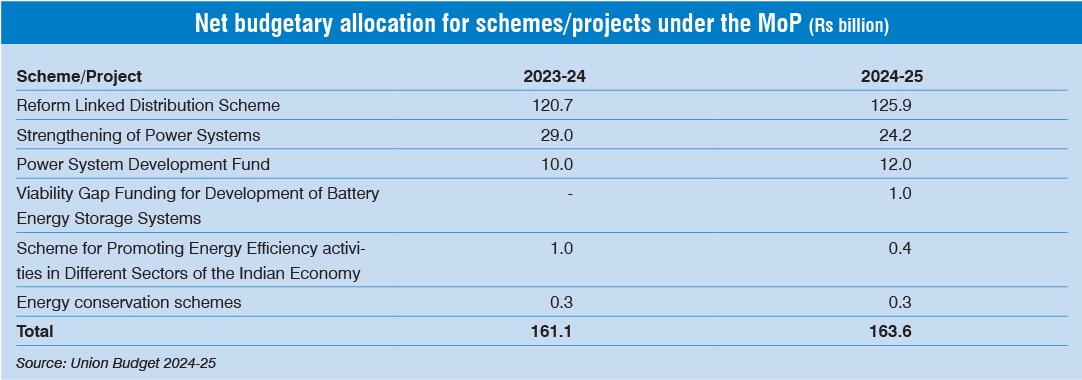
Under the MoP, a budgetary allocation of Rs 163.62 billion for 2024-25 has been made towards central schemes, an increase of 1.57 per cent compared to the 2023-24 allocation. The reforms-linked distribution scheme has received
Rs 125.85 billion. In addition, Rs 400 million has been earmarked for the Scheme for Promoting Energy Efficiency Activities in different sectors of the Indian economy. Apart from this, Rs 960 million has been allocated for viability gap funding for the development of battery energy storage systems.
Under the MNRE, a budgetary allocation of Rs 163.94 billion has been made towards solar energy, including Rs 62.50 billion for the PM Surya Ghar Muft Bijli Yojana and Rs 14.96 billion for the Kisan Urja Suraksha evam Utthaan Mahabhiyan. Further, the Programme for Wind and other Renewable Energy has been allocated Rs 8.51 billion, the National Green Hydrogen Mission Rs 6 billion and the BioEnergy Programme Rs 3 billion for 2024-25.
In terms of investment in public enterprises under the MoP, a total of Rs 672.86 billion has been proposed for 2024-25, an increase of 10.66 per cent over the previous year’s budget estimate. NTPC Limited has been allocated Rs 227 billion, an increase of 1.34 per cent over the previous year. Meanwhile, the allocation for SJVN Limited has increased by 20 per cent to Rs 120 billion from 100 billion in the previous year, while that for Power Grid Corporation of India Limited has increased by 40 per cent to Rs 122.5 billion from Rs 88 billion. The allocation for Damodar Valley Corporation Limited has increased by 20 per cent to Rs 32.62 billion.
 Key budget proposals
Focus on solar power: In the budget speech, the finance minister noted that, in line with the announcement in the interim budget, the PM Surya Ghar Muft Bijli Yojana has been launched to install rooftop solar plants, install rooftop solar, which will enable 10 million households to obtain free electricity of up to 300 units every month. The scheme has generated a remarkable response, with more than 12.8 million registrations and 1.4 million applications received so far. The 2024-25 budget has provided a budgetary allocation of Rs 62.5 billion to the PM Surya Ghar Muft Bijli Yojana according to the expenditure budget document.
The finance minister has also proposed to expand the list of capital goods exempted from customs duties for the domestic production of solar cells and panels. Given the adequate domestic manufacturing capacity for solar glass and tinned copper interconnects, the union budget has proposed to discontinue the existing customs duty exemptions for these items.
Policy to support pumped storage power: Another focus area of the union budget is the pumped storage segment, which is essential for providing energy storage given the growing integration of renewable energy. The budget has announced that a policy will be introduced to support pumped storage projects (PSPs), aimed at enhancing electricity storage and enabling the smooth integration of the increasing share of variable and intermittent renewable energy into the overall energy mix.
With their long-duration storage capabilities, PSPs have received significant attention in recent years from both the private and public sectors due to the growing power generation from renewable energy sources. A policy document for the PSP segment is likely to incentivise the segment and accelerate the development of such projects going forward.
Nuclear power development with Bharat Small Reactors: In the nuclear power segment, the finance minister has focused on research and development (R&D) in small and modular nuclear reactors. The budget recognises the critical role of nuclear power in the energy mix for a “Viksit Bharat”. To support this goal, the government has announced that it will collaborate with the private sector to establish Bharat Small Reactors, undertake R&D and explore new nuclear energy technologies.
Notably, instead of conventional large nuclear plants that take decades to build and commission, the government is now seeking public-private partnerships to set up Bharat Small Reactors based on India’s existing pressurised heavy water reactor technology. Bharat Small Modular Reactors are quicker to deploy and operate than large reactors. Private participation in nuclear energy generation is expected to open new avenues of finance and accelerate the growth of this segment in the country.
AUSC technology for coal-based plants: In the coal-based power generation segment, the finance minister has announced that the government will provide fiscal support to a joint venture between NTPC and BHEL to establish an 800 MW commercial plant utilising advanced ultra supercritical (AUSC) technology. According to the minister, the development of indigenous capacity for the production of high-grade steel and other advanced metallurgy materials for these plants will result in significant economic benefits.
The AUSC technology has been indigenously developed through a joint R&D effort by the Indira Gandhi Centre for Atomic Research, BHEL and NTPC Limited, with support of Rs 15.54 billion from the central government. India’s thermal power plants currently operate at an average efficiency of 32 per cent, while the efficiency of AUSC technology is approximately 46 per cent. This technology increases steam temperatures to 710-720 °C and pressures to 300 bar, leading to reduced coal consumption and lower emissions per MWh of electricity generated.
Transition from PAT to ICM: The finance minister has announced that the government will introduce a road map for transitioning “hard-to-abate” industries from current “energy efficiency” targets to “emission targets”. To achieve this, the minister has emphasised formulating appropriate regulations for transitioning these industries from the current “Perform, Achieve and Trade” (PAT) mode to the “Indian Carbon Market” (ICM) mode.
Launched in 2012, the PAT scheme established a market mechanism to enhance energy efficiency in energy-intensive industries by incentivising industries to invest in energy-efficient technologies and practices. The transition to carbon markets will shift the focus from energy saving to emission reduction, aligning with India’s commitments to combating climate change, encouraging the
adoption of cost-effective technologies and driving competitiveness.
Introducing climate finance taxonomy: The finance minister has announced that the government will develop a taxonomy for climate finance to enhance the availability of capital for climate adaptation and mitigation. This will support the achievement of the country’s climate commitments and green transition. A climate finance taxonomy refers to standardised regulations and guidelines that inform investors and companies about the impact of their investments in environmental conservation and climate change action. It defines clear criteria for green investments, helping avoid greenwashing and identify investments that truly focus on low-carbon economic development. This announcement has been largely welcomed by industry experts and is expected to attract green financing in
the economy.
Customs duty exemption for critical minerals: The finance minister has noted that minerals such as lithium, copper, cobalt and rare earth elements are critical for sectors such as nuclear energy, renewable energy, space, defence, telecommunications and high-tech electronics. Therefore, the budget has proposed fully exempting customs duties on 25 critical minerals and reducing basic customs duty on two of them. This is expected to provide a major fillip to the processing and refining of such minerals and help secure their availability for these strategic and important sectors.
Economic Survey 2023-24: “Climate Change and Energy Transition: Dealing with Trade-offs”
A dedicated chapter on “Climate Change and Energy Transition: Dealing with Tradeoffs” in the Economic Survey 2023-2024 notes that India faces the dual challenge of meeting growing energy demands while reducing carbon emissions. The government is prioritising a transition to sustainable and clean energy sources to support its Nationally Determined Contributions and net zero goals. This transition includes integrating renewables, exploring nuclear energy and utilising biofuels despite challenges such as renewable intermittency, waste management and the impact of biofuels on food security. To address these challenges, a diversified energy strategy, including renewables, nuclear, biofuels and continued use of thermal power, is essential to ensure energy security while minimising risks.
Further, advancing clean coal technologies, such as coal gasification and carbon capture and storage, is crucial in the short to medium term to reduce emissions and improve efficiency. While India has significantly increased its solar power capacity, addressing challenges related to intermittency and grid integration is necessary, along with incorporating other non-fossil fuels.
The survey also notes that to avoid high import dependency on solar panels and critical minerals, a balanced energy strategy that includes diverse sources – renewables, green hydrogen, nuclear energy and biofuels – is vital. International cooperation in the R&D of emerging technologies such as green hydrogen and small modular reactors is needed.
In addition, it is vital to provide the financial resources necessary for driving the green transition. Overall, a balanced approach that addresses both immediate development needs and long-term climate goals is crucial for effective climate action.
Conclusion
Overall, the Union Budget 2024-25 has largely met the expectations of power sector stakeholders. It has demonstrated a well-calibrated approach to energy sector development that focuses on creating a diversified energy ecosystem. By advancing renewable technologies, supporting critical energy projects and addressing climate change imperatives, the budget lays out a road map for sustainable and efficient energy sector development going forward.


