

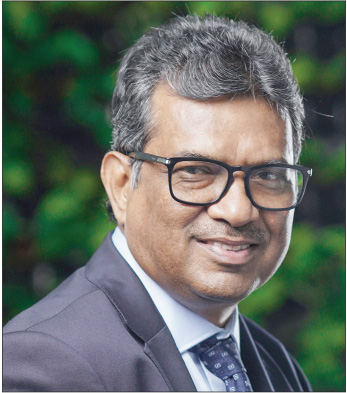
 In a recent interview with Power Line, N. Venu, Managing Director and Chief Executive Officer, India and South Asia, Hitachi Energy, shared his views on the performance of the power sector over the past year, his outlook for the sector, and the emerging opportunities for equipment providers. He highlighted Hitachi Energy’s key business achievements in the past year and the company’s top priorities and future plans. Edited excerpts…
What are your views on the current state of the power sector?
As the fifth-largest economy globally, India continues on its growth track despite global upheavals. The nation marches towards the bigger developmental goal of “Viksit Bharat” – to transform India into a developed country by 2047. To achieve this, the government has focused on striking an equilibrium between economic development and environmental impact, which will help attain the goal of sustainable growth while keeping the net zero journey on course.
The power sector is the cornerstone of this endeavour and the sector’s continued expansion has been impressive, with energy transition projects spanning across segments. Over the past 10 years, India’s installed capacity has nearly doubled, from about 248 GW in 2014 to 450 GW in 2024 (as of August 2024). Meanwhile, renewable installed capacity (including hydro) has also increased to approximately 200 GW (as of August 2024) from about 75 GW in 2014.
This reaffirms India’s commitment to augment non-fossil-fuel-based electricity generation capacity to over 500 GW by 2030. To match the growing renewable energy capacity addition, the government is already implementing the transmission plan for integrating 500 GW of renewable energy in a phased manner. This has opened up more opportunities, which will further contribute to the sector’s growth.
The country is on the cusp of an energy revolution, with focused policy initiatives to expedite the journey towards net zero. However, to reach national energy targets in both the mid- and long term, a concerted effort by all stakeholders is required to make our grids more flexible and secure.
What are the unresolved issues in the power sector?
The sector is evolving rapidly and has made significant strides in increasing power generation capacity, expanding grid connectivity and promoting renewable energy sources. But as we grow, there are also some challenges, such as a shortage of raw materials (coal), transmission losses, uneven distribution, and the integration of large-scale renewable energy into the grid. In addition, limited domestic manufacturing capacity for critical (power) equipment leads to potential supply bottlenecks and quality concerns.
Furthermore, the financial health of discoms has to improve so that the energy distribution network can reach the length and breadth of the country. The pace of the energy transition also demands that we use our manu-facturing capacities efficiently by evolving the order approach from a project to a programme mindset. This will not only help manufacturers plan their capacity allocation but also reduce lead time by templatising large-scale ventures like high-voltage direct current (HVDC) projects.
Therefore, collaboration among all stakeholders is crucial in addressing the challenges because it is bigger than one individual, company or nation. Creating synergies, partnerships and innovation will be critical to accelerate future growth.
What are the most promising and relevant new technologies for the Indian market?
There are three fundamental technology areas that are driving the evolution of the power system and enabling the energy transition – sustainable products and solutions, power electronics and digitalisation. With clean energy sources, such as solar and wind power, becoming more central to the country’s installed capacity, technologies pertaining to energy storage solutions like battery and pumped storage are gaining momentum.
With more renewable energy coming into the picture, grid modernisation is key for developing a resilient energy infrastructure. Each clean GW that we add to the energy system needs to be balanced with an increase in grid capacity and flexibility to ensure security, reliability and resilience. Power electronics and advanced control systems will play an important role in this effort.
Renewables, grid edge technologies and digitalisation will drive the evolution of future power systems. The future of the grid lies in the adoption of new technologies such as big data analytics for predictive maintenance, artificial intelligence, robotics and virtual reality/augmented reality kits for better
operations and maintenance of the transmission network.
Hitachi Energy provides mission-critical technology for its customers across various sectors – offering products and services across generation and consumption. It enables renewable energy integration, transmission, management and consumption through technologies that make grids flexible, secure and sustainable, such as HVDC Light®, EconiQ™, Grid-eMotion® and IdentiQ™.
What are your expectations for equipment orders from the power sector over the next one to two years?
India’s energy industry is experiencing significant shifts, with a strong emphasis on renewable energy growth, energy storage solutions, digital transformation and decentralised energy systems. Challenges relating to grid integration and stability, infrastructure development, complex regulatory environments and environmental impacts are prominent.
Hitachi Energy is strategically positioned to support the country’s energy transition, with one of the most comprehensive portfolios of innovative solutions and services across the entire energy value chain. By efficiently integrating renewable energy, modernising infrastructure and ensuring compliance with evolving policies, we contribute to a more resilient and sustainable energy future.
What are the emerging trends in the power sector and how is Hitachi Energy adapting to these?
Advancing the energy transition to reach the net zero target through clean energy sources will shape the global energy landscape. Factors such as the seamless integration of renewables, battery storage systems, digitalisation and smart grids are some of the key factors that will influence the future energy ecosystem.
At Hitachi Energy, we have a clear and crucial purpose to advance a sustainable energy future for all. To achieve this, we focus on three key components of the Hitachi Energy 2030 Plan:
Strengthening our leadership role in core technologies: With the increased urgency to strengthen, expand and evolve the power grid, we aim to deliver on our future grid promises and support the acceleration of the energy transition. As we push the boundaries through innovative technologies such as EconiQ™, our eco-efficient portfolio, and new business models (product-based to market-driven solutions), we are collaborating closely with customers and partners. These initiatives validate the momentum behind Hitachi Energy’s commitment to deliver real customer outcomes and enable a more sustainable, flexible and secure energy system.
Expanding our digital solutions and services: We are continuously expanding our digital solutions and services that are enabling carbon reductions. Additionally, we are evolving the power system through partnerships and new business models, as well as innovations/new technologies such as battery energy storage systems and green hydrogen.
Upgrading our portfolio: At Hitachi Energy, we endeavour to continuously upgrade our portfolio to strengthen and support the ever-expanding and evolving power system. We will continue to focus on customising our global product portfolio (for local use) and building indigenous capabilities and products. In addition, we will continuously evaluate the energy and demand landscape and ensure that we take the necessary steps to remain relevant and deliver cutting-edge solutions to our customers in India and around the world.
What have been the key business highlights for Hitachi Energy in the past year?
A strong cyclical revenue performance, coupled with a favourable external environment, has improved our revenue and bottom line. The focused and proactive approach has helped us achieve better revenue, both quarter on quarter and year on year.
In the quarter ended March 31, 2024, orders totalled Rs 14.07 billion, up 13.9 per cent quarter on quarter and 11.5 per cent year on year. Industries led the charge with the electrification and digitalisation of energy networks across sectors from steel to silicon. This was followed by contribution from transmission projects, with orders from the engineering, procurement and construction segment. Meanwhile, orders for hydro, wind and solar plant operations and integration sustained the renewables momentum.
Furthermore, service and export orders were both up by 43 per cent year on year, maintaining their strong contribution to the overall order book. Service orders included replacement equipment, annual maintenance contracts and upgrades, as well as innovative solutions like RelCare and RelScan for remote condition monitoring and maintenance. Exports of transformers, power quality technologies and other key products to markets such as the Middle East, Southeast Asia and neighbouring countries in South Asia accounted for around 25 per cent of the order book. Our order backlog stood at Rs 72.3 billion, providing revenue visibility for approximately 20 months.
What are your top priorities for Hitachi Energy in the near to medium term?
Since electricity is the backbone of the energy system, our most important role is to ensure that we have a modern energy system that is fit for the future.
We will continue to maintain leadership in our core portfolio of transformers, switchgear, power transmission systems, power quality (PQ) and grid automation, contributing to the energy transition in India and across the world.
While we already have the technologies to support the energy transition and the consequent growth of segments such as HVDCs, PQ, data centres and e-mobility, there will be a need for product evolution. In addition, Hitachi Energy will continue to innovate around three key areas – sustainable products, digitalisation and power electronics.
We will focus on expanding our digital solutions and services, particularly at the edge of the energy system. We will also continue to drive innovation, foster synergies with customers and Hitachi Group companies, and explore new partnerships to accelerate growth.
Apart from factories, we are investing in people and technologies, readying the future talent pool for the energy sector. We believe that diversity + collaboration = great innovation. Therefore, we will continue to invest in our talent, technology and infrastructure to build a diverse base for tomorrow’s energy systems, as well as expand and diversify our world-class manufacturing base
in India.
What is your outlook for the power sector, and what key opportunities do you foresee?
The power sector is experiencing significant growth, driven by the surge in renewable installations, innovative technologies such as green hydrogen and electric vehicles, and a growing focus on battery energy storage and pumped storage projects. Additionally, the sector expects more investment in the transport sector, with the announcements of various new Vande Bharat trains and high speed rail projects requiring an upgraded electrical infrastructure.
This surge in power demand indicates a rise in both domestic power supply and industrial power consump-tion, both in quantity and quality. Thus, we expect multiple opportunities across industrial sectors, transmission network expansions, distribution and generation, data centres and transport capabilities, with renewable energy at the forefront.
However, to reach the sector’s optimum potential, the focus should be on advanced planning, especially in terms of orders and visibility. Future visibility regarding orders will ensure long-term investment in planning and establishing local manufacturing and testing facilities, which will address the limited supplier base and support the growth of a robust local supply chain.
The issue is not about having enough supply but about ensuring better planning to align demand and supply with the requirements.