

India’s transmission sector is currently witnessing substantial infrastructure expansion and the adoption of cutting-edge technologies is positioning the country’s electricity grid as one of the largest synchronous grids globally. The sector has played a key role in supporting India’s growing energy demand while facilitating the integration of renewable energy sources. These advancements are pivotal as the country works towards achieving its ambitious climate goals and modernising its energy infrastructure for future needs. As electrical grids modernise to accommodate new energy sources, transmission towers and structures are evolving to meet changing needs. From innovative materials to advanced structural designs, several key trends are shaping the future of transmission tower infrastructure.
Size and growth
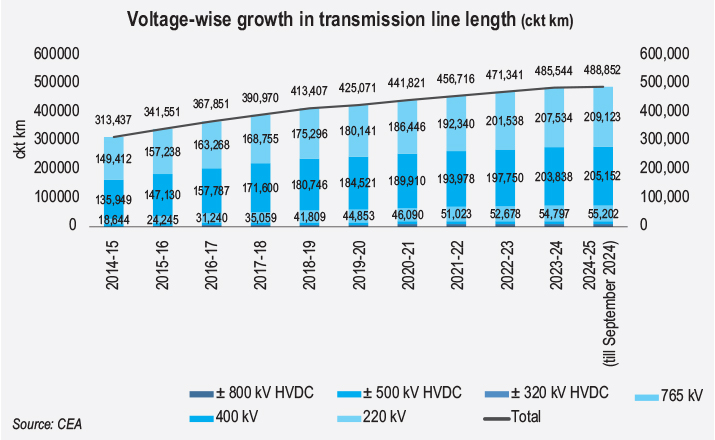
As of September 2024, the total length of transmission lines at the 220 kV and above levels stood at 488,852 ckt km, comprising 55,202 ckt km at the 765 kV level, 205,152 ckt km at the 400 kV level and 209,123 ckt km at the 230/220 kV level. At the high voltage direct current (HVDC) level, line length stood at 9,655 ckt km at the ±800 kV level, 9,432 ckt km at the ±500 kV level and 288 ckt km at the ± 320 kV level.
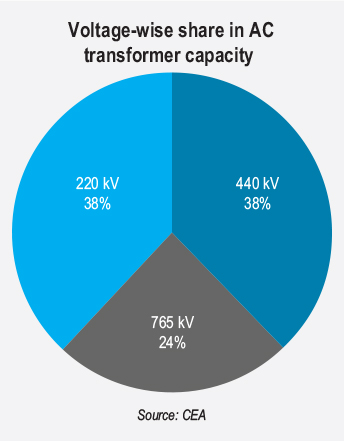
The total transmission line capacity addition during 2023-24 was 14,203 ckt km. In 2024-25, as of September 2024, the segment added 3,308 ckt km of line length. Further, the country’s total interregional capacity stood at 118,740 MW as of September 2024. During the same period, the total transformation capacity stood at 1276,770 MVA, comprising 299,200 MVA at the 765 kV level, 469,738 MVA at the 400 kV level and 474,332 MVA at the 230/220 kV level. HVDC capacity stood at 18,000 MVA at the ±800 kV level, 13,500 MVA at the ±500 kV level and 2,000 MVA at the ±320 kV level. The total transformation capacity addition during 2023-24 was 70,728 MVA, while for 2024-25, it stood at 25,690 MVA as of September 2024.
In order to fast-track the development of the country’s transmission network, tariff-based competitive bidding (TBCB) was introduced in 2006. As of September 2024, 114 inter-state transmission system (ISTS) projects have been bid out to public and private players since 2009 under the TBCB mechanism. Of these, 48 were secured by Power Grid Corporation of India Limited (Powergrid) and 66 were won by private players.
 Growth drivers
The growth in the transmission towers and structures market is primarily being driven by various factors, including expanding energy demand, renewable energy integration, technological advancements and infrastructure modernisation efforts. As urbanisation surges and industries expand, particularly in emerging economies, the need for reliable electricity is escalating, driving up demand for robust transmission infrastructure capable of carrying power over long distances and varying terrains.
The ongoing transition to renewable energy is another significant growth driver; with wind, solar and hydroelectric power plants often situated in remote areas far from urban centres, there is a growing need for high-capacity transmission lines and towers capable of efficiently delivering clean energy across long distances. This transition is stimulating investments in HVDC systems, which are more efficient for long-haul power transmission and require specialised towers that can handle higher voltages. Additionally, technological innovations such as smart grid integration, which includes towers with advanced sensors and monitoring capabilities, are transforming power networks by enhancing grid reliability, enabling real-time data analytics and optimising load management. The government is also focusing on updating ageing power infrastructure, recognising the importance of resilient and reliable energy systems in supporting economic stability. These modernisation projects frequently involve replacing outdated structures with new, more efficient transmission towers designed to withstand extreme weather and natural disasters, ensuring uninterrupted service in an era of climate volatility.
 Moreover, the adoption of eco-friendly and lightweight materials, such as composite and hybrid structures, is reducing the environmental footprint of new tower installations while enabling faster and more efficient construction processes, meeting the dual demands of sustainability and efficiency.
Engineering, procurement and construction projects are f=acing several significant challenges, particularly in scenarios requiring strict time management, rapid response and restoration. Limited shutdown periods are creating intense pressure, as teams must complete complex installations, maintenance or upgrades within a narrow timeframe, minimising downtime in power plants. This often overlaps with accelerated project delivery schedules, pushing engineering and construction teams to meet tight deadlines while maintaining quality and safety standards. Furthermore, the demand for immediate restoration after structural failures due to natural disasters compounds these challenges. In such instances, teams must rapidly assess damage, mobilise resources and rebuild to meet operational standards, often within constrained budgets and challenging conditions. These demands not only require highly coordinated planning and execution but also necessitate flexibility, resilient supply chains and advanced project management strategies to overcome the inherent risks and limitations.
Technology trends and digitalisation
The landscape of power transmission infrastructure is witnessing a growing trend for the utilisation of monopole structures in strategically selected areas. This shift is primarily driven by the significant reduction in footprint. Compared to traditional lattice towers, monopoles require a smaller base installation space, even when exceeding heights of 40-50 metres. This translates to a minimised environmental impact due to a reduced land footprint. This facilitates faster erection times due to the simpler structure of monopoles, leading to quicker project completion. Further, it enables shorter delivery times due to the streamlined design of monopoles, which expedites project timelines. These compelling benefits have resulted in the successful implementation of monopoles at various locations across India, demonstrating their potential as a viable and advantageous alternative to traditional lattice towers in specific applications.
The Kerala State Electricity Board (KSEB) has employed monopoles as part of its ambitious Transgrid 2.0 project, aimed at revamping the state’s transmission grid. Kerala’s grid faces several challenges, including a 2,800 MW infrastructure that supports only 2,000 MW, ageing infrastructure and limited space for expansion. The project goals include voltage upgrading and current uprating without constructing new lines, which is critical in a state where land availability is limited. The KSEB Transgrid 2.0 project implements a multi-circuit multi-voltage approach, increasing capacity by up to 14 times in N-1 conditions by leveraging existing transmission corridors. The use of high-temperature low-sag conductors further increases ampacity while reducing line sag, enhancing reliability and grid resilience without the need for additional physical space. Additionally, the project uses micropiles to minimise excavation, preserving soil integrity and reducing construction time.
Technological advancements in materials, design and construction techniques are also contributing to the growth of the transmission tower market. Innovations in materials science, such as the development of composite materials like fibreglass and carbon fibre, are enabling the production of lighter, more durable towers that require less maintenance and have a longer lifespan. These materials are corrosion-resistant and can better withstand harsh environmental conditions, making them ideal for remote or extreme climates.
Additionally, advancements in modular and prefabricated tower designs are reducing construction times and costs. Modular towers are easier to transport and assemble, making them suitable for remote or difficult-to-access locations. These technological innovations not only reduce installation costs but also improve the overall efficiency and reliability of transmission infrastructure, driving further growth in the market.
Transmission efficiency is a priority for power companies, as high energy losses over long distances can significantly impact profitability and sustainability goals. In many regions, energy loss in transmission and distribution can exceed 10 per cent, which is costly and environmentally detrimental. To address this, power companies are investing in high-efficiency transmission systems, such as HVDC, to minimise losses.
The adoption of HVDC technology requires specialised towers and structures capable of handling the unique demands of DC transmission. These HVDC systems are particularly valuable for renewable energy transmission, as they allow for the efficient transport of electricity generated from distant wind and solar farms. Reducing energy losses also supports grid decarbonisation goals by ensuring that more of the energy generated is delivered to end users.
Effective asset management in power transmission involves proactive planning and innovative technology solutions to ensure infrastructure resilience, particularly in challenging environments. Emergency restoration systems (ERSs) and specialised protection structures are key components in maintaining grid reliability during natural disasters or harsh seasonal conditions. A recent example is the response to the unprecedented flash floods in Assam during May and June of 2022, which resulted in the shifting course of the Kopili River and severe soil erosion between tower locations 228/0 and 230/0. On June 17 2022, both circuits tripped, with Tower 229 ultimately collapsing. Given the inaccessibility of the location due to high water currents and marshy soil, ERS was deployed to temporarily restore the critical 400 kV NERSS SM Line Circuit 1. Restoration was achieved on July 23, 2022, demonstrating the importance of ERS in rapid response and grid resilience.
In areas subject to extreme winter conditions, such as the Kashmir Valley, infrastructure faces additional challenges. IndiGrid’s 400 kV DC Sambha-Amargarh transmission line, which supplies power to the valley, traverses hilly terrain along the Mughal road, spanning approximately 280 km with 780 towers. Of these, 180 towers are located in snow-prone or otherwise inaccessible areas due to wildlife, forest and security constraints, and around 60 towers become unreachable during heavy snowfall. To maintain line reliability, specially designed avalanche protection structures were erected around critical sections of the line, protecting infrastructure against heavy snow loads and ensuring continuous power transmission in adverse weather. These initiatives highlight how technology and tailored asset management strategies can effectively address unique geographical challenges, bolstering transmission network durability and operational stability.
Renewable energy integration
The grid has undergone a major transformation, with non-fossil fuel capacity now making up around 44 per cent of the total installed capacity. The Central Electricity Authority’s (CEA) “Transmission System for Integration of over 500 GW Renewable Energy Capacity by 2030” report suggests that 50,890 ckt km of ISTS transmission lines and 433,575 MVA of substation capacity will be needed to integrate additional wind and solar capacities by 2030. The planned additional transmission systems required include 8,120 ckt km of HVDC transmission corridors (+800 kV and +350 kV), 25,960 ckt km of 765 kV AC lines, 15,758 ckt km of 400 kV lines and 1,052 ckt km of 220 kV lines, entailing an estimated investment of Rs 2,442 billion. The transmission plan also includes a transmission system required for the evacuation of 10 GW of offshore wind located in Gujarat and Tamil Nadu.
Under the Green Energy Corridor (GEC) scheme, Phase I of the ISTS was completed in 2020, enabling the evacuation of 6 GW of renewable energy. Intra-state transmission systems (InSTS) are under implementation in eight renewable-rich states – Andhra Pradesh, Gujarat, Himachal Pradesh, Karnataka, Madhya Pradesh, Maharashtra, Rajasthan and Tamil Nadu – connecting 18.72 GW of renewable energy to the grid. While most of the projects are nearing completion, some states have been granted extensions until 2024-25 due to delays in land acquisition and clearances.
The InSTS GEC-II scheme, with a total target of 10,750 ckt km of intra-state transmission lines and 27,500 MVA of substations, was approved by the Cabinet Committee on Economic Affairs in January 2022 with a total outlay of Rs 120.31 billion. The transmission schemes will be implemented by the state transmission utilities (STUs) of seven states, namely, Gujarat, Himachal Pradesh, Karnataka, Kerala, Rajasthan, Tamil Nadu and Uttar Pradesh, for the evacuation of approximately 20 GW of renewable energy. Currently, the STUs are preparing the packages and are in the process of issuing tenders for implementing the projects. The scheduled commissioning deadline for the projects under this scheme is March 2026.
Outlook
As per a recent announcement by the union minister for power, the new National Electricity Plan for central and state transmission systems, targeting a peak demand of 438 GW by 2032, has been finalised.
The transmission network is set to expand from 485,000 ckt km in 2024 to 648,000 ckt km by 2032, with the transformation capacity increasing from 1,251 GVA to 2,342 GVA. Additionally, nine new HVDC lines (33.25 GW) will supplement the existing 33.5 GW, while interregional transfer capacity will rise from 119 GW to 168 GW. The plan, covering networks of 220 kV and above, is estimated to cost Rs 9,150 billion. It will support the growing electricity demand, renewable energy integration and green hydrogen projects.
India’s power transmission sector faces several challenges, including right of way and land acquisition, resulting in project delays and cost increases. Acquiring land for transmission corridors is a complex and time-intensive process, frequently met with resistance from local communities and environmental concerns. Global supply chain issues, particularly for high-tech components, underscore the need for local manufacturing. Power transmission also faces a shortage of skilled workers for specialised tasks such as tower erection and maintenance. Advanced technologies, including artificial intelligence, drones and predictive maintenance, have the potential to address these challenges by improving operational efficiency and reducing downtime.
Going forward, trends such as sustainable materials, compact designs, HVDC technology, climate resilience, smart grid integration, prefabricated construction, renewable energy compatibility and advanced maintenance protocols will shape the future of transmission infrastructure. By embracing these trends, power companies can ensure more efficient, reliable and environmentally friendly transmission systems, contributing to a stable and sustainable energy future. Further, investing in these advancements not only improves transmission efficiency but also aligns with efforts to transition to a cleaner, smarter and more resilient power grid.