

Driven by the country’s ambitious expansion and modernisation of its power sector, India has one of the most dynamic and fast-growing transformer markets in the world. As of 2024, the Indian transformer market, which was valued at around $5.1 billion, is set on a steep growth trajectory.
Companies are actively expanding their transformer manufacturing capacity to meet the growing market demand. The transformer market expansion is being driven by a number of factors. India’s growing renewables base (500 GW target by 2030) and a revival in expanding thermal capacity are fuelling the demand for a reliable transmission and distribution infrastructure. This has further led to the increasing demand for high-voltage and extra high-voltage transformers. India’s burgeoning industrial base and the rising demand for electricity driven by urbanisation, economic development and infrastructure upgrades are creating opportunities for advanced transformer technologies to be deployed, which will enhance efficiency and reliability.
Power Line takes a look at the key trends, demand drivers and outlook for the transformer industry…
Overview
India’s transformer industry is almost five decades old, with over 300 players (organised and unorganised) contributing a capacity of around 400 GVA. The transformer market is segmented into various types, such as power transformers, distribution transformers (DTs), instrument transformers and speciality transformers, each catering to different applications and needs.
Transformers are highly versatile, as they can be integrated optimally anywhere across the value chain of power system projects, such as in generation, transmission and distribution. The integration of renewable energy and growing power demand is expected to drive substantial investments in Indian transmission infrastructure.
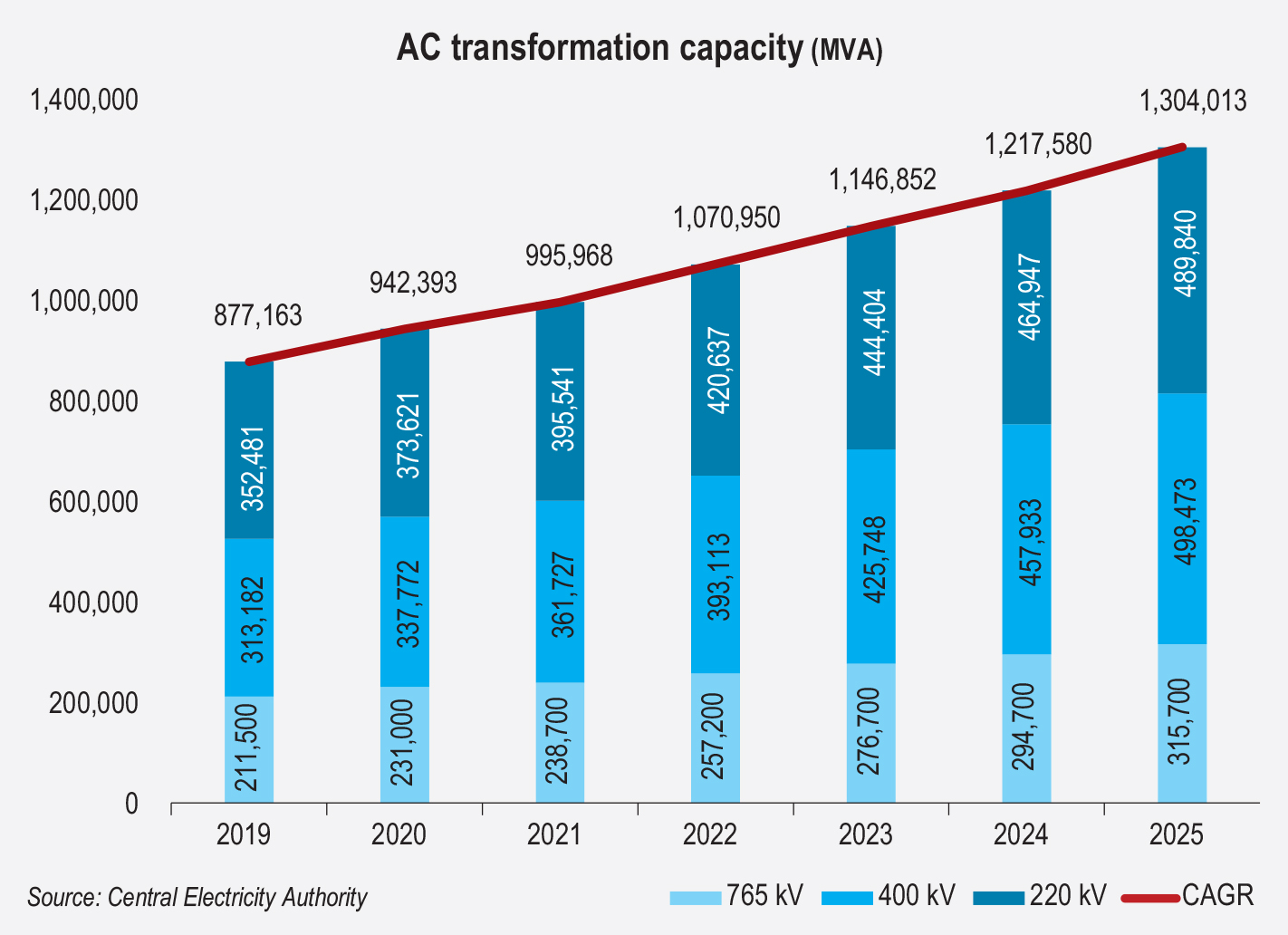
The pace of new substation capacity addition at the 220 kV and above voltages has increased significantly. According to data from the Central Electricity Authority (CEA), India added an impressive 86,433 MVA of transformation capacity in 2024-25, which was 22.2 per cent higher than the 70,728 MVA added in 2023-24. As of March 2025, the AC transformation capacity was around 1,304 GVA for voltage levels between 220 kV and 765 kV, witnessing a compound annual growth rate (CAGR) of 5.82 per cent from 2018-19. In AC transmission systems, 765 kV is the highest voltage level at which a transmission line operates.
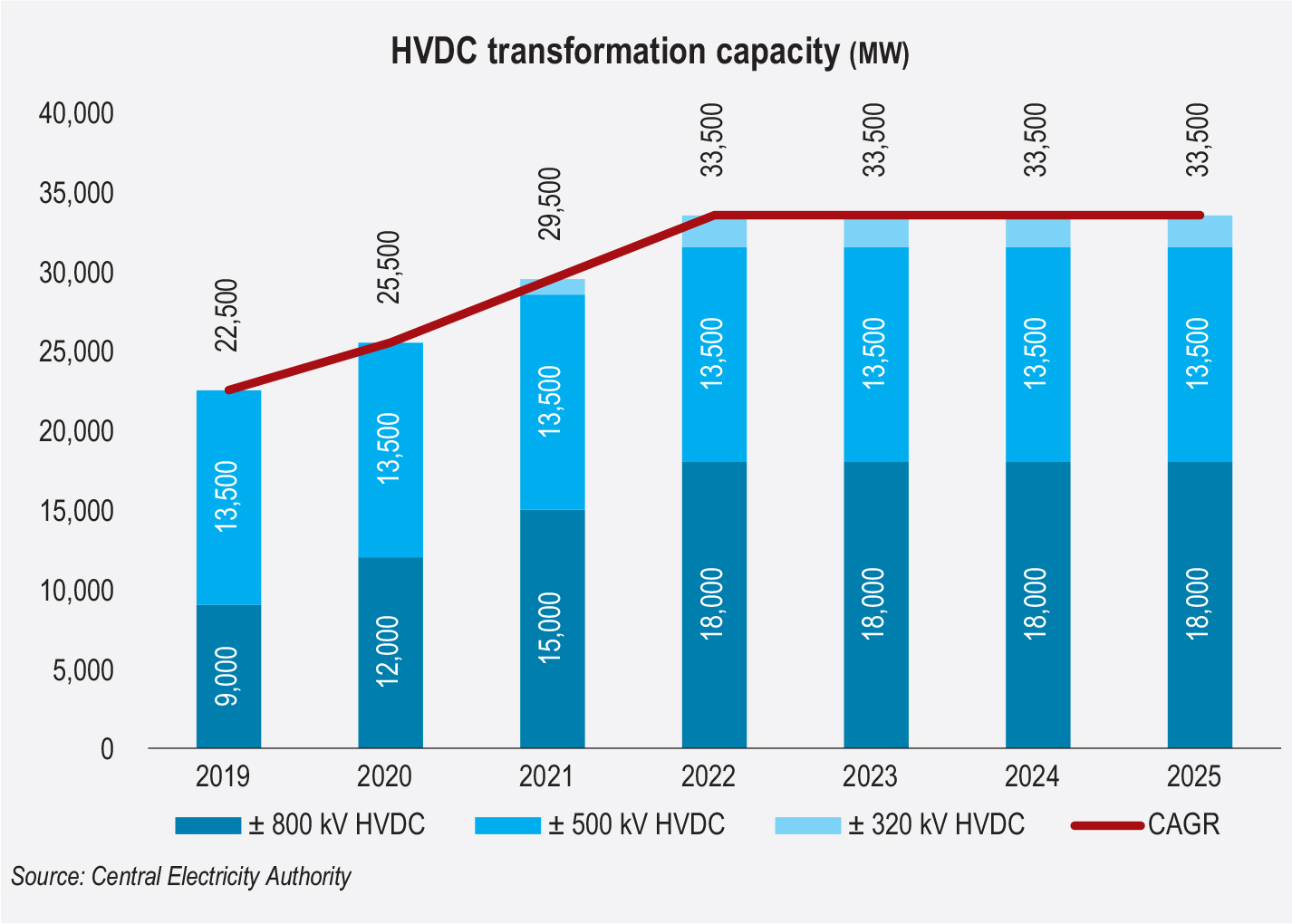
As of March 2025, the high-voltage direct current (HVDC) transformation capacity stood at 33,500 MW for voltage levels between ± 320 kV and ± 800 kV, with a CAGR of 5.85 per cent during 2018-19. The ± 800 kV level had a share of around 53.7 per cent, followed by ± 500 kV with 40.2 per cent and ± 320 kV with 5.9 per cent.
Demand drivers
Grid expansion for renewable energy integration: Renewable energy integration is crucial for sustainable development, especially in the dynamic energy production and consumption landscape. As global economies aim to increase renewable energy capacity to reach net-zero targets, efficiency in power transmission has become vital. The government aims to integrate 500 GW of renewable energy, including 280 GW of solar and 140 GW of wind by 2030, where the availability of robust transmission becomes critical.
The CEA has laid out ambitious transmission plans in its National Electricity Plan (NEP) (Transmission), including thousands of new high-voltage lines and hundreds of new substations. It envisages an addition of about 191,474 ckt km of transmission lines and 1,274 GVA (220 kV and above levels) and 33.2 GVA (HVDC) of transformation capacity addition by 2031-32. As outlined in the NEP, the overall capex projected in the grid is over Rs 9 trillion during 2022-32 in inter and intra-state transmission networks.
The NEP also emphasised the deployment of innovative technology alternatives, such as phase shifting transformers, to upgrade the grid and reinforce the transmission and distribution network, taking into account the growth of the electricity market and large-scale renewable energy generation. The ambitious renewable targets and the need to integrate renewables into the grid are driving transformer market growth in India.
 Green energy corridors and green hydrogen: The ongoing Green Energy Corridor initiative is also expected to entail significant grid investments. Under Phase II (currently under way), transmission schemes will be implemented by seven states – Gujarat, Himachal Pradesh, Karnataka, Kerala, Rajasthan, Tamil Nadu and Uttar Pradesh – for the evacuation of approximately 20 GW of renewable energy. The renewable energy push is expected to spur the demand for specialised inverter duty transformers used in solar power projects.
As per estimates by the Ministry of New and Renewable Energy, additional electricity demand from green hydrogen/green ammonia production is projected to reach 70.5 GW by 2031-32, which is expected to drive the demand for rectifier transformers required by electrolysers.
Distribution capex: The government has initiated the flagship programme Revamped Distribution Sector Scheme to strengthen electricity access, improve power quality and upgrade transmission grid infrastructure. A significant capex of over Rs 3 trillion was proposed under the initiative, driving a surge in demand for DTs, which recorded a 32.8 per cent growth index in FY2024, according to the Indian Electrical and Electronics Manufactures’ Association. Government initiatives such as Deendayal Upadhyaya Gram Jyoti Yojana and the Saubhagya scheme have also promoted widespread rural electrification, significantly driving transformer demand.
Nuclear and thermal push: The Nuclear Energy Mission, announced in this year’s budget, with its ambitious 100 GW target and support for small modular reactors, is aimed at diversifying the country’s energy mix. This is expected to open up new avenues of growth for transformer manufacturers. Further, the government has announced plans to add close to 80 GW of thermal capacity by 2031-32 in view of the rising demand.
Rising electricity demand: Population and economic growth have led to rapid urbanisation in India. These dynamics are expected to persist in the coming years, necessitating the strengthening of the grid with robust equipment to cater to the growing electricity demand. Moreover, the uptake of cooling applications due to prolonged summers and aggressive pre/post-harvest practices in the agriculture sector has shot up electricity demand in recent years. For instance, according to the Ministry of Power (MoP), India witnessed an all-time high peak demand of 250 GW in FY2024-25. In 2031-32, as per CEA, the peak demand is expected to hover at around 458 GW. Urban load growth requires new substations and distribution transformer upgrades to handle higher densities. Similarly, an expansion of industries (steel, cement, petrochemicals and manufacturing) is expected to drive demand for both DTs within plants and power transformers feeding industrial clusters.
Addition of emerging assets: Electric vehicles (EVs) are poised to play a key role in decarbonising the transportation fleet. As per the International Energy Agency, the demand for EV charging stations in India is expected to reach 83 TWh by 2030. The consumption of power at charging stations is likely to cause a spike in electricity demand. Unlike most home appliances, EV chargers, particularly fast chargers, put a significant strain on the power system due to the large electrical load they require. Moreover, as the government develops guidelines for reverse grid charging from EV batteries (known as the vehicle-to-grid concept), the electricity distribution network is anticipated to become vulnerable to disruptions from ongoing challenges such as network congestion, surge in peak load, over- and under-voltage situations, and reactive power adjustment requirements. This scenario is likely to drive the installation of transformers at substations to ensure that the additional load from widespread EV charging can be supported by the grid.
Railway capex: The railway sector received a Rs 2.7 trillion capex allocation in this year’s budget. While track expansion and electrification projects remain a priority, the government has focused more on metro development, high-speed rail corridors and rolling stock modernisation. A key area of focus remains the expansion of the Vande Bharat train network, with a target of 400 new trains to be operational by March 2027. The railway sector’s expansion plan is expected to drive the demand for static synchronous compensator transformers to ensure efficient electrification.
 Data centres: Owing to digital transformation, data centres are rapidly evolving around the world. The energy-intensive nature of data centre operations demands a substantial amount of electricity. As data centres grow, the energy demand from such infrastructure is likely to drive power grid upgradation and modernisation. In such a scenario, critical electricity infrastructure becomes necessary. This involves funding higher-capacity transmission lines, including transformers, to dynamically balance electricity flow and load. As per estimations of Nomura, by 2030, data centres could account for 3 per cent of the total electricity consumption. In April 2025, the Ministry of Electronics and Information Technology held a dialogue with the MoP to discuss issues related to the rising electricity demand from data centres and to explore ways for their sustainable growth.
Technology trends
With the ongoing energy transition and increasing environmental mandates, it has become important to ensure that equipment in electricity grid infrastructure, such as transformers, operates with a minimal impact on the environment.
Energy loss in the form of heat is common in older transformers during power conversion. This raises electricity costs and increases carbon emissions. Transformers that are eco-friendly can reduce energy loss, improve operations, and lower the carbon footprint.
Similarly, traditional transformers use mineral oil as a cooling and insulation medium, which poses risks of leakage and environmental pollution. Environmentally safe alternatives, such as dry insulation systems and biodegradable oils, can solve the issue. Material efficiency has become an important aspect in the construction of transformers. Natural ester oil transformers use a renewable, bio-based dielectric fluid instead of traditional mineral oil, offering several advantages such as enhanced fire safety, reduced environmental impact and potentially longer insulation life.
Moreover, cooling systems cause noise pollution and vibrations. Eco-friendly transformers are designed to generate less noise, making them suitable for densely populated areas. These transformers feature compact designs, with fewer materials used for construction, which translates into reduced resource consumption and transportation costs.
With respect to the manufacturing of transformers, the utilisation of recyclable materials is gaining traction among manufacturers. As per industry estimates, about 95 per cent of materials used in power transformers can be recycled. Materials such as copper and steel can be recycled and reused, thereby lessening the environmental impact induced by raw material extraction. The design of transformers can play a critical role in ensuring robust performance and environmental friendliness.
Owing to their strategic importance in electrical networks, transformers have become the focus of power asset digitalisation efforts, and thus, one of the top priorities for asset digital twin development.
Challenges and outlook
The lack of domestic cold rolled grain-oriented (CRGO) steel production has been a key challenge for the transformer industry. India is currently facing a shortage of CRGO steel, which is essential for transformer construction. Domestic production is able to cater to only 10-12 per cent of the industry demand, with India heavily relying on imports, largely from Japan and a few other sources. This concentration makes the supply chain vulnerable. In addition, as foreign suppliers require certification from the Bureau of Indian Standards under a quality control order, it restricts options to a few approved vendors and suppliers, often leading to longer lead times.
According to industry estimates, around 20 per cent of installed transformers are either overloaded or have surpassed their operational lifespan, increasing the risk of failures and compromising grid reliability. Discoms are burdened with debts, along with escalating transformer costs and potential project delays, which have exacerbated financial woes.
Despite these challenges, the transformer industry is making strategic investments in local supply chains, including CRGO steel production. The outlook for transformer demand remains strong. Several major players have healthy order books from power utilities and have announced significant expansion and capex plans to scale up their production capabilities for both power and distribution transformers over the next few years. They are also gearing up to meet export demand, driven by factors such as the ageing power grid in the US and ongoing decarbonisation efforts in Europe. Indian players are making inroads into international markets through bundled engineering, procurement and construction exports and joint bids in regions such as Africa and Southeast Asia.
Utilities are driving grid expansion through upgrades and modernisation, driving demand for transformers. At the high-voltage transmission level, rapid industrialisation and the influx of large-scale renewable energy projects are expected to drive grid expansion. In this regard, major capex planned by the government, along with a projected increase in transformation capacity at both AC and HVDC voltage levels, are expected to accelerate the deployment of transformers in the future.